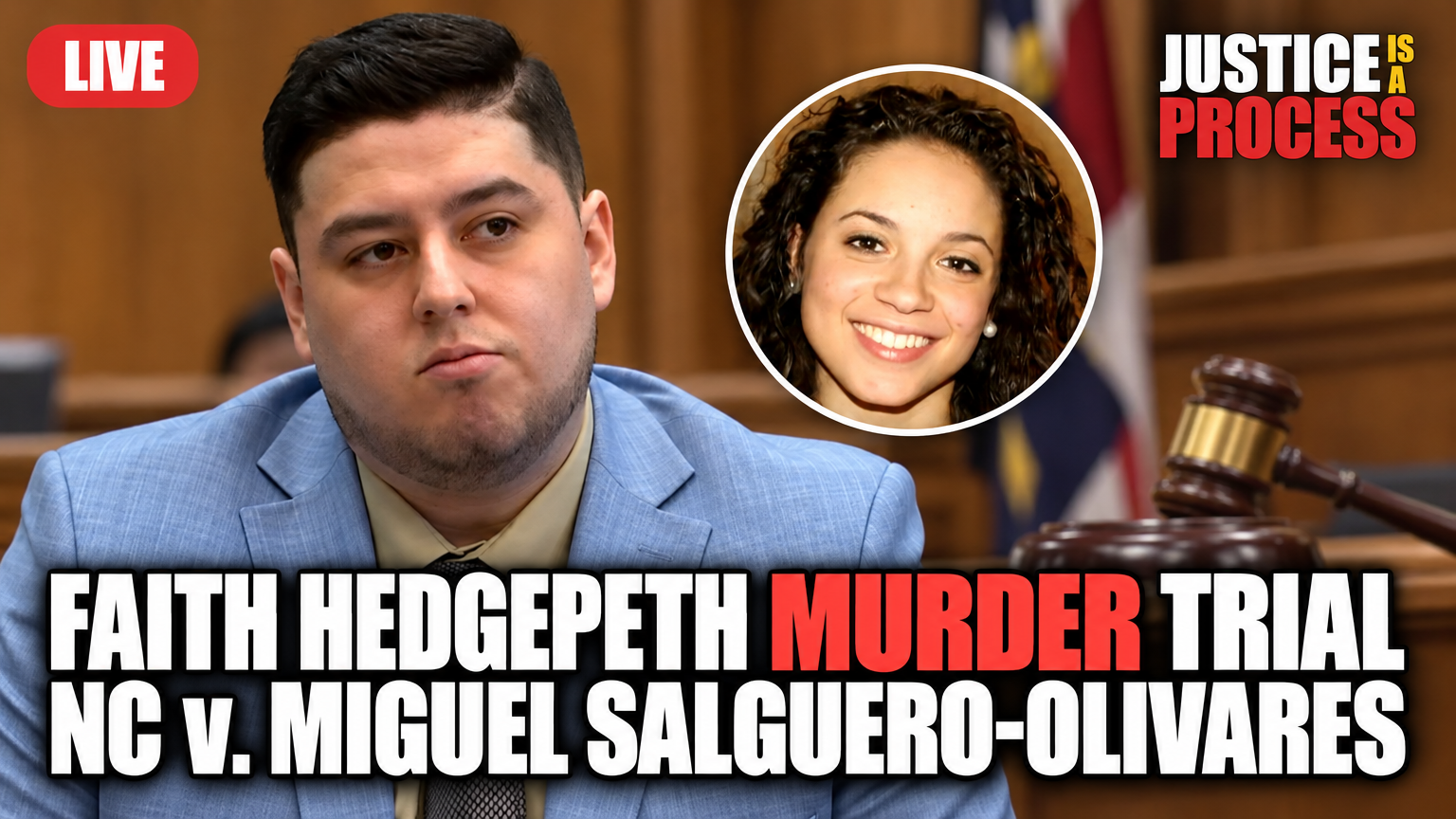
Nine Years to a Name: The Faith Hedgepeth Murder Trial
October 2026 | Justice Is A Process
On the night of September 6, 2012, Faith Hedgepeth texted her niece a question. The Democratic National Convention was on television, and Faith wanted to know whether Alexis was registered to vote. Alexis said she was, and asked Faith the same thing. Faith answered with one word: "duh."
That was the last message her family ever got from her.
Faith was nineteen. She was a student at the University of North Carolina at Chapel Hill, studying biology, and she wanted to be a pediatrician. She came from Hollister, a small community in Warren County, near the Virginia line, the heart of the Haliwa-Saponi tribe. She and her niece were born on the same day, September 26, 1992, and grew up a few doors apart, closer to sisters than to aunt and niece. Her family has said for fourteen years that she was the gifted one, the warm one, the protective one, the one people were drawn to.
On the morning of Friday, September 7, 2012, her best friend and roommate found her dead in the bedroom they shared in a small apartment just off the road between Durham and Chapel Hill. She had been killed sometime in the dark hours before dawn.
For nine years, nobody was charged. Chapel Hill police swabbed hundreds of people. The State Bureau of Investigation joined the case. The FBI wrote a profile. Rewards were posted and raised. A company that builds faces from DNA released a computer-generated image of the man investigators were looking for. Police made public a handwritten note found on a takeout bag in the apartment, a few angry words in block letters, and asked anyone who recognized the handwriting to come forward. Every September, Faith's family stood in front of cameras and asked the public not to forget her.
Then, in September 2021, Chapel Hill police announced an arrest. The man they charged was Miguel Enrique Salguero-Olivares, then 28, who lived in Durham. The State says he was a complete stranger to Faith, that his DNA matched the profile investigators had been carrying since 2012, and that his palm print was on a bottle in her bedroom. He has pleaded not guilty to every charge. He has been held without bond ever since.
On Wednesday, October 7, 2026, fourteen years and one month after Faith died, a jury of twelve, with four alternates, heard opening statements in Durham County Superior Court. The two sides could hardly have been further apart. The State told the jury this is a simple case about one man's DNA, and that everything else they have heard about it over the years is "noise." The defense told the jury that the noise is the evidence.
We are not here to convict Miguel Salguero-Olivares, and we are not here to acquit him. He is presumed innocent. That is the design of the whole system, and it binds us as much as it binds the jury. The State of North Carolina has to prove, beyond a reasonable doubt, every element of every charge, including the most basic one: that he is the person who killed Faith Hedgepeth. He does not have to prove anything. He does not have to say a word.
What we are here to do is watch. Watch whether DNA can carry the weight of a case on its own. Watch whether a nine-year investigation holds up when a defense lawyer goes through it item by item. Watch a family that has waited fourteen years. And watch whether the system, this late, does what it is supposed to do for a young woman who never got to finish college.
This is Justice Is A Process. Let's begin.
Here is what the State laid out for the jury in its opening statement, and what news reports have described over the years. Remember as you read it: an opening statement is a promise about what the evidence will show, and the jury is instructed that it is not evidence.
In early September 2012, Faith was between places to live. She was staying with her best friend at college, Karena Rosario, in Rosario's one-bedroom apartment. The two of them shared the bed, shared a car, and shared a single key, so the door was often left unlocked.
On the evening of Thursday, September 6, the two studied at the university's Davis Library. Later they went to a Chapel Hill nightclub called The Thrill. According to the State, Rosario was going through a hard time and drank too much. Faith was the designated driver and did not drink. They left the club around 2 a.m. and were home by about 3 a.m.
Rosario was sick. The State says she threw up in a trash can by the bed, then sat in the bathroom for an hour or more trying to reach a young man named Jordan McCrary, then a UNC soccer player, to come get her. When he arrived, around 4:20 a.m., she left. She left the key with Faith, believed Faith was asleep, and left the door unlocked behind her.
Later that morning, Rosario could not reach Faith. She tried again and again. She got a friend, Marisol Rangel, to drive her back to the apartment. Faith's car was still in the lot. Inside, they found Faith in the bed, under the bedspread. Rosario called 911. The jury will hear that call.
Faith had died of injuries to her head. The State says the weapon was a bottle of rum from the apartment, which investigators found covered in blood. Under a court order in this trial, no autopsy or crime-scene images of Faith will be shown to the jury or to the media, and we will never show or describe them here.
One piece of evidence has hung over this case for more than a decade. In the apartment, investigators found a white takeout bag holding a half-eaten sandwich. Written on the bag, in block letters, were the words the State read to the jury on Day 1: "I'm not stupid. B---h. Jealous." Police later made the note public in the hope that someone would recognize the handwriting. The State's position is that the man who killed Faith wrote it. Before trial, the judge ruled that prosecutors may argue that a pen found at the scene was the pen used to write it.
Why did a case the State now calls simple take nine years? The prosecutor's answer to the jury was blunt: because the man was a stranger. Chapel Hill police, a department that sees only a few homicides a year, started with the people closest to Faith and worked outward in widening circles. Investigators compared DNA from dozens of items of evidence against samples from more than two hundred people. By January 2013, the state lab had identified an unknown male DNA profile. Nobody they swabbed matched it.
In the meantime, the case collected what the State called noise: theories, suspicions, and talk, including talk about people who were close to Faith. The prosecutor told the jury that once investigators found the defendant in 2021, that is all it ever was.
In 2021, according to court documents reported by the News & Observer and ABC11, investigators used genealogy matches to find distant relatives of the man whose DNA they had, interviewed those relatives, and narrowed the search. Warrants say investigators then obtained a DNA sample from Miguel Salguero-Olivares without his knowledge during a DWI traffic stop. Raleigh police had arrested him on a DWI charge in August 2021. Reporters have noted it is not fully clear from the documents whether the sample came from that arrest or a later stop.
On September 16, 2021, Chapel Hill police announced that he had been arrested and charged with first-degree murder. Faith's father, Roland Hedgepeth, said, "I want to thank God for allowing me to see this day." Investigators then sought his fingerprints and palm prints. Warrants said two fingerprints and a palm print were found on a wine bottle in the apartment, and that an initial palm print comparison matched.
One thing the jury will not hear about: the genealogy. Before trial, Judge Keith Gregory excluded the investigative genetic genealogy evidence. The jury will be asked to weigh the DNA comparison itself, not the family-tree detective work that led police to the defendant's door.
In its opening, the State walked the jury through the list that is, in effect, its whole case on identity. Prosecutors say the defendant's DNA is on the rum bottle they call the murder weapon; on Faith's clothing; in samples taken from Faith's body; on a second bottle, a blue Riesling wine bottle at the foot of the bed, along with his palm print and left thumbprint; and on the takeout bag with the note.
The State also says he had reason to be nearby. His brother-in-law is expected to testify that he came from Guatemala in 2010 to join his mother, who worked at an Outback Steakhouse in Durham, and that he worked there briefly. Prosecutors told the jury that many Guatemalan families lived in Faith's apartment complex, and that a neighbor from across the parking lot will describe a cookout that ran from about 6 p.m. until about 5 a.m., at a picnic table near where Faith parked.
Notice what is not on that list. The State did not forecast any witness who saw the defendant at the apartment, any statement from him, or any reason he would have gone inside. The prosecutor was candid about the last point. She told the jury they may never learn what set him off, "but you will see exactly what he did."
Faith Danielle Hedgepeth was nineteen years old. She grew up in Hollister, in the Haliwa-Saponi tribal community, in a close family. Her niece, Alexis Evans, the State's first witness, told the jury about a childhood spent outside all day, making up dances, singing in the church choir, joining tribal youth groups, and planning a youth summit together. Faith was a cheerleader and a member of the National Honor Society. She came to UNC through its Summer Bridge program in 2010, as a scholarship student, studying biology with the goal of becoming a pediatrician.
Alexis described her as charismatic, warm, and fiercely protective. She told the jury about a night at Myrtle Beach when a girl made a rude gesture at Alexis's younger sister, and Faith was already marching over to confront her before the cousins pulled her back. The last time Alexis saw her was the Sunday before she died, when Faith surprised the family for her mother's birthday and brought Karena Rosario home with her. They watched a movie and laughed.
After her death, students gathered in The Pit at UNC for a candlelight vigil organized by the Carolina Indian Circle and the Alpha Pi Omega sorority, which later made her an honorary member. Her parents, Roland and Connie Hedgepeth, and her sister Rolanda have spoken publicly about her many times since. They have been in court for this trial.
In this report Faith is called by her name. She is the reason it exists.
The defendant was 28 at his arrest in 2021 and is in his early thirties now. He lived in Durham at the time of his arrest. Reports differ on when he came to the United States from Guatemala: one outlet says he came with his mother as a child and worked as a painter and drywall installer, while the State told the jury he came in 2010 to join his mother. The only prior arrest in public reporting is the 2021 DWI. He was not among the people investigators looked at during the first nine years.
He has been in custody without bond since September 2021, more than five years before his trial began. On August 3, 2026, he formally pleaded not guilty to every charge. He appears in court in civilian clothes, without visible restraints, as the judge ordered. He is presumed innocent.
Karena Rosario was Faith's roommate and best friend at college, the last person known to have seen her alive, and the person who found her. She is not charged with any crime. She now lives out of state; the State is paying for her, and for Jordan McCrary, to be available to testify through the end of October.
Her account of that night sits at the center of the defense's case, and the judge has drawn a firm line around how the defense may use it. Before trial, Judge Gregory granted a State motion barring the defense from arguing that Rosario, or any other specific person, committed the crime. We explain that ruling below. It matters for how you watch every witness.
The case is prosecuted by the Durham County District Attorney's Office. Assistant District Attorney Angela Garcia-Lamarca delivered the State's opening statement, and Lisa Coltrain, described in court filings and press reports as a special prosecutor, is also trying the case. The lead defense lawyer is James Rainsford, who delivered the defense opening. Superior Court Judge Keith O. Gregory presides.
Why Durham, if this is the "Chapel Hill" case? Because the apartment sat just across the Orange County line, inside Durham County, even though it carried a Chapel Hill address and was investigated by Chapel Hill police. No change of venue was involved.
Jordan McCrary, the friend who picked Rosario up that morning. Marisol Rangel, the friend who drove Rosario back to the apartment. A downstairs neighbor, Joy Barker, who told police she heard loud thumps in the night. The Chapel Hill officers and SBI analysts who worked the case for nine years. And, for the defense, a UNC biology professor expected to testify about what a DNA match does and does not mean.
Miguel Salguero-Olivares faces four charges. He was first charged with first-degree murder in 2021. In November 2024, prosecutors added three more charges, all first-degree felonies, one of them first-degree burglary. In this report and across our coverage we refer to the two remaining counts simply as "the other charges." They are part of the public court record, and they matter to the murder count in a specific legal way that we explain below, but we do not name them on our pages.
What it means: North Carolina has two main roads to first-degree murder. The first is a killing that is willful, deliberate, and premeditated: the defendant decided to kill, and thought about it, however briefly, in a cool state of mind. The second is felony murder: a killing committed during certain serious felonies, including burglary and the other charges in this case. Under felony murder, the State does not have to prove premeditation at all.
What the State must prove: That Faith Hedgepeth is dead; that Miguel Salguero-Olivares caused her death; and either that he acted with premeditation and deliberation, or that he killed her while committing one of the qualifying felonies.
Potential sentence: The State is not seeking the death penalty; it filed notice in September 2021 that this is a non-capital case. For an adult convicted of first-degree murder in a non-capital case, North Carolina law sets one sentence: life in prison without parole.
The burden: Entirely on the State. The defendant does not have to prove anything.
What it means: Breaking and entering an occupied home at night with the intent to commit a felony inside. In North Carolina, a "breaking" does not require force. Opening a closed door, even an unlocked one, can be enough.
What the State must prove: That someone broke and entered Faith's dwelling; at night; while it was occupied; and that at the moment of entry he intended to commit a felony inside. Intent at the moment of entry is the element to watch: it is where the State's "stranger who came in" theory carries the charge.
Potential sentence: First-degree burglary is a Class D felony, punished under North Carolina's structured sentencing grid according to the offense and any prior record.
The burden: Entirely on the State.
What they are: Two additional first-degree felony charges, added by the grand jury in November 2024. They appear in the public court record.
Why they matter: Both are among the felonies that can support first-degree murder under the felony-murder rule. That means they are not side counts. If the jury finds the State proved one of them, and that Faith was killed in the course of it, the murder count can rest on felony murder without any proof of premeditation. Watch the forensic testimony on these counts as closely as the testimony about the killing itself.
The burden: Entirely on the State, beyond a reasonable doubt, count by count.
Each count is decided separately. A jury can convict on some and acquit on others, and it must be unanimous on each.
This case is at trial because the State says one stranger's DNA, on the bottle it calls the murder weapon and across the room where Faith Hedgepeth died, answers a question that went unanswered for nine years. The defense says DNA cannot tell a jury when or how it got there, and that a 2012 investigation that lost a blood swab it never tested left exactly the doubt the State is calling "noise."
That is the whole fight. There is no confession. There is no eyewitness. There is no surveillance video of anyone entering that apartment. There is a laboratory result, a palm print, a handwritten note, and a night that the two sides tell in completely different ways.
The State's theory is simple to say. A stranger came into an unlocked apartment in the early morning hours, attacked a sleeping young woman, killed her, and left his DNA on nearly everything he touched. The note on the takeout bag, in the State's telling, is the voice of a man who could not stand to be laughed at. The State calls the nine years the predictable result of looking for a stranger among the people who knew her.
Its first witness made the point quietly. After Alexis Evans finished describing Faith's life, the prosecutor asked one more question: did Faith ever mention anyone named Miguel? No. Expect that question to be asked of everyone who knew her well. It is the State building, brick by brick, its claim that the two never met.
James Rainsford's opening attacked the case from three directions.
First, the DNA itself. The defense says most of the DNA samples are mixtures of more than one person, many with missing markers, and that the bottle sample was overwhelmingly Faith's own DNA. It says the lab's statistical comparisons were built in a way that inflates the numbers, and that at least one item the State calls his DNA actually carried a full profile that excluded him. It says some samples came from a re-cutting of evidence in 2021, years after technicians handled the scene. And it says the core problem is one no lab result can fix: DNA can tell you whose it probably is, but not when or how it got there. A UNC biology professor is expected to testify for the defense on exactly that, and Rainsford warned the jury about what lawyers call "the prosecutor's fallacy," which we explain below.
Second, the investigation. The defense told the jury that the crime-scene team did not get inside until mid-afternoon, after many people had been through the apartment; that Faith's body was moved in ways nobody recorded; that a drip of what tested presumptively as blood was found on the bathroom door frame three days later, was never tested, and has since been lost; and that what might have been blood was found at a sink. Before trial, the defense asked the court to dismiss the case over the lost swab. The judge denied that motion. Prosecutors have called the loss negligence, not bad faith.
Third, the timeline of the night. The defense told the jury that nobody saw or heard from Faith after about 4:20 a.m., that there was no activity on her phone after that, and that the downstairs neighbor wrote that she heard four loud thumps between 3 and 4 a.m. It also told the jury about things that happened in those hours involving Faith's roommate and the friend who picked her up, including a voicemail the friend left police that evening, and presumptive blood testing on his car.
Here is the line the defense has to walk, and the judge's ruling that drew it. On September 21, 2026, Judge Gregory granted the State's motion barring the defense from arguing that Karena Rosario, or any other third party, is guilty. The judge found the defense had offered inference and conjecture, not evidence. But he allowed specific facts in: a red spot on Rosario's finger, the presumptive blood in McCrary's car and on the bathroom door frame, the location of Rosario's shirt, and the neighbor's testimony about the thumps. Any other third-party matter has to be raised with the judge first, outside the jury's presence.
So the defense's opening never said that anyone else killed Faith. It framed every one of those facts as a question about whether police did their job: things a proper investigation is supposed to run down and rule out. That distinction, between "the police never ruled this out," which is allowed, and "this person did it," which is not, is going to be argued objection by objection for weeks. Karena Rosario has never been charged with anything, and nothing in this report suggests she should be.
Judge Gregory made a series of rulings in August and September 2026 that shape what this jury will and will not see:
Most murder cases built on DNA also have something else: a relationship, a motive, a statement, a phone record, a witness. This one, by the State's own forecast, is almost entirely forensic on the question of who. That puts enormous weight on the lab, and on whether the jury understands what a DNA statistic actually says.
Here is the idea the defense will keep coming back to. A DNA analyst reports a likelihood ratio: how much more probable the lab result is if the defendant contributed DNA to a sample than if an unknown person did. That number can be in the millions or billions. But it measures the lab result. It says nothing directly about guilt. "The prosecutor's fallacy" is the mistake of hearing "this result is a billion times more likely if he contributed" and translating it into "it is a billion to one that he is the killer." Those are not the same question. Even a perfect match tells you whose DNA it probably is. It does not tell you when it got there, how, or what the person was doing.
The number also depends on the two explanations the analyst chose to compare. The defense says the comparisons in this case were not built like-for-like. Watch the cross-examination of the State's DNA analysts closely. It is the most important testimony in the trial.
On Day 1, the two sides made flatly contradictory promises about what specific items will show. The State said his DNA is on certain evidence; the defense said a full profile on at least one of those items excludes him. One side made a promise in opening that the evidence will not keep. A broken promise is not a legal error, but it is a closing argument, and the jury will remember it.
The Constitution guarantees a defendant a meaningful opportunity to present a complete defense. It also lets courts keep out evidence that only casts a vague shadow on someone else without real proof. North Carolina, like most states, requires that evidence pointing at another person do more than create suspicion or conjecture: it has to actually tend to show that person's guilt and be inconsistent with the defendant's. Judge Gregory has ruled the defense did not meet that bar. Whether that line holds as the evidence comes in, and whether the defense preserves its objections for appeal, is the single most important legal question to watch.
A swab of possible blood from the bathroom door frame was collected, never tested, and cannot be found. Under the general rule in American constitutional law, when police lose evidence that was only potentially useful to a defendant, the defendant generally has to show the loss was in bad faith to get the case thrown out. Without that showing, the usual remedy is that the defense can tell the jury about the loss and argue what it means. That is where this case is: the motion to dismiss was denied, and the defense is now making the lost swab a story for the jury. We will be watching how the State's witnesses explain it.
Investigators found this defendant through genealogy matches and a DNA sample taken without his knowledge. Courts around the country have generally allowed police to collect DNA people leave behind in public, and the genealogy evidence will not be part of this trial. But the method raises real questions about privacy that go far beyond one case, because the DNA of a distant cousin, given for a family-history test, can lead police to someone who never consented to anything. We are not saying the method was unlawful here. We are saying citizens should understand it.
Miguel Salguero-Olivares was arrested in September 2021 and has been held without bond since. His trial began five years later. When the trial date was set in November 2025, the defense asked for an earlier date, noting he had been in and out of court for more than four years. The presumption of innocence lives side by side with a man who has spent five years in a jail cell without being convicted of anything. Whatever the verdict, that is worth noticing.
Through all of it, one rule does not move. The State must prove each element of each charge beyond a reasonable doubt. The defense does not have to explain how the DNA got there. It does not have to prove who did it. It does not have to call a single witness. If the evidence leaves a reasonable doubt, the law requires an acquittal, no matter how long a family has waited. And if the evidence proves the charges beyond a reasonable doubt, the law requires the jury to say so. That is the job. We will be watching whether everyone in that courtroom does theirs.
The trial is expected to run for several weeks. The State has told the jury to expect friends and family, police officers, forensic scientists, neighbors, and the defendant's brother-in-law. Karena Rosario was expected to be the State's second witness. The 911 call, the crime-scene investigators, and the DNA analysts are all still ahead. The defense is expected to call its UNC biology professor on DNA, and the out-of-state witnesses are being held available through the end of October, which suggests the defense case could run late into the month.
Because the State is not seeking death, there will be no separate sentencing trial. If the jury convicts on first-degree murder, the sentence is life without parole. If it acquits, he walks out of a jail he has been in for five years.
We are covering this trial from the public court record, every day the jury sits. Here is how to follow it with us:
We stay with the record: watching the system work, and asking out loud when it does not.
Miguel Enrique Salguero-Olivares is presumed innocent until proven guilty beyond a reasonable doubt. That is the foundation of everything we do here.
Fourteen years ago, a nineteen-year-old who wanted to take care of children did not wake up. The State says it finally knows who is responsible. The man it accuses says it does not. Twelve people are going to decide. Let's watch, together.
Opening statements were heard Wednesday, October 7, 2026, in Durham County Superior Court.
No Breaks editions. Case Story episodes. Key Moments. Analysis every step of the way.
The defendant is presumed innocent until proven guilty beyond a reasonable doubt.
Let's watch the system together.
Subscribe to Justice Is A Process on YouTube for live trial coverage, No Breaks editions, and breaking news as it happens.
🔴 Subscribe on YouTube86,000+ subscribers watching the system with us
Discussion