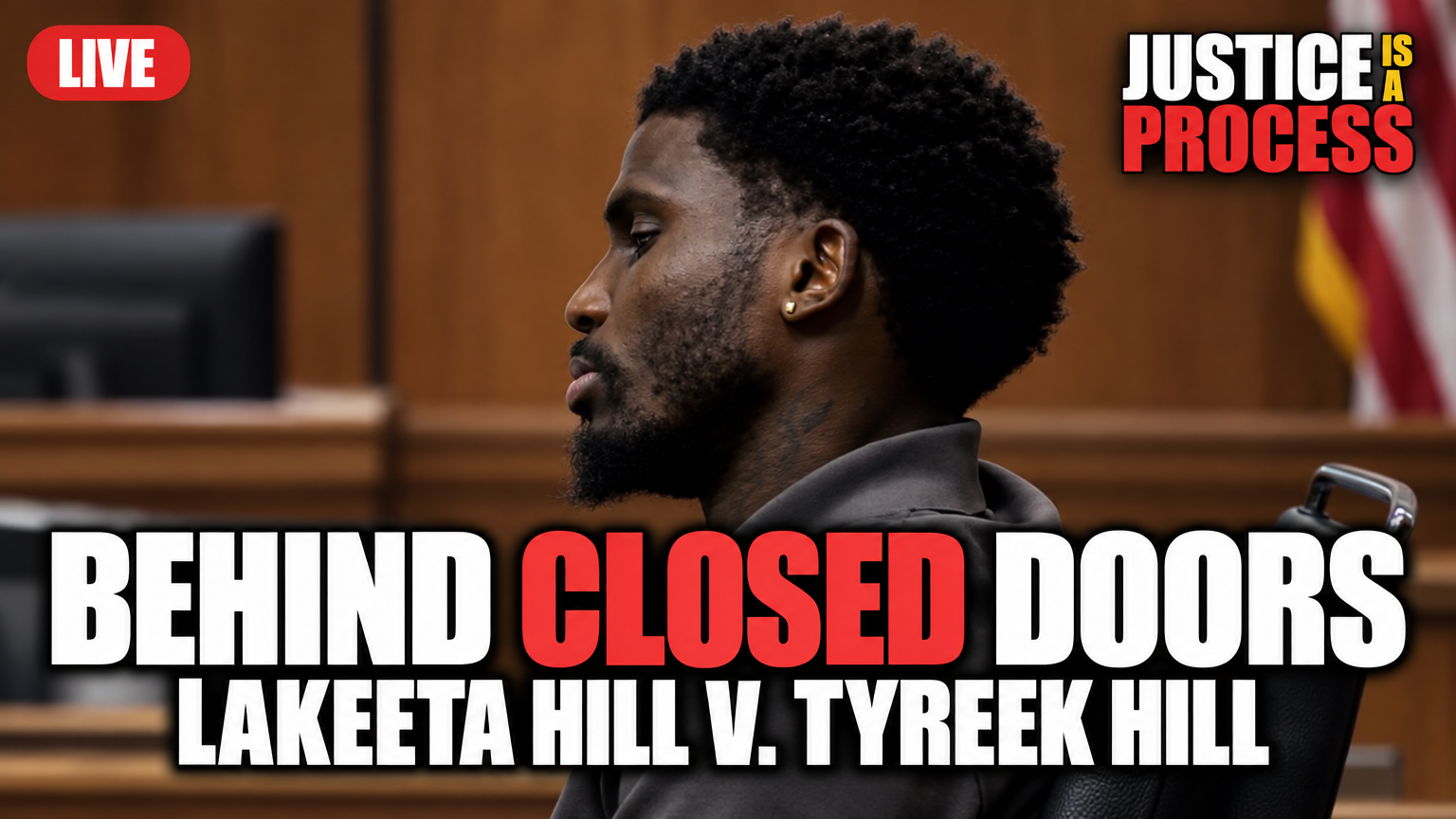
Behind Closed Doors: her eight allegations of what happened in the marriage, against his records made at the time
October 2026 | Justice Is A Process
For most of their marriage, the people who lived it say almost nobody else saw it.
Keeta Vaccaro Hill says that inside the homes, hotel rooms and cars she shared with her husband, Tyreek Hill, eight incidents happened between January 2024 and April 2025 that left her afraid, hurt and, according to the psychologist her lawyers hired, carrying a trauma she still lives with. Tyreek Hill, one of the fastest and most famous wide receivers of his generation, says none of it happened the way she tells it. His lawyers call the allegations "vexatious and patently false."
On October 6, 2026, that disagreement walked into a courtroom in Miami-Dade County, Florida, and sat down in front of a jury.
This is not a criminal case. Nobody in this courtroom is charged with a crime. Tyreek Hill was never arrested for any of the eight incidents in this lawsuit, and the State of Florida is not a party. This is a civil jury trial: one spouse suing the other for money damages over claims that were carved out of their divorce. The plaintiff, Lakeeta "Keeta" Vaccaro Hill, says her husband physically harmed her, threatened her, and put her through a pattern of conduct designed to inflict emotional distress, and she brings a claim under a Florida law written specifically for people who say they lived through continuing domestic violence. The defendant denies every one of those allegations.
Her lawyer framed it in one line during his opening statement on Day 1: "Most of the incidents that occurred happened behind closed doors." There are not many photographs. There is not a police report for every incident. Keeta, he told the jury, "wasn't trying to build a case. She was trying to build a life."
Hill's trial team answered with a line of their own, and it may be the most important sentence of this trial: "The story being presented during this trial is very different than the story that was being told while the evidence in this marriage was actually happening."
That is the whole case in two sentences. On one side, her account of what happened behind closed doors, told now, under oath, to a jury. On the other, the records made at the time: police officers from three departments who came, looked, found no injury and made no arrest; doctors who asked her directly whether she was being hurt at home and wrote down her answer; a counselor whose notes, the defense says, never mention it; and a timeline in which the allegations were added to a divorce petition seven days after a ruling went against her.
Her eight allegations of what happened behind closed doors, against his records made at the time. That is the question this jury has been asked to answer.
And it is a harder question than it sounds. People who live with abuse often do not report it. They protect the person hurting them. They tell the doctor "no" because the person is in the next room, or because they are ashamed, or because they still hope it will stop. Every domestic violence advocate in the country will tell you that silence is not proof nothing happened. But a jury cannot hold someone liable on the assumption that silence means abuse either. Silence is evidence of nothing in particular. Somebody has to prove what happened, and in this courtroom that somebody is the plaintiff.
We are not here to decide who is telling the truth. That is the jury's job, and only theirs. We are here to watch whether the process does what it is supposed to do: give a woman who says she was hurt a fair hearing, give a man who says he is being falsely accused the same, and hold the plaintiff to her burden of proof without letting fame, money, sympathy or assumptions about husbands and wives do the deciding.
These are allegations. Nothing in this report is a finding. Nothing is proven until a jury says so.
This is Justice Is A Process. Let's begin.
Let's start with how these two people got here, because the timeline is not background in this case. The timeline is the evidence.
According to the plaintiff's opening statement, Keeta Vaccaro met Tyreek Hill while she was a college student at the University of Miami. Her lawyer told the jury she was not starstruck: she grew up in Brownwood, Texas, in a football family, with a brother who played seven seasons in the NFL and an uncle who won a Super Bowl. She had been around professional athletes her whole life. He pursued her, the relationship grew, and the two were engaged at a large party on July 4, 2021.
She broke the engagement off. The plaintiff says she will explain why from the witness stand. He kept pursuing her, and, her lawyer told the jury, he sent her messages saying she was the love of his life, that he had grown up and changed, and that he was ready to settle down. The two married on November 8, 2023, in a ceremony in Austin, Texas.
Both sides agree that a postnuptial agreement became a fault line almost immediately. A postnup is like a prenup signed after the wedding: a contract that sets out who owns what if the marriage ends.
Her side says that not long after the wedding, Hill began demanding she sign one, that she was willing to consider it, and that the draft she was handed included a clause waiving any claim she might ever have for emotional harm in exchange for one dollar. Her lawyer told the jury that the fights over that document are where the trouble started.
His side says the postnup was prepared by his wealth managers and lawyers, and that his financial protections were in place long before he ever met her. His trial team told the jury that when Hill signed his major NFL contracts, he did not manage the money himself: he placed it with a wealth advisor to secure "generational wealth" for his children, and that money was never available for everyday spending. In the defense's telling, this is not a story about a husband who turned violent when he did not get his way. It is a story about a divorce that turned into a fight over money.
In September 2025, Keeta Vaccaro Hill amended her divorce petition to add eight separate incidents she says happened during the marriage. The 23-page document was filed under seal and became public in October 2025, after a coalition of news organizations asked the court to open it. Based on that petition as reported by Defector, NBC Sports and CBS News Miami, and on the timeline her lawyer showed the jury on Day 1, here is what she alleges, in the order she says it happened. Every one of these is an allegation. Hill denies all eight.
Press accounts of the petition and the timeline the jury saw on Day 1 do not line up perfectly on every date. Her lawyer's chart listed incidents on January 10, January 21 and late January 2024, then May and mid-May 2024, July 12, 2024, and November 2024. Small differences like these are exactly what cross-examination is built from, and the defense has already promised to point out every contradiction between the petition, what she told police, what she told her doctors, and what she says on the stand. When those dates come up in testimony, we will report what the witnesses actually say, not what the press summaries said.
The plaintiff says the last hope of saving the marriage ended on April 7, 2025. The couple's daughter had been born by then. A nanny camera mounted above the baby's crib in the Sunny Isles Beach condominium recorded part of what happened that day, and her lawyer played a portion of that video for the jury during his opening statement. At the court's direction, cameras were turned away while it played, so the public has not seen it.
Press reports describing the video say Hill can be heard saying he would take his daughter and leave, while Keeta and her mother plead with him. The defense told the jury a different thing about the same video: that Hill can be heard saying "stop pushing me, stop hitting me," that there was a lot of bad language on both sides, and that when Sunny Isles Beach police arrived they found no reported injury and no damage in the condominium. No one was arrested.
The next day, April 8, 2025, Keeta Vaccaro Hill filed for divorce.
The divorce began as an ordinary filing. The eight allegations came later, in the amended petition of September 4, 2025. Hill's legal team asked to keep that document sealed, arguing that it touched on matters involving the couple's young child. Six news organizations, including Defector Media, asked to intervene under Florida's public-records law, which is among the most open in the country. Hill's lawyers changed course and stopped opposing the release, and the document was unsealed in early October 2025.
Hill's divorce attorney, Seth Schneiderman, told reporters at the time: "We believed that the filing should be sealed to protect the minor child of the parties from such false and vexatious allegations." He added: "The allegations are vexatious and patently false. There is no objective corroborating evidence." Her attorney, Evan R. Marks, said he believed the release was appropriate under Florida law. Press reports said the NFL opened a review under its Personal Conduct Policy once the petition became public.
The claims for money damages were then split off from the divorce itself and set for trial before a jury. That is the case that opened on October 6, 2026.
In criminal cases we talk about "the victim." This is not a criminal case, and no court has found that anyone victimized anyone. Keeta Vaccaro Hill is the plaintiff: the person who brought the lawsuit and who carries the burden of proving it.
Her lawyer introduced her to the jury as the daughter of a church-going, "Texas tough" family from Brownwood, a small town in central Texas. Football runs through that family: one brother played seven seasons in the NFL, both brothers played at the University of Texas, and an uncle won a Super Bowl. She came to South Florida for college at the University of Miami. Her lawyer described her as composed by upbringing and by nature, and told the jury that very composure is part of why, in his telling, responding officers looked at a calm woman and a famous football player and "didn't do anything."
She is also a mother. The couple's daughter was born during the period this lawsuit covers. Our coverage will never show that child's picture.
Her case asks the jury to believe that she stayed, kept up appearances, and said little in public because she was married to a high-profile athlete whose every move ended up on social media, and because she was trying to make the marriage work. The defense will ask the jury to look at the same silence and see something else. How she holds up on the witness stand, especially under cross-examination about what she told doctors, may decide this case.
Tyreek Hill is one of the most recognizable players in the NFL of the last decade, a wide receiver whose speed earned him the nickname "Cheetah," with Super Bowl success in Kansas City before a blockbuster move to the Miami Dolphins. His career has been in question since a serious knee injury in September 2025.
His trial team introduced a different side of him to the jury: a man born in a small town and raised by his grandparents in Georgia, grandparents who have been married for more than 50 years and who are expected to testify about the values they gave him. The defense described him as intensely disciplined and deeply committed to his family, and told the jury he showed up for every couples-counseling session and was the one who asked for counseling in the first place.
Hill has faced public allegations before, and none of them is on trial here. In May 2026, a separate civil lawsuit brought by a social media influencer, who claimed he injured her during a training session, settled after a day and a half of trial in Broward County. He denied those claims. This jury will decide this case on this evidence, and so will we.
Tyreek Hill is a civil defendant. He has not been charged with a crime in connection with any of these allegations, he denies all eight, and under the law he does not have to prove anything. The plaintiff has to prove her claims.
For the plaintiff, the opening statement was delivered by her trial lawyer, Paul Schwiep. Evan R. Marks has represented her in the divorce. For the defense, the opening was delivered by his trial lawyer, Christi Bright; Seth Schneiderman has represented him in the divorce, and press reports have also identified Julius B. Collins as his personal attorney and Michael Gottlieb as part of his legal team. We will confirm names and roles on the record as the trial goes on and correct any spelling the record shows we got wrong.
The trial is being heard in the Circuit Court of the Eleventh Judicial Circuit, in and for Miami-Dade County, Florida, before Judge Spencer Eig and a civil jury. (Press reports about the divorce itself name a different judge, who handles the separate divorce file.) The judge's role in a civil jury trial is the same as in a criminal one: rule on what evidence comes in, keep the trial fair, and tell the jurors what the law is. The jurors decide the facts.
Based on the opening statements, the jury is expected to hear from: Keeta Vaccaro Hill herself, who was called as the first witness on Day 1; a psychologist retained by the plaintiff, who has diagnosed her with post-traumatic stress disorder and anxiety; police officers from three departments, Davie, Orlando and Sunny Isles Beach, who responded to calls during the marriage; her OB-GYN and other treating providers; the couples counselor; Hill's grandparents; and very possibly Tyreek Hill himself. Her mother is a figure in several of the allegations and in a pretrial fight over two recorded phone calls. Crystal Espinal, the mother of three of Hill's children, has become part of the case through a pretrial dispute over contact with a potential witness.
In a criminal case this section would be called "the charges." There are no charges here. There are civil claims, and the difference matters for everything that follows.
A criminal case is brought by the government, the defendant's liberty is at stake, and the State must prove guilt beyond a reasonable doubt. A civil case is brought by a private person, money is at stake, and the plaintiff must prove her claims by "the greater weight of the evidence." Lawyers sometimes call it a preponderance of the evidence. Picture a scale: if the evidence on her side tips it even slightly, she wins that claim. If it is balanced, or tips the other way, she loses. That is a far lower bar than a criminal trial, and it is why a person can be sued successfully for conduct they were never charged with. It is also why the jury's verdict here will say "liable" or "not liable," never "guilty" or "not guilty."
The defense told the jury that the judge will instruct them to consider each alleged incident separately. Eight allegations are not one big allegation. Proving one does not prove the others, and failing to prove one does not disprove the others.
What it means: An intentional, harmful or offensive touching of another person without consent. In a civil case it is a personal wrong between private people, not a crime prosecuted by the government.
What the plaintiff must prove: That Hill intentionally made harmful or offensive contact with her, that she did not consent, and that it caused her damage.
What is at stake: Money damages for the harm proven.
What it means: In civil law, an intentional threat, by word or act, to do violence, coupled with an apparent ability to carry it out, that puts a person in reasonable fear that violence is imminent. No touching is required.
What the plaintiff must prove: That Hill threatened her with physical harm under circumstances where she reasonably believed the harm was about to happen. Her lawyer framed it to the jury exactly that way on Day 1.
What is at stake: Money damages for the harm proven.
What it means: Conduct so outrageous that it goes beyond all bounds of decency, done intentionally or recklessly, that causes severe emotional distress.
What the plaintiff must prove: Outrageous conduct, intent or recklessness, causation, and emotional distress that is severe. Florida courts set a high bar for this claim: rude, insulting or hurtful conduct alone is not enough. Expect the psychologist's testimony, and the defense's attack on it, to center here.
What is at stake: Money damages for the emotional harm proven.
What it means: Florida law gives "a victim of domestic violence who has suffered repeated physical or psychological injuries over an extended period of time, as a result of continuing domestic violence" a civil cause of action against the person responsible. The law allows compensatory damages and punitive damages, and it gives the person four years from the last incident to sue.
What the plaintiff must prove: Not one incident but a continuing pattern, repeated injuries over an extended period, and that the pattern caused those injuries.
What is at stake: Compensatory damages, and possibly punitive damages, which are meant to punish rather than to repay a loss.
Her lawyer summed up the plaintiff's version of the burden in his opening: whether he harmed her as she alleges, whether she consented, and "if he did, what are the damages that she's entitled to." Hill's trial team summed up theirs in three steps: she must prove the conduct, then prove an injury, then prove that the conduct caused the injury. "Mr. Hill does not have to prove that they did not happen," the defense told the jury. "The plaintiff must prove that they did."
Strip away the celebrity and this case is a credibility contest with an unusual twist. In most he-said, she-said cases there is very little paper. Here there is a great deal of paper, and almost all of it was written at the time, by people who were not thinking about a lawsuit. The plaintiff says the paper is silent because she was protecting herself and her marriage. The defense says the paper is silent because nothing happened. The jury has to decide which explanation for the silence fits the evidence.
Her eight allegations of what happened behind closed doors, against his records made at the time. Every witness in this trial lands on one side of that line.
Her case rests first on her own testimony: the details of each incident, told by the only witness who was in the room for most of them besides Hill. Her lawyer told the jury that testimony will be corroborated by other evidence, including recordings the jury will hear, documents and photographs, and the nanny-cam video from April 7, 2025.
Second, it rests on a theory about why the record is thin. The incidents happened in private. She did not photograph everything. When police did come, she says, they saw a composed woman and a famous man and left. She stayed, as many people in her position do, and kept up appearances on social media.
Third, it rests on expert testimony. A psychologist retained by the plaintiff has evaluated her and concluded that she suffers from post-traumatic stress disorder and anxiety, that she is in treatment, and that the cause was the conduct she alleges. That testimony is the bridge from "this happened" to "this is what it cost her," and it is the foundation of any damages award.
Finally, it rests on motive, and specifically on the postnuptial agreement. Her lawyer told the jury that the fights flowed from Hill's demand that she sign it, and from the clause that, in her telling, valued any future emotional-harm claim at one dollar. He also told the jury, directly, that the defense would say she is only in it for money, and asked them to find that it is "not about money."
The defense has made its theme unmistakable. "Then versus now," Hill's lawyer told the jury. What was said then, to police and to doctors? What was documented then? What did witnesses see then? And how does that compare to what the jury will hear now?
The defense previewed five lines of evidence.
The police. Officers from Davie, Orlando and Sunny Isles Beach responded to calls during the marriage. The defense says that across all three departments, not one officer, including a female officer asked to photograph the plaintiff, found a single scrape or mark, and no arrest was ever made. The defense calls these officers "the most objective witnesses in this case."
The doctors. During part of the period covered by the allegations, she was seeing her doctors for regular medical visits. The defense says her providers asked her directly whether she was experiencing abuse or domestic violence, and that she answered "no." Not "I don't want to talk about it." Not "I'm afraid to answer." No. And the defense told the jury that when she was later asked under oath whether she had been untruthful in denying abuse to her doctors, she said yes. At a follow-up medical visit in December 2024, the defense says, her providers recorded normal mood, with no depression, anxiety or sleep problems noted.
The counselor. The couple saw a counselor. The defense says Hill attended every session and asked for the counseling, and that while she has testified that abuse was the main subject of those sessions, the counselor's own records document no disclosure of domestic violence and no visible signs of it.
The expert. The defense says the first time she reported PTSD symptoms to anyone was after her lawyers hired an expert and sent her to him, more than two years after the first alleged incident. Hill's lawyer warned the jury they will hear from medical professionals "hired by attorneys and paid hourly" and urged them to weigh bias and motive.
The timing. She filed a simple divorce on April 8, 2025. The defense says that after hearings in the same courthouse went against her, and seven days after the last of those rulings, she amended her petition to add the eight allegations. In January 2026, press reports said a judge in the divorce ordered Hill to pay $5,500 a month in temporary spousal support while criticizing a request for additional money toward a luxury car as excessive. The defense wants the jury to see the allegations as part of a contentious divorce over money. The defense also says that after the divorce was filed, Hill moved out and left the condominium to her and their daughter, and that she voluntarily shared time with him and their daughter while the divorce was pending, which the defense says is not the behavior of someone afraid.
The battles before trial tell you where both sides think the case will be won.
The mother-in-law's recordings. Hill's team says his mother-in-law secretly recorded two phone calls with him and has fought to keep them out of the trial. Florida is an all-party consent state: under Chapter 934 of the Florida Statutes, recording a private conversation without everyone's consent is generally unlawful, and an unlawfully intercepted conversation generally cannot be used as evidence. Whether and how the jury hears those calls could matter a great deal, because they may be among the few pieces of evidence that capture Hill's own words in the moment.
The witness-contact accusation. In September 2026, the plaintiff's side accused Hill of improper contact with Crystal Espinal, the mother of three of his children, ahead of trial. Hill moved for sanctions in response, saying there was "no threat, no misleading statement, and no offer of any benefit."
The Day 1 arguments. Before the jury came in on October 6, the lawyers argued over a text message argued to be protected as part of settlement talks (Florida's evidence code generally keeps offers to compromise away from the jury), over the nanny-cam video, and over whether evidence of other conduct could come in to show intent or the absence of a mistake. The court's handling of those questions will shape what the jury is allowed to weigh.
The broadcast. The court has allowed cameras, with limits. Jurors are never shown, and the judge told the jury that some evidence will be presented with the cameras stopped. When the public broadcast goes dark for a piece of evidence, that is the court controlling its own record, and we will tell you when it happens rather than guess at what was shown.
A civil trial does not carry the constitutional machinery of a criminal one. There is no right to remain silent at trial without consequence, and no proof beyond a reasonable doubt. What there is: allegations, not findings, until a jury rules. But the principle underneath all of it still governs this courtroom: an accusation is not evidence, and the person making a claim has to prove it. The defense put it plainly on Day 1: "An allegation does not come with the presumption that it is true." The flip side is just as true. A denial does not come with that presumption either. That is why we have juries.
Here is what we will be watching.
Is the burden being respected? The plaintiff carries the burden on every claim and every incident. The greater weight of the evidence is a low bar, but it is a real one. Watch whether the jury instructions, and the lawyers' arguments, keep that burden where it belongs, incident by incident, rather than letting eight allegations blur into one impression.
How does the court handle the silence? This is the hardest evidentiary problem in the case. Experts who study domestic violence know that people often deny abuse to doctors and police. Lawyers who defend against false claims know that a lack of contemporaneous complaints can mean there was nothing to complain about. Both things are true in the world. Watch whether the jury hears both explanations fairly, through witnesses qualified to give them, rather than through lawyer argument alone.
The expert battle. A diagnosis made by a retained expert, years after the events, for a lawsuit, will be attacked as advocacy. A diagnosis is also how the law measures invisible harm. Watch how the court handles the line between what the psychologist can say about her condition and what the psychologist cannot say about whether the incidents happened. The first is expert testimony. The second is the jury's job.
Fame on both sides of the scale. Her lawyer argued that police deferred to a famous athlete. His lawyer asked the jury to decide on evidence, "not sympathy, not celebrity, not assumptions about husbands, not assumptions about wives." Celebrity can cut both ways in a courtroom: it can earn a defendant deference, and it can make him a target. A fair trial neutralizes it. Watch whether this one does.
Recordings and privacy. The fight over the mother-in-law's recordings puts two good principles in tension: Florida's strong protection of private conversations, and the search for the truth. How the court resolves that tension, and whether the jury ever hears those calls, is the kind of ruling that shapes the outcome without the public ever seeing why.
Open courts and the people in them. This case only became public because news organizations went to court to unseal it. Florida's commitment to open records is part of why you can watch this trial at all. At the same time, there is a young child at the center of this family, and nothing about her belongs on a broadcast. We will cover the courtroom openly and keep her out of it.
Justice Is A Process was built on a simple idea that came from my father, Steven M. Askin, a lawyer who spent his career insisting that the system prove its case and treat every person in front of it fairly. That idea does not change because the case is civil, or because the defendant is famous, or because the claims are ones nobody wants to believe could happen. It means taking her account seriously enough to test it, and taking his denial seriously enough to test that too.
The plaintiff's case comes first: her testimony, her mother, the recordings the court allows, the nanny-cam video, and the psychologist. Then the defense case: the police officers from three departments, the OB-GYN and treating providers, the counselor, the grandparents, and possibly Tyreek Hill himself. If either party takes the stand for a long cross-examination, those will be the defining days of this trial.
Nobody has announced a firm length for the trial. Civil trials of this size often run one to two weeks. They can also end suddenly. A civil case can settle at any point, even in the middle of testimony, and Hill's separate civil trial in Broward County in May 2026 settled after a day and a half. If this one settles, is dismissed or ends in a mistrial, we will tell you the moment it happens.
If it goes to verdict, the jury will answer questions claim by claim and incident by incident: did the plaintiff prove this, and if so, what damages did it cause. If it awards compensatory damages under the domestic violence statute, it may also be asked about punitive damages. The verdict will say "the jury found" or "the jury did not find." There is no conviction and no acquittal in a civil case, and there will be none in our coverage either.
We are following this trial every day it is in session. You will get:
NO BREAKS EDITIONS of each trial day, every word of testimony with the dead air removed.
TOP MOMENTS from each day, the testimony that matters most in one place.
WHOLE TESTIMONIES so you can watch a witness from the first question to the last, and judge credibility for yourself.
KEY MOMENTS AND CLIPS when the record turns, on direct or on cross.
We will report what the witnesses say, from the record, with the timestamps to check us. We will call allegations allegations until a jury says otherwise. And we will keep the couple's daughter out of every frame we make.
This is a civil case. Tyreek Hill is not charged with any crime, he denies every allegation, and the plaintiff must prove her claims by the greater weight of the evidence. Keeta Vaccaro Hill deserves to be heard. So does he. Fairness works both ways.
Let's watch the system together.
Subscribe to Justice Is A Process on YouTube for live trial coverage, No Breaks editions, and breaking news as it happens.
🔴 Subscribe on YouTube86,000+ subscribers watching the system with us
Discussion