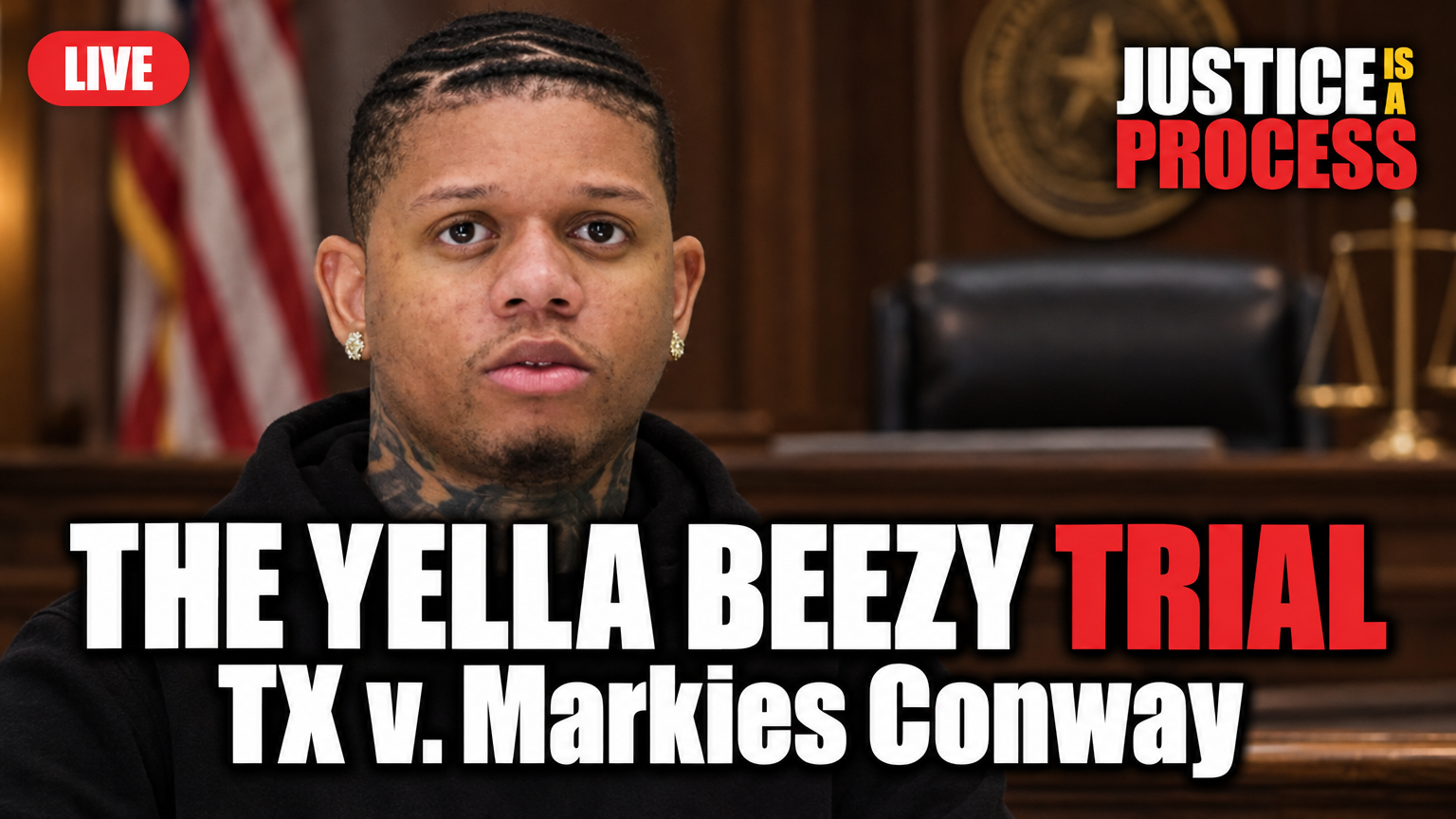
Prosecutors say a rapper paid for the highway killing of Mo3. The defense says it is all circumstantial.
October 2026 | Justice Is A Process
On the night of November 11th, 2020, a 28-year-old father of three was driving on Interstate 35E in Dallas, Texas, when another vehicle came up behind him.
He stopped in the center lane. According to the account that has been reported since, he reached for a weapon, could not get it, and ran. A man on foot chased him down the highway and shot him multiple times with a rifle. The shooter got back into a dark car and drove away. Melvin Noble, the North Dallas rapper the world knew as Mo3, was pronounced dead at a local hospital.
Mo3 was a regional star whose song "Broken Love" had been heard by millions. His family lost a son and a father. His fans lost a voice. And a city with a long, complicated relationship with its own rap scene lost one more young man to the street.
Today, almost six years later, the State of Texas is asking twelve jurors in a Dallas courtroom to decide a question that goes well beyond the man who allegedly pulled the trigger. That man, Kewon White, has already been tried. A Dallas County jury found him guilty of capital murder in September of this year and he was sentenced to life without parole. The question in front of this jury is about the man prosecutors say sent him.
Prosecutors say that man is Markies Conway, the Dallas rapper known to the public as Yella Beezy. They say he hired White, for money or the promise of money, to kill a rival. Conway has pleaded not guilty. He denies it. And under the law in this country, that is exactly where he stands today: a man presumed innocent, with a jury about to hear the State try to prove otherwise.
We are not here to convict or to acquit. We are here to watch whether the system does what it promises to do: make the State prove every piece of its case, beyond a reasonable doubt, while protecting the rights of everyone in the room, including a family that has waited nearly six years to hear a jury speak.
This is Justice Is A Process. Let's begin.
Let's start with what we know, and be very clear about the source of each piece. Nothing in this section has been proven in this trial. Everything here is either an allegation by prosecutors, a finding in a case against someone else, or a fact reported in the public record. Where it is an allegation, we will say so.
Melvin Noble was shot and killed on November 11th, 2020, on Interstate 35E in Dallas. Reporting describes a chase in which another vehicle pursued him and stopped him in the center lane. He tried to retrieve a weapon, did not succeed, and got out and ran on foot. A gunman followed and shot him multiple times with a rifle. The shooter then fled in a dark vehicle that investigators believed to be a 2015 Chevrolet Camaro.
That is a violent, close-range, public killing on one of the busiest highways in the country. It left a crime scene, a getaway vehicle to trace, and a city asking who could have wanted this young man dead badly enough to do it in the middle of traffic.
The investigation moved quickly toward the man who was allegedly holding the rifle. Kewon White was arrested on December 9th, 2020, about four weeks after the shooting. Devin Brown was arrested on April 23rd, 2021, and charged as well. Both men were charged with capital murder. For years, those were the only two defendants.
That matters for how you should read this trial. For most of the time since the killing, the public story was about a gunman and a second man accused of helping. The idea that someone had paid for the killing was not part of the first arrests. It came later, and it came in the form of a charge against a far more famous name.
On March 20th, 2025, more than four years after the shooting, Markies Conway was arrested in Texas and booked into the Dallas County Jail on a capital murder charge, case number F-25-00154. A grand jury indictment followed. The charging language, as reported, accuses Conway of employing White to murder Noble "for remuneration and the promise of remuneration."
That wording is the heart of the charge. Under Texas law, a murder committed for hire is not just a murder. It is capital murder. The State does not say Conway pulled the trigger. It says he arranged and paid for someone else to do it. We will walk through exactly what that means, and exactly what prosecutors would have to prove, in the charges section below.
Bail was first set at $2 million. A judge later reduced Conway's bond to $750,000, with conditions that, as reported, include no contact with witnesses or the victim's family, and he was released while he waited for trial. According to coverage of the bond hearing, the judge pointed to a lack of evidence tying him directly to the crime at that stage. We will treat that detail with care, because a bond ruling is not a ruling on guilt or innocence. But it tells you the case did not look like a simple one even to the judge supervising it.
The State's theory, as laid out in court documents and in coverage of the pretrial hearings, is that Conway hired White to kill Noble in exchange for a promised cash payment. The motive prosecutors point to is a long-running feud between two rival Dallas rap artists who came up in the same city at the same time.
At a pretrial hearing on the admissibility of rap lyrics, a detective described what prosecutors say is the history of that feud, including a July 2019 concert in Frisco. According to the reporting, law enforcement coordinated a response because authorities believed having both artists at the same event posed a public safety risk, and Mo3 was removed from the lineup and arrested on outstanding warrants after he arrived at the venue. Prosecutors then played Instagram Live videos that both men posted afterward, which they argue show the feud escalating.
Investigators, according to reports, say they built the case from witness statements, physical evidence, wiretaps, social media posts and more. The State's own description of its evidence is a mix of the kind of thing a jury can hold in its hands and the kind of thing a jury has to interpret. That mix is going to define this trial.
Before he was a case number, Melvin Abdul Noble Jr. was a kid born on May 31st, 1992, in McKinney, Texas, who grew up in North Dallas. He started making music young and put out his first mixtape, Shottaz, in September of 2014. His remix of "Hold Ya Tongue" with Mr. Lucci built a following in the region, and by 2016 his project Shottaz Reloaded caught the ear of Baton Rouge star Boosie Badazz, who wanted to bring him into his orbit.
The breakout came in 2020. His song "Broken Love," with a remix featuring Kevin Gates, went on to be certified two-times platinum by the RIAA. In February of 2020 he released the album Badazz MO3 with Boosie, which reached the Billboard 200. He was a rapper whose music was built on pain, loyalty, street life and love, and whose audience heard in it something they recognized in their own lives.
He had three children, two girls and a boy. He was 28 years old when he died. After his death, a posthumous album, Shottaz 4Eva, reached number 36 on the Billboard 200. A federal jury in Sherman, Texas, also ruled in May of 2025 in a dispute over ownership of his recordings, finding that the music belonged to his estate. Even in death, his work continues to matter to the people who loved it.
We will say this plainly every time it comes up: Mo3 was a person. He is not a lyric, not a caption, not an exhibit. In a case where the jury will hear his music, we want to keep in front of us that he was also a son, a friend and a father.
Markies Conway is a Dallas rapper who performs as Yella Beezy. He rose to national attention in the late 2010s with the song "That's On Me" and went on to collaborations with some of the biggest names in hip-hop. He and Mo3 came from the same city and the same scene.
He was arrested in March of 2025, years after the killing, and has been out on bond under conditions since. He has pleaded not guilty to capital murder, and he has denied hiring anyone to hurt Mo3. In the eyes of the law he is an innocent man until twelve people unanimously say otherwise beyond a reasonable doubt.
That presumption is not a courtesy. It is the structure that makes everything else in a trial legitimate. We say that about every defendant, whether they are famous or nobody has ever heard of them. A celebrity on trial does not carry more guilt, or less. The jurors are supposed to forget the name on the door and look at the evidence on the table.
Kewon White is the man prosecutors say carried out the shooting. He was arrested in December of 2020. His trial in Dallas County ran for roughly two weeks, concluding on September 4th, 2026, when a jury found him guilty of capital murder. He was immediately sentenced to life in prison without parole. Reporting indicates he was already serving time on an unrelated gun charge.
The jury that convicted White heard evidence the public has only read about in headlines: a jailhouse interview of White that jurors watched, a second jail phone call that referenced his money, testimony about video that police say captured the shooter, and detectives who testified that Conway paid White. Those are the headlines. We have not seen the full testimony and we will not pretend otherwise. What we know is that a separate jury, hearing a separate trial, reached a verdict on White.
Here is the legal wrinkle, and it is a big one. White's conviction is not evidence of Conway's guilt. The question for this jury is not "did White kill Mo3." It is "did Conway pay him to." And in Texas, as we will explain below, the State cannot prove that point by leaning on the testimony of an accomplice alone.
Devin Brown was arrested in April of 2021 and is also charged with capital murder in connection with the killing. His alleged role has been described in different ways in different reports, and his case has not been tried. Reports indicate he faces his own capital murder trial after Conway's trial ends. Like every defendant, he is presumed innocent.
For this trial, Brown matters in one specific way: he is a name the jury may hear, and a person whose connection to the others will be part of what prosecutors say happened. He is not on trial here.
The case is in Dallas County Criminal District Court 7, with Judge Chika Anyiam presiding. Judge Anyiam has handled the most consequential pretrial fights in this case, including the bond reduction, the continuances that pushed the trial date several times, and a lengthy ruling on the rap lyrics that we will cover below. When the judge told the jury that the trial is expected to last two to three weeks, that was the first time many of them understood how much of their fall they had agreed to give up.
We are still confirming the full roster of prosecutors and defense counsel from the live feed. We will not guess at names. When we have each attorney's name confirmed from the courtroom, we will say it, spell it correctly, and add it to our reporting.
What it means: Under Texas law, a murder becomes a capital offense when it meets certain conditions. One of them is that the person committed the murder "for remuneration or the promise of remuneration," or that the person "employs another" to commit the murder for remuneration or the promise of it. In plain English: killing someone for money is capital murder, and so is paying someone else to kill for you.
What the State must prove: Beyond a reasonable doubt, that Melvin Noble is dead, that his death was caused by an intentional killing, and that Markies Conway employed the person who did it, for payment or the promise of payment. The State does not have to prove Conway was at the scene. It does have to prove he was the one who hired the shooter, and that money, or the promise of it, was part of the deal.
Potential sentence: Under Texas law, a person convicted of capital murder faces either life in prison without the possibility of parole or, where prosecutors seek it and the jury agrees, death. Nothing in the reporting we have seen indicates the State is seeking the death penalty here, and Kewon White received life without parole.
The burden: Entirely on the State. Conway does not have to prove anything, call a witness, take the stand or explain a single lyric.
Think about the structure of that charge for a moment. The jury has to be convinced of two things, not one. First, that a murder-for-hire happened. Second, that this defendant is the one who arranged it. The first part may be the easier of the two, given White's conviction. The second is the whole trial.
The charge is built around an agreement between two people, and agreements are, by their nature, usually private. There may be no video of a handshake. There may be no signed contract. So prosecutors, in a case like this, build the agreement out of pieces: messages, money, phone records, witnesses who say they heard something, and a motive. Each piece is something a jury can weigh. None of them is the agreement itself.
That is the one-line version, and it is the lens we will use on every witness. Every person who takes the stand in this courtroom will either strengthen a link in the chain the State is trying to build between Markies Conway and Kewon White, or leave a gap in it. The chain is the case.
A chain has an important property. It is only as strong as its weakest link, and the State needs every one of them. Does the evidence show there was a payment, or a promise of one? Does it show who made it? Does it show that the promise was to kill? Does it show the person who made it was Conway and not someone else, such as a friend, an associate or a person acting on their own? The prosecution has to answer all of those questions with evidence the jury believes. The defense only needs one of them to stay open.
The prosecution's theory, as described in public filings and pretrial coverage, rests on several pillars. We list them here the way prosecutors have described them, not as findings.
A feud with a history. The State says this was not random. It says Conway and Mo3 were long-running rivals whose conflict played out on stage, in songs and on social media. A detective described the 2019 Frisco concert at a pretrial hearing as a flashpoint. Prosecutors say Instagram Live videos from both men afterward show the dispute getting hotter, not colder.
The shooter, already convicted. The State will point to the conviction of Kewon White and the evidence the other jury saw: the video that police say captured the shooter, the vehicle, and the statements White made in jail. The State's theory is that White did not act alone and did not act for himself.
Payment. Court documents allege that Conway hired White for a promised cash payment. In White's trial a detective also testified about a bank withdrawal slip for $40,000 that prosecutors link to Conway, as reported in coverage of that trial. A jail call that referenced White's money was heard by the White jury, and a detective in that trial testified, in the words of the live coverage, that Conway paid White. Whether this jury will hear the same material, in the same way, is something the trial will answer.
Wiretaps, messages and social media. Investigators have described a body of electronic evidence in the case. We do not yet know exactly what the jury will hear from it, who will sponsor it, or how strong the connection to Conway will turn out to be. We will tell you as soon as we see it in the courtroom.
The music. The State fought to put Conway's lyrics in front of this jury, arguing that certain songs mirror real events and imply a murder-for-hire arrangement. That fight is important enough to give its own section.
The defense has said the State's case is circumstantial. A circumstantial case is one built on inference rather than direct proof. It is not weaker by definition, and juries convict on circumstantial evidence every day. But it does mean that the jury has to take a series of smaller facts and decide whether they add up to only one reasonable explanation. If there is a second reasonable explanation, the State has a problem.
The defense has also pushed hard on the idea that a rapper's songs are art, not confession. At the pretrial hearing, defense expert Dr. Erik Nielson, a University of Richmond professor and co-author of the book Rap on Trial, testified that rappers often act as characters, adopting exaggerated personas and staged rivalries. The argument is that if you treat every violent line as a statement of fact, you are no longer asking what a man did. You are punishing him for the genre he works in.
The defense has also made clear that Conway denies hiring anyone. That is not a complicated position. He says he did not do it.
One of the most important rulings in this case came in July of 2026, after a three-day pretrial hearing. Judge Anyiam issued a 14-page order on what the jury would and would not be allowed to hear.
Of nine songs submitted, she allowed three: "2 Nineteen" by Mo3, "Keep It In The Streets" by Yella Beezy, and "On Ya Head" by Trapboy Freddy featuring Yella Beezy. She also approved a 2019 interview Conway gave to VladTV, and references to a 2017 assault, a 2018 shooting involving Conway on a Dallas tollway, and a 2020 physical altercation involving Mo3's manager. Most of what the State asked to use was kept out.
That is a compromise ruling, and it will shape the trial. The jury will not hear a wall of lyrics. It will hear a handful of songs and some outside incidents, and each side will fight over what they mean. The prosecution will say the lyrics line up with real events. The defense will say a lyric is not a confession, and that the other incidents are being used to make Conway look like a violent man, which is the one thing the law says the State should not do to prove he committed this crime.
Expect objections. Expect the judge to give the jury limiting instructions about what they may and may not do with the lyrics and the other incidents. Watch how the jurors react when those songs play. A lyric is easy to feel and hard to weigh.
Here is where Texas law gets interesting, and where we expect much of the real fight to happen.
Texas has a rule, in Article 38.14 of the Code of Criminal Procedure, that a conviction cannot rest on the testimony of an accomplice unless there is other evidence that tends to connect the defendant to the offense. In plain terms, the State cannot just put a person on the stand who says "he told me to do it," and then sit down. It has to bring something else: records, other witnesses, physical evidence, anything that corroborates the claim and points back to the defendant.
That "something else" does not have to prove the whole case on its own. It just has to tend to connect Conway to the crime. But it cannot be the accomplice repeating himself. The law was built this way because people who trade their testimony for a better deal have a reason to say what prosecutors want to hear.
That is why the other evidence matters so much. A feud on its own does not hire anyone. Lyrics on their own do not hire anyone. A wire transfer or a payment record is a stronger link, but only if someone ties it back to the deal. The State has to tie them together in a way that is more than suspicion.
Let's be direct about something that will matter in the minds of viewers. White has been convicted. Many people will assume this means Conway must have been involved. That is not how the law works, and it is not how this jury is supposed to think.
A jury that convicted White decided that White committed the killing. It did not decide who, if anyone, paid him. White's trial and Conway's trial are separate proceedings with separate evidence, and the law is clear that each person is tried on the proof against him. The existence of one verdict is not a link in the chain against the other man.
If you find yourself reasoning, "well, someone paid the shooter, and the feud was with Conway, so it must have been him," pause. That is a theory, not proof. A theory is where a prosecution starts. Proof is where it ends.
Our job is not to cheer for either side. Our job is to watch whether the process is honest. Here are the questions we are carrying into this courtroom.
Is the burden of proof being respected? The State has to prove every element of capital murder beyond a reasonable doubt. That includes the identity of the person who hired the shooter. If the State's answer to a question is "it must have been him, because who else," that is not proof.
How is the corroboration handled? We will track every piece of evidence the State offers to connect Conway to White independent of White or any other accomplice. If the corroboration is strong, we will say so. If it is thin, we will say that too.
Is the music being used fairly? The jury hears songs for a reason, and the judge has told them what that reason is allowed to be. We will watch whether the State stays inside that line, whether the jurors are reminded of it, and whether anyone treats the lyrics as a confession.
Are the rights of everyone in the room protected? That includes the defendant, whose silence cannot be held against him, and the family of Melvin Noble, who deserve a trial that is run the right way so that whatever verdict comes can stand. A shortcut that helps the State today is a reversal on appeal tomorrow, and a reversal is a second trial for a grieving family.
What does the jury actually see? A trial transcript and a trial on video can feel very different. We will watch the faces, the exhibits and the pace, and tell you what the evidence did in the room, not just what it said on paper.
This is where the legacy of Steven M. Askin matters. He spent his life believing that ordinary people should understand the rules that govern their own prosecution. We are going to try to carry that forward by explaining these rules as they come up in real time, with a real defendant and a real victim in the room.
A reminder, because it is the foundation of this channel: we are not the jury. When we give our read on the evidence, it is our opinion, formed from what we see in the courtroom, and it is not a verdict. Twelve people in a box in Dallas will decide this case.
The judge has told the jury the trial should last two to three weeks. That is a long trial by most standards, and it signals that the State has a lot of witnesses and a lot of exhibits to put in front of the jury. Expect testimony from the investigators who built the case, from people who knew the two men and the feud between them, and from technical witnesses who can explain phone records, social media and other electronic evidence.
Expect the defense to cross-examine every one of them about what they actually know, as opposed to what they assume. Expect a fight about every exhibit that touches the lyrics. And expect the story to move in pieces. A trial is not told in order. It is told in the order the lawyers decide, and the jury only sees the whole picture at the end.
Devin Brown's trial is expected to follow this one. Whatever happens here, the Noble family's wait is not over.
It helps to say plainly what these twelve people are, and are not, being asked to decide. They are not being asked whether Mo3's death was a tragedy. It was. They are not being asked whether Kewon White did it. Another jury has answered that. They are not being asked whether they like Yella Beezy's music, or whether his persona makes them uncomfortable, or whether the feud was real.
They are being asked a narrow, hard question: has the State proven, beyond a reasonable doubt, that Markies Conway hired someone to kill Melvin Noble for money or the promise of money? If the answer is yes to every part of that, the law tells them what to do. If the answer is no, or if they are not sure, the law tells them what to do then too. That second instruction is the one people forget. "Not sure" is not a gray zone in a criminal trial. It is an answer.
A good juror in a case like this does something hard. They separate what feels true from what has been shown. A feud feels like a reason. A shooter's conviction feels like an answer. A song about violence feels like a confession. Each of those feelings can be completely understandable, and none of them is evidence of a payment. The job is to hold the feelings at arm's length and ask what the witnesses actually said, what the documents actually show, and what is still missing.
The defense has one more tool in this courtroom, and it is the simplest. The defense can ask the jury to notice what is not there. Nothing about that is unfair. It is the system working exactly as it was designed to work: the State brings the proof, and if the proof has a hole in it, the jury is entitled to see the hole.
That is what we will be watching for, one witness at a time.
There is a temptation, with any celebrity trial, to treat it as entertainment. We understand that. The names are familiar. The music is familiar. The story has all the parts a headline needs.
But look at what is actually at stake. A man faces the possibility of spending the rest of his life in prison if the jury convicts. A family wants to know who is responsible for the death of a son. A community is watching to see whether the justice system can handle a case in which the evidence is mixed up with art, reputation and rumor.
And a hard legal question is being tested in public. Can a jury hear a rapper's lyrics and treat them as evidence of a crime? Where is the line between a motive the State can prove and a character the State is smearing? How much does it matter that the person who allegedly pulled the trigger has already been convicted? These are the same questions that will come up in another courtroom in another city next year, with a different defendant and a different genre of music. That is why we are here.
We are following the trial from the courtroom feed every day. Expect a Case Story Part for each day of testimony, and the hottest moments cut as clips as they happen. Justice Breakdowns follow the key witnesses.
Markies Conway is presumed innocent until proven guilty beyond a reasonable doubt. That is not a technicality. That is the foundation of everything we do here.
Let's watch the system together.
Subscribe to Justice Is A Process on YouTube for live trial coverage, No Breaks editions, and breaking news as it happens.
🔴 Subscribe on YouTube86,000+ subscribers watching the system with us
Discussion