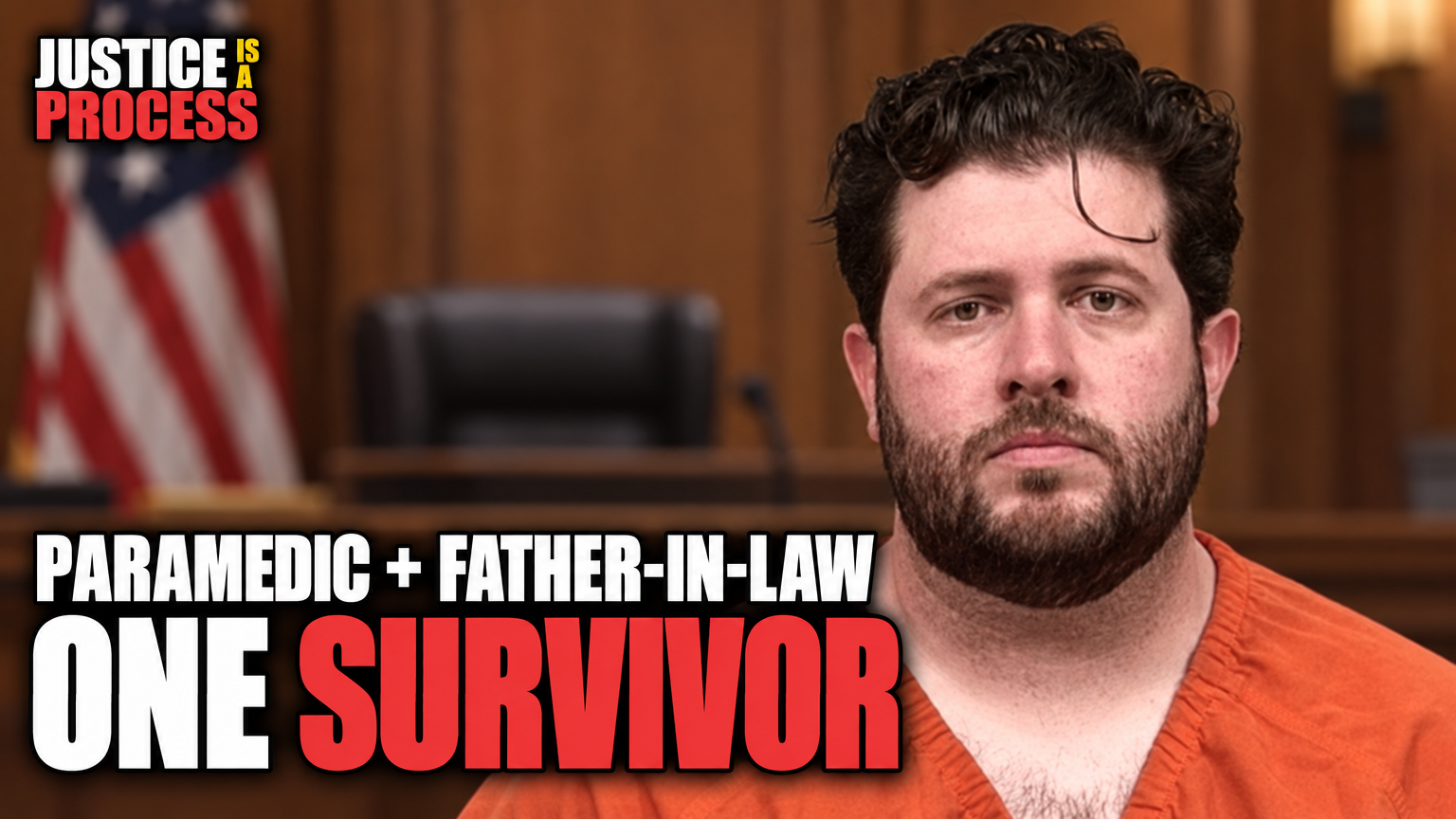
A paramedic, his wife, and her father. Only one of them walked out of that house alive, and the jury returned two different verdicts for two deaths.
October 2026 | Justice Is A Process
On the afternoon of January 20, 2021, Rachel Konen was packing for a ski trip.
She was thirty years old, a mother of four, and she was in the middle of a divorce. The camera in her bedroom on Westwood Drive, in the Sango community of Clarksville, Tennessee, caught her folding and moving bags through the afternoon and into the evening. At about 4:26 p.m. her father walked into the room, playing with three of his grandchildren. His name was David Rodgers. He was sixty-two, hard of hearing, nearsighted, a man who loved construction work and remodeling, and by every account the people who knew him gave a jury, a grandfather who could not get enough of those kids.
The camera last saw Rachel at about 6:22 p.m., moving her bags.
Twenty minutes later, her husband was on the phone with 911, screaming for help while children cried in the background.
Matthew Konen was a paramedic. He told the dispatcher that his father-in-law had shot his wife and then tried to shoot him, and that he had pistol-whipped the older man to stop him. Paramedics reached the house about six minutes after that call. They found Rachel on the hallway floor with a single gunshot wound that had gone through her back and her heart. Her husband had been doing chest compressions on her. A baby sat between her legs. She was pronounced dead at about 6:54 p.m.
In the dining room, David Rodgers lay in a pool of blood. His face had been beaten so badly that the medical examiner would later tell a jury the whole middle of it was sunken in. He died of blunt force injuries to the head.
Three adults were in that house when the shot was fired. Two of them died. The only adult left to tell anyone what happened was the man who called 911, and his story never changed in its core: his father-in-law fired the gun.
The State of Tennessee did not believe him. Police charged Matthew Konen with two counts of first-degree murder in May 2021. Then, in October 2023, the District Attorney dropped the case, saying the proof was not there yet. In May 2025 a grand jury indicted him again. In September 2026 a Montgomery County jury finally heard it all: the affair, the divorce papers, the life insurance, the father-in-law's struggles, the gun that may or may not have misfired, and the question of what a man may do once he has taken the gun away.
On October 8, 2026, that jury came back with something neither side asked for. It found Matthew Konen guilty as charged of first-degree murder in the death of David Rodgers. For Rachel, it found him guilty only of a lesser offense: criminally negligent homicide.
One gun. One hallway. One survivor. Two victims, and two very different verdicts.
We are not here to retry this case. Twelve jurors heard the evidence, and the verdict is theirs. Matthew Konen has not yet been sentenced, and the law still gives him every avenue of review it gives anyone. What we are here to do is what we always do: walk through how the State built its case, how the defense answered it, and whether the system did what it is supposed to do, prove every element beyond a reasonable doubt while protecting the rights of everyone in that courtroom.
This is Justice Is A Process. Let's begin.
To understand that night, you have to understand the house, and the strange arrangement inside it.
Matthew and Rachel Konen had four children. Rachel had trained as a nurse, and according to the defense she stopped working when the family started so she could care for and homeschool the kids, while Matthew sometimes worked two jobs to support them. In 2020 Matthew was a paramedic with the Nashville Fire Department.
That year, the marriage broke. According to the State, Rachel learned in June 2020 that her husband was having an affair with a co-worker. The couple tried marriage counseling. It did not hold. Divorce papers followed in the fall of 2020. The defense told jurors Matthew confessed the affair himself, that he and Rachel tried for a few months to reconcile, and that in the end they had simply grown apart.
Here is where it gets unusual. In the middle of that divorce, the Konens sold their old home and closed on a new one together, on Westwood Drive, in October 2020. They bought it as tenants in common, each holding half. Rachel's own divorce attorney told the jury that was very unusual. The plan, according to the defense, was to stay under the same roof for the time being, with Matthew living in the basement, while they learned to co-parent. The signed divorce agreement gave Rachel primary custody. It was set to become final in mid-February 2021, about four weeks after the night she died.
The terms of that agreement matter, because the State built its motive on them. Matthew agreed to pay $1,677 a month in child support and $500 a month in rehabilitative alimony through August 2025. He agreed to pay off Rachel's car and insurance, keep her on his health insurance until she could get her own, and transfer half of his retirement within six months of the divorce being final. The parenting plan gave Rachel 315 days a year with the children and Matthew 50.
There was also life insurance. In early 2020, before the affair came out, the couple sat down with a financial adviser who had known Rachel most of her life. They took out a $700,000 policy on Rachel, naming Matthew as the beneficiary, and a $1 million policy on Matthew, naming Rachel. Rachel's policy took effect in March 2020. According to that adviser, Matthew's take-home pay at the time was about $5,300 a month, and the family carried roughly $350,000 in debt.
January 20, 2021 was supposed to be the start of a trip for Rachel. She was heading out on a ski trip, and phone records later showed she had been on a date with another man; minutes before the 911 call, he sent her a picture of an exercise bike. Her phone recorded that message as unread.
David Rodgers had come over that afternoon. His phone connected to a cell tower near the Westwood Drive house at about 4:09 p.m. For hours, by the State's account, he was in that house alone with Rachel and the grandchildren. The bedroom camera, which recorded on motion and sound and left gaps, caught him playing with the kids. Matthew's phone reached the area around 5:45 p.m. He told detectives he got home around six.
At about 6:42 p.m., Matthew Konen called 911. The jury heard that recording. He yelled for help as children screamed. He told the operator his father-in-law had shot his wife and tried to shoot him, so he pistol-whipped him. He described running out to his car for his medic bag and starting CPR. The defense would later point out that on the same call he begged the dispatchers to drive faster and asked them to launch a medical helicopter.
The first police officer reached the house at about 6:48 p.m. Two of the Konen children were outside, yelling that their mother was inside. Matthew opened the door and went straight back to Rachel to continue CPR. On the officer's body camera, Matthew tells him that Rodgers shot Rachel. The officer can be heard saying he believed Matthew might be in shock, though he told the jury he was not a medical professional and left that judgment to the paramedics.
The first paramedic through the door found Rachel in the hallway. Within minutes he checked her pulse, and she was pronounced dead. He turned to David Rodgers and found massive injuries to his face and upper airway. Rodgers was conscious, thrashing, unable to speak or follow commands. The paramedic believed there were fractured teeth and possibly other objects in his airway. They tried to breathe for him with a bag valve mask and found it extremely difficult.
An advanced EMT on the scene called it one of the bloodiest calls she had ever worked. She told the jury that when she informed Matthew of the deaths, he seemed calm, while noting that trauma affects people differently. She saw blood on his cheek and asked if he was hurt. She testified that he wiped it away and said, "That's not mine."
Life always comes first at a scene like this, and the crime scene paid for it. The officer who arrived first and the commander of the Crime Scene Unit both told the jury that by the time investigators could work the house, things had been moved by people trying to save lives. On the body camera, the first officer can be heard telling a colleague to stop messing with things. A phone on the floor had been picked up by someone who mistook it for an officer's work phone because it was the same model.
That night, starting at about 8:57 p.m. and running until about five the next morning, the lead homicide detective interviewed Matthew Konen. The jury saw portions of it, roughly three hours of video.
Matthew told him he saw Rodgers walking behind Rachel through the dining room. As she stepped into the hallway, he saw a flash and heard a bang, and she dropped "like a sack of potatoes." He said Rodgers turned the gun on him, and he heard a click. He tackled the older man. They wrestled on the floor for the gun, and he said Rodgers kept trying to pull the trigger. He said he pulled back the slide so the gun could not fire and beat Rodgers until he appeared to be unconscious.
Then he checked on Rachel, ran down to the basement for his phone, called 911, got his medic bag, and began CPR. At some point after that, he said, he went back to Rodgers, who was sitting up, and kicked him.
He described his father-in-law as "incredibly passive" and "empathetic," and said he believed Rodgers had been struggling with declining mental health and memory problems.
The State seized on one more thing in that interview. Matthew told detectives he did not know David Rodgers owned a gun.
Investigators recovered a 9 mm Glock model 19 from the dining room table. It had already been taken apart, with the magazine out, and it was covered in reddish-brown stains, with stains visible coming out of the magazine well. They recovered a spent casing and two loose bullets in the dining room, and a bullet that had passed through the hallway wall and traveled down into the basement. They collected four cellphones.
The gun belonged to David Rodgers. He bought it in 2019. His ex-wife told the jury it was the first gun he ever owned, that he usually kept it in his truck, that he had no training and did not really know how to use it, and that he bought it for protection because without his hearing aids and glasses he would not know if someone was in his home.
From there, the case went to the forensic labs, and the labs did not give either side a clean answer. We will walk through every piece of that science below, because it is the heart of why twelve people had to decide this case.
Rachel Konen was thirty. She had trained as a nurse, and she gave that up to raise and homeschool four children. A childhood friend who had known her since they were about four years old told the jury they talked almost every day. A former co-worker of her husband's described her as really sweet and all around personable. Her mother called her "a joy."
The record shows a woman doing something hard with a lot of grace. She was ending a marriage after an affair, and still sharing a house with the man she was divorcing, for the sake of four kids. Phone records showed more than 1,600 text messages between Rachel and Matthew in January 2021 alone. Some were conflict: she wanted him out, and he wrote that she was pushing him out of his kids' lives. Some were gratitude: early that month, she thanked him for his sacrifice in the workforce and for providing for their family. Some were just about the kids.
And some were about her father. Rachel wrote to Matthew that she was worried about him: "It's either mental health stuff or early dementia."
David Rodgers was sixty-two. He was married to Rachel's mother for about thirty years before their divorce was finalized around 2011. She told the jury he had hearing problems from a young age and was nearsighted: without his hearing aids, if he was not looking at you, he would not know you were talking. He loved manual labor, construction and remodeling. When the couple was married he forgot to pay bills because he was too wrapped up in his work, so she took over the finances.
Near the end of his life, he lived with his mother, who could no longer stand because of severe osteoporosis, and he was her primary caretaker. She was on hospice care. She died a couple of months after he did.
Everyone who testified about David Rodgers and his grandchildren said the same thing. His ex-wife said she was never once worried about herself, Rachel, or the grandkids being around him: "He was the grandpa that everybody wanted to have." His girlfriend said he played with the grandkids a lot. Rachel's childhood friend called him very fatherly and loving. After he died, his ex-wife went to his home and found a blanket he had made for Rachel. She read its words to the jury through tears: "I will always be there to love you, and I will always be there to support you."
But the jury also heard about his struggles, and the defense built its whole case on them. His ex-wife testified that when their marriage ended he was depressed, slept on the floor of a house he was remodeling, and contemplated suicide, though she said he never reached the point of planning anything. Near the end of 2020 she told him it would be good if he found somebody to talk to. People who saw him in his last weeks described him as withdrawn, thinner, physically sick, quieter than usual, and dazed.
Matthew David Konen was thirty-six at trial. He was a paramedic with the Nashville Fire Department in 2021. After the deaths, the department reassigned him and he later resigned. Co-workers who testified for the State described him as excellent at the job; one former partner said she trusted him with her life. Two former co-workers also told the jury he owned several firearms, taught one of them to operate, clean, and break down a gun, and was a good marksman.
His relationship with the co-worker began as a friendship on the same ambulance in 2019 and became a physical affair around May 2020, according to her testimony. She is now his wife; they married in October 2023. He has lived with her family since Rachel's death.
Matthew Konen pleaded not guilty to every charge, and he maintained from the 911 call forward that David Rodgers fired the shot that killed Rachel.
The prosecution was led by Robert Nash, District Attorney General for Tennessee's 19th Judicial District, who delivered the State's opening statement and part of its closing, with an assistant district attorney arguing beside him. Matthew Konen's trial lawyer carried the defense from opening statement through closing argument. A different defense lawyer spoke for him when the first case was dropped in 2023. The trial took place at the Montgomery County Courts Center in Clarksville.
The jury heard from first responders, the lead detective, crime scene investigators, the medical examiner, Rachel's divorce attorney, the family's financial adviser, Rachel's childhood friend, David Rodgers' girlfriend, two of Matthew's former co-workers, a criminal investigator from the District Attorney's office who analyzed the phones, and three scientists from the Tennessee Bureau of Investigation. For the defense, it heard from Matthew's new wife, her mother, Matthew's mother and father, and a crime scene reconstruction and firearms expert.
Matthew Konen went to trial on two counts of first-degree murder: one for Rachel, one for her father. A Tennessee jury in a murder trial is not limited to guilty or not guilty on the top charge. It can also consider lesser offenses that fit inside it, and that is exactly what happened here on one of the two counts.
What it means: In its most common form, first-degree murder in Tennessee is a premeditated and intentional killing. Premeditation means the decision to kill was made after the exercise of reflection and judgment. Tennessee law does not require that the plan exist for any set length of time.
What the State had to prove: That Rachel Konen is dead; that Matthew Konen caused her death; that he did it intentionally; and that he did it with premeditation. All of it beyond a reasonable doubt.
What the jury found: The jury did not convict on first-degree murder. It found him guilty of the lesser offense of criminally negligent homicide.
What it means: The same offense, for the second victim.
What the State had to prove: That David Rodgers is dead; that Matthew Konen caused his death; that he did it intentionally and with premeditation; and, because self-defense was raised, that he was not acting in lawful self-defense.
What the jury found: Guilty as charged.
Potential sentence: Life imprisonment is the minimum sentence for first-degree murder in Tennessee. The harsher sentences the law allows require the State to file formal notice before trial, and no such notice has been reported in this case.
What it means: Conduct that amounts to criminal negligence and results in a death. Criminal negligence means a person ought to have been aware of a substantial and unjustifiable risk and failed to perceive it, and that failure is a gross deviation from the care an ordinary person would use. It is the lowest level of homicide in Tennessee law. It does not require any intent to kill, or even awareness of the risk.
Potential sentence: It is a Class E felony, the least serious felony class in Tennessee, with the term set by the judge according to Tennessee's sentencing ranges.
Sentencing is set for January 13, 2027, at the Montgomery County Courts Center. The judge will decide the sentence on the negligent homicide count and whether the sentences run one after the other or at the same time.
The burden on every element of every count was on the State, and only the State. Matthew Konen never had to prove anything, including self-defense. That rule is the hinge this whole trial turned on.
Strip away everything else and that is what twelve people were asked to decide. There was no eyewitness who survived other than the defendant. Four children were in the house, but no adult besides Matthew Konen lived to give an account. Every other piece of evidence, the gun, the residue, the blood, the bullet hole, the texts, the search history, had to be read against one man's story.
And this was not a case the State charged once and rode to trial. It charged Matthew Konen in May 2021. In October 2023 it dropped the case by nolle prosequi, a formal notice that it would not prosecute "at this time." In a statement, District Attorney General Nash said that if further investigation developed proof beyond a reasonable doubt, the charges could be brought back through the grand jury, and that there were no other persons of interest. In May 2025 a grand jury indicted Matthew Konen again. What new proof brought the case back has never been reported publicly.
The State's theory was simple, and it fit in one sentence from the closing argument: the only person in that house with a reason to kill was Matthew Konen.
Motive: the money and the new life. Prosecutors told the jury that almost half of Matthew's income would go to Rachel and the children once the divorce was final. They pointed to the $700,000 policy on Rachel's life with him as beneficiary. In the State's words at opening: he gets his kids, he has money, and he starts a new life with the woman he had been seeing for over a year.
The texts. An investigator from the District Attorney's office walked the jury through the phones. In the first weeks of January 2021, Matthew messaged two friends asking whether they wanted a roommate, writing that Rachel was trying to kick him out and that he could not comfortably afford to live alone. He told his girlfriend he was worried about money, and that he could not wait to have his kids and her all under one roof. On January 9 he told a friend he felt he needed to start taking antidepressants. On January 10 he wrote to his girlfriend that his parents had turned their backs on him: "If I didn't have you, I would literally be completely alone. I have nothing left." On January 18, two days before the deaths, he wrote: "You know my character flaws are a ... quick temper and big time impatience."
The shooter's skill. Two former co-workers testified that Matthew owned several guns and was a good marksman. In rebuttal, one of them added two things he told her while teaching her to handle a firearm: "You don't pistol play with people," and "If you pull the trigger, make sure everybody's dead because nobody's there to talk but you." She said he said them in the context of teaching her to defend herself. The other co-worker testified that during the affair and divorce Matthew told him he was extremely stressed, that his head was not right, and that he was concerned he might hurt himself. The State argued that one shot, in the dark, through the center of Rachel's back and into her heart, pointed to a skilled shooter.
What came after the gun. This was the State's most powerful point on the second count, and it came from Matthew's own account. By his own telling, he already had the gun when he beat David Rodgers. District Attorney General Nash held up the photographs of Rodgers' face in closing and asked whether a man who beat someone with a gun on every side of his head was not trying to kill him. "That's intent," he told the jury. He reminded them that Matthew himself had described Rodgers as extremely passive.
The contradictions. The State pointed to Matthew telling detectives he did not know Rodgers owned a gun, against the testimony of Rodgers' girlfriend that she watched Rodgers show the gun to Matthew in the driveway and Matthew "checked it out." It pointed to Matthew telling police he was not being kicked out, against his own texts. And it pointed to his family's testimony that they always stood ready to help him financially, against his own text that they had turned their backs on him. "Either his texts aren't the truth or their statements aren't the truth," the prosecutor told the jury.
The father-in-law. The State spent real effort humanizing David Rodgers, and it showed the bedroom footage of him playing with his grandchildren a second time in closing. It argued there was no conflict at all between Rodgers and his daughter, that he had no motive, and that his only diagnosed mental health issue was generalized anxiety disorder. "On that day, David Rodgers didn't die by suicide," the prosecutor told the jury. "David Rodgers died by beating."
The defense told the jury, from its first sentence, that David Rodgers shot his daughter. It did not claim to know why. The defense lawyer said Matthew Konen had no way of knowing whether Rodgers did it on purpose or by accident, and would never have expected it.
The father-in-law's state of mind. The defense told jurors Rodgers had a history of depression, had been suicidal in the past, and had been diagnosed with anxiety, insomnia and chronic pain. The phone investigator, a State witness, read out Rodgers' searches from late December 2020 and the first week of January 2021, including "What happens when you overdose," "Companion funeral and cremation services," and "Where can you go for help from demonic influence." In his room, his ex-wife found a legal pad listing an attorney with a note to request a copy of his will, contacts for a mortgage company, his life insurance provider, and a funeral home in Cleveland, Tennessee. The State answered the funeral home search in rebuttal: Rodgers' mother was on hospice, and after her death she was laid to rest at that same funeral home. At one point the courtroom sat almost silent for nearly an hour while each juror paged through Rodgers' medical and pharmacy records, including records from a behavioral health clinic. Only the jurors, the judge and the lawyers saw what those records said.
The gun. It was Rodgers' gun, the first he ever owned, and by his own ex-wife's account he did not really know how to use it. The State's firearms expert from the Tennessee Bureau of Investigation test-fired it about twenty-two times without a single malfunction, using proper technique, but he agreed that firing with a limp wrist can cause a range of malfunctions. The defense expert then showed the jury video of himself firing a newer Glock 19 with a loose grip and a limp wrist: the first shot fired, the second clicked, and he had to clear the cartridge by hand. He repeated it five times, and called it an extreme example. The defense argued it matched Matthew's account exactly: a flash, a bang, then a click when the gun turned on him.
The science. Gunshot residue particles were found on Matthew's hands, in his ears and in his nose. Particles were found on Rodgers' clothing but not on his hands. The State's own analyst told the jury residue means a person could have fired a gun, been near one when it fired, or picked residue up by transfer, that a simple touch can transfer it, and that it cannot identify a shooter. She agreed blood can mask residue, though she said she did not see enough blood in Rodgers' hand samples to note it. She received no samples from Rodgers' face, which was covered in blood, and Matthew's clothing was not tested under the bureau's policy once his skin tested positive. On DNA, the blood on the trigger was a mixture of at least two people: Rodgers, and an inconclusive contributor. The grip carried a mixture of at least three: Rodgers, and others inconclusive. In closing, the defense told the jury Matthew's fingerprints were not found on the trigger or the grip, and that Rodgers' blood was on the gun.
The height of the shot. The bullet that killed Rachel went through the hallway wall about 3.8 feet off the floor. The defense expert said he could not determine a shooter's height, only the height of the gun, and that a person about six feet tall holding the gun in a normal manner would be consistent with that hole, depending on body position. The medical examiner measured Rodgers at five feet nine. Matthew's mother confirmed her son is about six feet three. A 2019 medical record listed Rodgers at five feet eleven, and his ex-wife told the jury he was never that tall.
The money. The defense called Matthew's new wife, who said she was financially independent and did not believe he was in financial trouble, and that they had planned a trip to Disney World for the day Rachel was due back. Her mother, a retired Metro Nashville Police commander, told the jury she had made it clear before Rachel's death that the couple could live with her family and she would do everything she could to help. Matthew's mother said she had built a large home with room for multi-generational living, that the family had stayed there while closing on the Westwood Drive house, and that her son "knew there was generational money." His father said he, too, had helped with bills and stood ready to help.
The kicks. The defense never ran from the hardest fact in the case. It owned it in opening. Matthew hit Rodgers with the gun again and again until he stayed down. After checking on Rachel and calling 911, he saw Rodgers sitting back up, decided he was still a threat, and kicked him again and again. In closing, his lawyer put it in the frame of a father: four small children were still in that house, and given everything that had just happened, he saw Rodgers as a threat, so he kicked him until he was down.
Self-defense in Tennessee is governed by statute, Tenn. Code Ann. § 39-11-611. In plain English: a person who is not engaged in unlawful activity and is in a place where he has a right to be has no duty to retreat. He may use deadly force if he reasonably believes he faces an imminent danger of death or serious bodily injury, the danger is real or honestly believed to be real, and the belief is founded on reasonable grounds.
Two pieces of that matter enormously here. First, the defense stressed that Matthew owned half of that house and had every right to be in it, even if Rachel wanted him out. Second, once the evidence fairly raises self-defense, the burden falls on the State to prove beyond a reasonable doubt that the defendant was not acting in self-defense. The defendant does not have to prove he was.
So the jury faced not one question but a sequence of them. Who fired? If Rodgers fired, was Matthew still in danger when he beat him? Was he still in danger when he came back and kicked him? A self-defense claim can be valid for the first blow and fail for the last. The danger has to be imminent, and the force has to answer it.
No significant pretrial suppression fights or evidence rulings have been reported. The defining pretrial event in this case was the State's own decision: the 2023 dismissal and the 2025 re-indictment. The most visible evidentiary decision at trial was the handling of Rodgers' medical records, which the jury read but the public in the courtroom did not.
A trial with a verdict already in can feel finished. It is not. Every one of these questions still matters, both for the sentencing ahead and for any review that follows, and they are the questions we will carry through every part of the Trial Story.
This case is a textbook test of the burden of proof. On the question of who fired, the evidence pulled in both directions. Residue on the defendant's hands, not on the father-in-law's. No defendant's prints on the trigger or grip, the father-in-law's blood on the gun, inconclusive DNA. A bullet hole a defense expert called consistent with a six-foot shooter holding the gun normally. A gun that never misfired for the State's expert and did misfire for the defense's.
When the physical evidence is that close, the motive evidence carries enormous weight, and motive evidence is the kind most likely to make jurors dislike a defendant. An affair. Texts about money. A new wife on the stand. Watch, as the testimony unfolds, how much of the State's proof is about what happened in that hallway and how much is about who Matthew Konen was in that marriage. Both are legitimate. Only one tells you who pulled the trigger.
Here is the question that makes this trial worth studying. The same jury, on the same evidence, convicted Matthew Konen of the most serious homicide Tennessee recognizes for one death, and of the least serious for the other.
On the count for David Rodgers, the verdict means the jury found, beyond a reasonable doubt, that Matthew killed him intentionally and with premeditation, and that the State had disproved self-defense. That is consistent with a jury that focused on what happened after the gun was in Matthew's hands, the beating and the return to kick a man who was sitting up. It may also be consistent with a jury that believed he fired the shot. The verdict form does not tell us which.
On the count for Rachel, the jury did not convict on first-degree murder or on any of the more serious forms of homicide below it, and landed on criminal negligence: a death caused by a gross failure to perceive a risk. What conduct did they find negligent? The verdict does not say. The defense told the jury in closing that Matthew did not intentionally fail to treat Rachel, which suggests the jury heard argument about the care she received in those minutes. We will not guess at what twelve people were thinking. We will show you what they heard, and let you sit with the same question they did.
For the record, our view is just that, a view: a split like this one is what reasonable doubt can look like when it is real on one count and not on the other. We are not the jury. They heard every word, and the verdict is theirs.
The State dropped this case in 2023 and brought it back in 2025. That is lawful. A nolle prosequi entered before a jury is sworn does not trigger double jeopardy, because jeopardy does not attach until a jury is empaneled and sworn. But it means Matthew Konen lived for more than five years with a double murder charge either pending against him or hanging over him. The Sixth Amendment guarantees a speedy trial, and the gap between a dismissal and a re-indictment is exactly where that guarantee gets tested. The public never learned what new proof justified bringing the case back. That is a fair question for any watchdog to ask, whatever one thinks of the verdict.
Paramedics did exactly what they should have done: they tried to save two people. In doing so, they moved things. A phone was picked up by mistake. The gun was found taken apart on a table. Clothing that might have held more residue was never tested, by policy. None of this is misconduct. All of it shapes what the evidence could and could not prove, and a fair trial depends on jurors understanding the limits of what investigators were able to preserve.
Steven M. Askin spent his career defending the idea that the Constitution means the most when the defendant is the least sympathetic person in the room. A man who had an affair, who was divorcing the mother of his four children, who beat his father-in-law so badly the medical examiner described a collapsed eye and a sunken face: that is not a sympathetic defendant. That is precisely why the burden of proof, the right to present a defense, and the requirement that the State disprove self-defense beyond a reasonable doubt matter here. Those protections are not rewards for good behavior. They belong to everyone, or they belong to no one.
The trial ran about three weeks. It moved in four movements, and the Trial Story follows them.
The State's case took the jury from the 911 call to the lab. First responders described the scene. The first officer's body camera put jurors inside the house. Rachel's mother described her ex-husband's life, his health and his love for his family. Crime scene investigators walked through the gun, the casing and the bullet in the basement. The medical examiner explained how each victim died. The bedroom camera and the 911 recording captured the victims' final hours. Rachel's divorce attorney and the family's financial adviser laid out the money. The lead detective played Matthew's interview. Then came the friends, the co-workers, the phones, and the three state scientists on DNA, residue and the gun.
The defense case turned the lens around: the father-in-law nobody saw coming. It called the people closest to Matthew to answer the money motive, a reconstruction expert to answer the shot and the misfire, and it put Rodgers' medical records in front of the jury.
Rebuttal and closings brought back the phone investigator and Matthew's two former co-workers, with the texts about a quick temper and the line about making sure nobody is left to talk. Then the last word on the only witness: the State's "he snapped," against the defense's "the State did not disprove self-defense."
The verdict came on October 8, 2026, after nine days of testimony: two victims, two different verdicts.
We are telling this one differently.
The Konen Trial Story is a new format for this channel: the whole story of a trial, told in parts, in the order it happened. The courtroom does most of the talking. You will hear the witnesses themselves, the 911 call, the detective's interview, the scientists, the experts, the closings, and the verdict, in long, uninterrupted stretches. Between the phases, I will set up what you are about to see, fill in what happened around it, and close each part with what it means for the question at the center of this case.
Each part follows a phase of the trial. The State's case. The defense's case, and the father-in-law nobody saw coming. Rebuttal and the last word on the only witness. And the verdict, two victims and two different outcomes, with what comes next on January 13, 2027.
You already know how it ends. That is the point. Watch it knowing the verdict, and ask yourself at every witness: is this the moment the jury decided? Is this proof about the hallway, or proof about the marriage? Would you have drawn the same line they did between David Rodgers and his daughter?
The jury has spoken, and we respect its verdict. Matthew Konen still has his right to be sentenced fairly and to seek review under the law. That is not a technicality. That is the foundation of everything we do here.
Let's watch it together.
A new format: the full story of the trial, told in parts, in trial order.
Konen Trial Story, Part 1 starts with the State's case.
The verdict is the jury's. The questions are ours to ask. Let's watch the system together.
Subscribe to Justice Is A Process on YouTube for live trial coverage, No Breaks editions, and breaking news as it happens.
🔴 Subscribe on YouTube86,000+ subscribers watching the system with us
Discussion