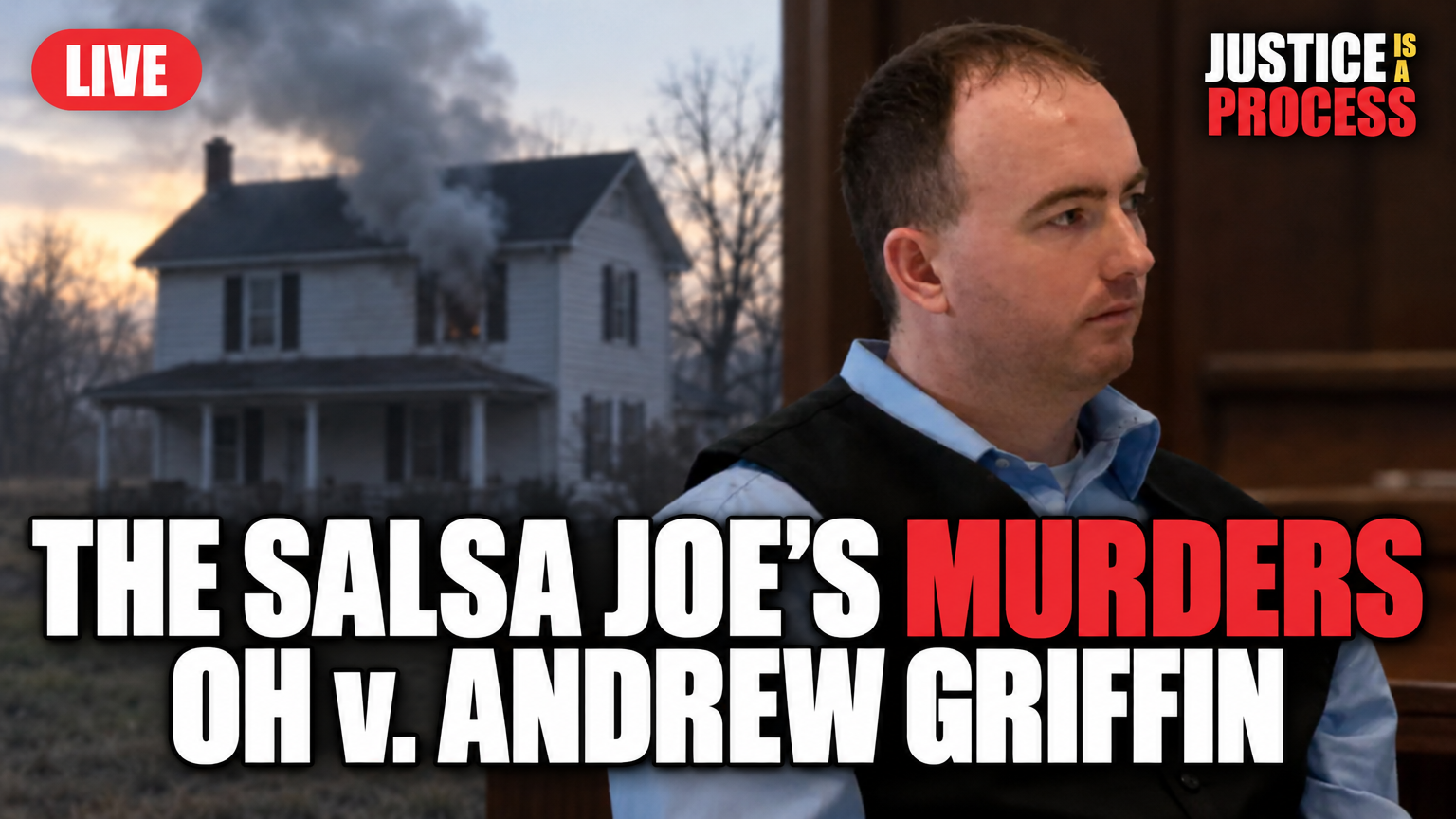
The Salsa Joe's Murders. A restaurant owner and his wife were shot in their home and the house was set on fire. Prosecutors say his former business partner came back from Oklahoma to do it. Now they have to prove the trip.
October 2026 | Justice Is A Process
Sometime before seven in the morning on Tuesday, September 21st, 2021, a neighbor on Trails End Drive, out in the rolling country near Belmont, Ohio, saw smoke coming from the second floor of a home down the road. The neighbor called 911. Fire crews came up the road and went to work on a two-story home that belonged to Tom and Angela Strussion.
When the fire was out, the firefighters found them both inside. Tom was 51. Angela was 49. Their dogs were dead too. For a few hours it looked like the kind of tragedy that happens in rural Ohio more often than anyone wants to admit: an early-morning house fire, a couple who never got out. It did not stay that way. The Ohio Bureau of Criminal Investigation came in to process the scene, officials called it suspicious, and within days Belmont County Sheriff Dave Lucas stood in front of cameras and said what the investigators already knew. This was a double homicide. Investigators say Tom and Angela Strussion had been shot before the fire was ever set.
Tom Strussion was not a stranger in the Ohio Valley. He owned Salsa Joe's restaurants, a Tex-Mex smokehouse name people around Wheeling and Belmont County knew. In May 2021, just five months before the fire, a new Salsa Joe's had opened in Elm Grove, across the river in Wheeling, West Virginia. Tom had a partner in that location. A young man from Oklahoma who had moved to eastern Ohio the fall before. His name was Andrew Isaac Griffin.
Local papers would come to call it the Salsa Joe's double homicide. It would take three and a half years for Griffin's name to mean anything to the public. Griffin had left the area a few weeks before the killings. The case went cold enough that the FBI published a national alert asking for help. Then, in February 2025, two Belmont County detectives walked into a Home Depot in Hilo, Hawaii, made eye contact with a man in a ballcap and flip-flops, and arrested him. A Belmont County grand jury had just indicted Andrew Griffin on fourteen counts, twelve of them aggravated murder. He has pleaded not guilty to every one of them, and he is presumed innocent of all of it. Nothing in this report should be read any other way.
Here is what makes this trial different from most of the murder trials we cover. Prosecutors have not told the public why. No motive has been announced. No confession has been reported. No eyewitness has been named. What the State has signaled, over eighteen months of pretrial hearings, is a case built on distance and movement: phone records and the cell towers that handled them, a theory that a man living in Oklahoma traveled back to Ohio, a motorcycle, physical items recovered in Texas, and people from Griffin's life in Oklahoma, one of whom has already been convicted of lying to detectives about this case.
On Monday, October 26th, 2026, at the Belmont County Courthouse in St. Clairsville, before Judge Chris Berhalter, twelve jurors will hear opening statements. Then, if the plan prosecutors described in court holds, those jurors will board a bus and go see the house on Trails End Drive for themselves. This is a capital case. If the jury convicts Andrew Griffin of aggravated murder with a death specification, the same twelve people could be asked to decide whether he lives or dies.
This is Justice Is A Process. We are not here to convict Andrew Griffin, and we are not here to acquit him. We are here to watch whether the State can prove, beyond a reasonable doubt, that a man who was supposed to be hundreds of miles away was standing in that house that morning. And we are here to watch whether the system does it the right way, with a man's life on one side of the scale and two people who deserve the truth on the other. Let's begin.
Let's start with what is not in dispute, because it is the only ground anyone can stand on right now. On the morning of September 21st, 2021, fire broke out at the Strussion home on Trails End Drive, a rural road in Belmont County near the village of Belmont and the Morristown area along Interstate 70. A neighbor reported smoke from the second floor before seven o'clock. Most of the damage was upstairs. When firefighters got the fire under control, they found Thomas and Angela Strussion dead inside. Their dogs, three of them by the sheriff's count, did not survive either.
The Ohio Bureau of Criminal Investigation, the state agency that handles complex scenes for local departments, processed the house. Within days, the sheriff's office announced it was investigating a double homicide. Chief Detective Ryan Allar of the Belmont County Sheriff's Office later said publicly that the couple had been shot before the fire. That single fact changes everything about the case. A fire that kills two people is a tragedy. A fire set after two people were shot is, if the State is right, an attempt to erase what happened inside that house.
That is why one of the fourteen counts against Griffin is aggravated arson. The State's position is that whoever killed the Strussions also set the fire. Whether the fire did what its setter wanted it to do, whether it destroyed evidence or preserved more than anyone expected, is one of the things this jury will learn that the public has not.
The investigation took a turn almost immediately, and it is worth knowing about because it may matter at trial. Less than a week after the killings, Belmont County deputies served a search warrant at a home on Guernsey Street in Bellaire and arrested two people, a 31-year-old man and a 25-year-old woman, on extortion charges. Investigators said the pair had been extorting Tom Strussion, threatening to expose a personal matter, and press reports said he had paid them. At the time, Sheriff Lucas said investigators were unsure whether the extortion was related to the homicide. Both later pleaded guilty to extortion and were each sentenced to prison. According to reporting at the time of Griffin's arrest, both were ruled out as suspects in the murders.
Why does that matter now? Because a defense lawyer's job in a circumstantial case is to show the jury that the investigation had other doors it could have walked through. Whether Griffin's lawyers try to open that door, and whether Judge Berhalter lets them, is something we will be watching from the first witness.
Then the case went quiet for a long time. In September 2022, a year after the fire, the FBI's Violent Criminal Apprehension Program, known as ViCAP, published a national alert on the Strussion homicides. ViCAP alerts are the federal government's way of putting a stalled case in front of every police department in the country. The alert asked anyone with information to contact Chief Allar or the FBI. That alert told the public something important: more than a year in, investigators did not have what they needed to charge anyone.
Behind the scenes, the investigation was moving west. When the sheriff's office finally announced an arrest in 2025, it thanked more than twenty agencies and individuals, and the list reads like a map. The FBI. The LeFlore, McCurtain and Choctaw County sheriff's offices in southeastern Oklahoma. The Hugo, Oklahoma, police department. The Hawaii County Police Department. The Cold Case Foundation. Detectives conducted interviews across the country. Belmont County officials have said the investigation's costs included travel and technology, which tells you something about where the evidence came from.
Two other facts from those years are part of the public record, and both will likely surface at trial in some form. In mid-2023, the Pottawatomie County Sheriff's Office in Oklahoma listed Andrew Griffin as a missing person. He had last been seen leaving a family member's home in Shawnee at the end of June. In October 2023, Houston police took him into custody at George Bush Intercontinental Airport as he got off a flight from Honduras, on outstanding Oklahoma warrants in matters that have nothing to do with this case and are not part of this trial. And in July 2024, Belmont County detectives traveled to Oklahoma to interview a man named Dalton Ray about what he knew. We will come back to Dalton Ray, because he is the only person who has been convicted of anything connected to these murders.
Here is the State's theory as it has been described in court and in public reporting, and every word of it is an allegation, not a fact. Griffin moved to eastern Ohio in the fall of 2020 and went into business with Tom Strussion at the Elm Grove Salsa Joe's, which opened in late May 2021. A few weeks before the killings, Griffin left the area and went back to Oklahoma. Investigators believe he then traveled back to Belmont County, killed Tom and Angela Strussion inside their home, killed their dogs, set the house on fire, and returned to Oklahoma. According to a December 2025 report in The Times Leader, prosecutors believe Griffin traveled to the Strussion home on a motorcycle.
That is a remarkable claim when you say it out loud. Southeastern Oklahoma to Belmont County, Ohio, is roughly a thousand miles. The State is not alleging a man drove across town. It is alleging a long trip, there and back, that nobody announced and that the State must reconstruct for twelve jurors from records, objects and witnesses. Every mile of that trip is something prosecutors must prove, and every gap in it is something the defense will point to.
In early February 2025, after roughly three and a half years, a Belmont County grand jury returned a fourteen-count indictment against Andrew Isaac Griffin and an extradition warrant was issued. On February 18th, 2025, Chief Detective Ryan Allar and Detective Sergeant Jordan Blumling were in Hilo, on the Big Island of Hawaii, with officers from the Hawaii Police Department. According to LEDE News, they found Griffin in a Home Depot, walking with his younger brother, wearing a ballcap, a white long-sleeve fishing shirt, khaki shorts and flip-flops. He made eye contact with Chief Allar. Officers took him into custody without incident. Hawaii police said he had been staying with relatives in the Puna district.
At a hearing in Hilo, a Hawaii judge denied bail, citing the allegations, over a public defender's request for a $50,000 bond. His younger brother told detectives he was not hiding him. After nearly a month in a Hawaii jail, Griffin was extradited to Ohio and booked into the Belmont County Jail in mid-March 2025, escorted in personally by Sheriff James Zusack. Before Hawaii, Chief Allar and Sergeant Blumling had made nine trips to Oklahoma and Texas. He has been held there since, a little over five miles from the courthouse where he will be tried. At his arraignment that March, Judge Berhalter read the indictment to him and told him that, if he were convicted of aggravated murder, capital punishment could apply. Griffin pleaded not guilty.
Thomas Strussion's sister, Lisa Balog, spoke to WTOV9 after the arrest about what those years had been like for the family. "Every day in the past three and a half years, honestly, feel like the day it happened," she said. Former Sheriff Dave Lucas, who had retired at the end of 2024 and returned for the announcement, said: "I had in my heart, if anybody was going to solve it, it was going to be our people."
It is too easy, in a case like this, for the victims to become a pair of names in a caption. Tom and Angela Strussion were a married couple in their late forties and early fifties, living in a two-story home on a quiet road in the county where Tom had built a business. Tom Strussion owned Salsa Joe's restaurants, including a location on National Road east of Morristown, and he had just expanded into Elm Grove in Wheeling. Running restaurants in the Ohio Valley is not a glamorous life. It is long days, thin margins and a lot of people who depend on you. The Strussions' dogs were part of that household, and their deaths are part of why this case hit this community the way it did.
Their family has waited more than five years for a jury to hear this case. Lisa Balog has spoken publicly for them. Her words after the arrest were not about vengeance. They were about the passage of time: every day feeling like the first one. Whatever this jury decides, it will not give those years back. What the system owes the Strussion family is a trial done right, one whose verdict holds up, so that they never have to go through it twice.
Andrew Isaac Griffin is 34. He is a native of Whitesboro, a small community in LeFlore County in southeastern Oklahoma, and before Ohio he worked in the oil and gas fields of Oklahoma and Texas, according to LEDE News. He came to Belmont County in the fall of 2020, at 28, and became an investor in Salsa Joe's Smokehouse and Tom Strussion's partner in the Elm Grove location. He shows up in the restaurant's social media photos from that fall through late July 2021. Former employees told LEDE News he left the area well before the murders. He was living in Hawaii with relatives when he was arrested. He has no public statement on the case. He filed an affidavit of indigency, which is a sworn statement that he cannot afford a lawyer on his own, and the court has released public funds for parts of his defense, including a mitigation specialist.
Through eighteen months of pretrial hearings, Griffin appeared in court with a long red beard and a handlebar mustache. At jury selection on October 21st, 2026, he appeared clean-shaven, in a dark vest and a light blue shirt, seated between his lawyers. That is a normal thing for a defendant to do before a jury sees him. It is also a reminder of what this trial is. The twelve people in that box are deciding about the man in front of them, on the evidence in front of them, and nothing else.
Andrew Griffin is presumed innocent. That presumption is not a courtesy. It is the law, and it stays with him through every witness until a jury decides otherwise, if it ever does.
Dalton Ray is not on trial here, but his name will be heard. Ray, a man from Broken Bow, Oklahoma, was interviewed twice by Belmont County detectives in Oklahoma in 2024. After the first interview, detectives concluded that what he told them was untrue. In the second, prosecutors say, he lied again, and this time detectives confronted him with evidence that contradicted him. He ran from officers, led them on a high-speed chase in Oklahoma, was caught, served time in Texas on a probation violation, and was extradited to Belmont County. On June 3rd, 2025, a Belmont County jury convicted him of obstructing justice, a third-degree felony. Judge Berhalter sentenced him to 30 months in prison.
Prosecutor Kevin Flanagan has said Ray lied to detectives about knowing Griffin and about the Strussion deaths. Assistant Prosecutor Joe Vavra has said Ray has no connection to the Ohio Valley and was assisting Griffin. Prosecutors refused to say publicly what Ray lied about, to avoid, in Flanagan's words, prejudicing "future jurors in the next trial as it relates to the homicides of the Strussions." Whether Ray testifies, what he says if he does, and whether his credibility can survive cross-examination after a conviction for lying to these same detectives, may decide a great deal.
The Court: Judge Chris Berhalter of the Belmont County Court of Common Pleas, who has presided over this case since Griffin's arraignment, held monthly pretrial hearings, and also presided over Dalton Ray's case. His courtroom is on the third floor of the Belmont County Courthouse in St. Clairsville.
The Prosecution: Belmont County Prosecutor Kevin Flanagan, with Assistant Prosecutor Joe Vavra, who tried the Dalton Ray case. Flanagan won the Republican primary for a seat on the Belmont County Common Pleas bench in May 2026 and is expected to leave the prosecutor's office to become a judge. This may be one of the last cases he tries.
The Defense: Kate Clark and Samuel H. Shamansky of the Samuel H. Shamansky law office in Columbus, a criminal defense firm. Earlier in the case, the Ohio Public Defender's office was involved in Griffin's representation.
The Investigators: Chief Detective Ryan Allar and Detective Sergeant Jordan Blumling of the Belmont County Sheriff's Office, who worked the case for more than three years and made the arrest in Hawaii. Sheriff James Zusack, who was chief deputy at the time of the killings, has said publicly: "It's a very complex case, and there will be more surprises."
Griffin faces fourteen counts. Here is what each means in plain English. Not what the State has proven, because nothing has been proven yet.
Twelve counts of aggravated murder for two deaths sounds like a mistake. It is not. Ohio prosecutors routinely charge the same killing under several different legal theories, so that if a jury rejects one theory but accepts another, the case does not collapse on a technicality. According to Prosecutor Flanagan, six of the twelve counts relate to Tom Strussion and six to Angela Strussion. If Griffin were convicted on more than one count for the same victim, Ohio law would merge them for sentencing. Twelve counts does not mean twelve sentences. It means the State has given the jury several ways to reach the same conclusion.
What it means: Aggravated murder is Ohio's most serious crime. The State can prove it in different ways. One is that the defendant purposely killed someone with prior calculation and design, meaning a plan formed in advance, not a sudden act. Another is that the defendant purposely killed someone while committing or fleeing certain serious felonies, including aggravated burglary and aggravated arson. The public reporting describes "various counts" of aggravated murder; the exact theory behind each count will become clear in the jury instructions.
What the State must prove: That Tom and Angela Strussion are dead. That Andrew Griffin caused their deaths. That he did it purposely. And, depending on the count, either that he planned it in advance or that he did it during an aggravated burglary or aggravated arson.
Potential sentence: This case has been described in court and in the press as a capital case. If the jury convicts on aggravated murder and also finds a death-penalty specification proven beyond a reasonable doubt, the case moves to a separate penalty phase, where the possible sentences are death, life without parole, or life with parole eligibility after 25 or 30 years. Without a proven specification, the sentence is life in prison with parole eligibility set by the court.
The burden: Entirely on the State. Griffin does not have to prove anything.
What they are: In Ohio, a death sentence is only possible if the indictment charges, and the jury finds, at least one "aggravating circumstance" listed in the statute. Two on that list fit the allegations as publicly described: killing two or more people as part of the same course of conduct, and killing someone while committing aggravated burglary or aggravated arson. Local reporting describes the twelve aggravated murder counts as carrying specifications of aggravating circumstances based on a course of conduct, and at arraignment Prosecutor Flanagan explained that the State also alleges the killings happened during a burglary and an aggravated arson.
Why it matters: If the State proves a specification, the jury does not go home after the verdict. It comes back and hears evidence about Andrew Griffin's life, his background, and anything that might weigh against a death sentence. That is what a mitigation specialist prepares for.
What it means: Knowingly using fire to create a substantial risk of serious physical harm to a person, or to cause physical harm to an occupied structure.
What the State must prove: That the fire at the Strussion home was set on purpose, not accidental, and that Griffin is the person who set it.
Potential sentence: A first-degree felony in its most serious form, carrying an indefinite prison term under Ohio's sentencing law, with a minimum of three to eleven years.
The burden: Entirely on the State.
What it means: Trespassing in an occupied home, by force, stealth or deception, with the purpose of committing a crime inside, while either inflicting or threatening physical harm or carrying a deadly weapon.
What the State must prove: That Griffin entered the Strussion home without permission, that he meant to commit a crime there, and that he caused harm or had a weapon. This count matters beyond its own sentence, because it can also be the felony that turns a killing into aggravated murder and supports a death specification.
Potential sentence: A first-degree felony, carrying an indefinite prison term with a minimum of three to eleven years.
The burden: Entirely on the State.
What they mean: A firearm specification is an add-on to a charge. It asks the jury a separate question: did the defendant have a firearm and display it, brandish it, use it, or indicate that he possessed it while committing the offense? WTOV9 reported that the indictment carries firearm specifications.
Potential sentence: A mandatory three years, served before and in addition to the sentence for the underlying crime.
Every case that reaches a jury is there for a reason. This one is at trial because the State says Andrew Griffin came back to Ohio from Oklahoma, killed his former business partner and his partner's wife, set their house on fire and left again, and it has to prove that trip without any public confession, any public eyewitness or any public motive. What it has instead, as far as the public record shows, is a case built from location records, physical items, and the people around Griffin, at least one of whom has already been convicted of lying to the detectives who built it.
That is not a weakness to wave away and it is not a strength to assume. Circumstantial evidence convicts people every day in this country, and the law treats it the same as direct evidence. Fingerprints are circumstantial. DNA is circumstantial. A chain of small facts, each one ordinary on its own, can add up to proof beyond a reasonable doubt. But the chain has to hold at every link. When the State's case is a journey, the jury is entitled to ask about every mile of it.
The clearest window into the prosecution's case is what it has asked the court for. In October 2025, Prosecutor Flanagan asked Judge Berhalter to let the jury visit the Strussion home, the surrounding terrain, and four cell phone towers that had handled the defendant's phone. "We believe that it would assist the jurors in seeing where the towers" are, he said. By August 2026, after consulting detectives, the State narrowed the request: "one tower near the house and the house, and that is it." Flanagan asked that the jury take that trip right after opening statements, on the first day of trial.
Think about what that tells you. A prosecutor does not put a jury on a bus to look at a cell tower unless the location of a phone near that house is central to the case. The State wants the jurors to see, with their own eyes, how close that tower is to Trails End Drive, before they hear a single expert explain what a tower record can and cannot prove.
In July 2025, both sides told the court to expect digital evidence, which they said could mean cell phone data, video, or both. Other filings fill in the outline. The State asked the court to require Griffin to disclose any alibi early, and both sides agreed to a deadline of November 30th, 2025. The State asked the court to decide a question of spousal privilege for a witness, the rule that can let a spouse refuse to testify against a spouse. The State asked to present an Oklahoma witness by video deposition because he has a serious medical condition and depends on oxygen; the defense opposed it. In May 2026, the State disclosed it had learned of a new physical piece of evidence that required a subpoena. In September 2026, prosecutors told the court that physical items had been recovered in Texas and were in the sheriff's custody, with photographs given to the defense, and that the State had prepared about 155 exhibits, many with multiple parts.
The defense has not laid out its theory in public, and it does not have to. What its filings show is a defense contesting the State's chosen method of telling the story. Kate Clark opposed the tower trip, arguing it was not "the best use of jurors' time and resources" and that the towers could be shown on a map, and she questioned how useful it would be for jurors to see a tower in relation to the crime scene. She opposed the use of a previously recorded deposition. And the alibi notice deadline tells you the defense was at least asked to say whether it will claim Griffin was somewhere else.
Expect the defense to attack every link in the travel chain: what the phone records can actually show, who had the phone, what a motorcycle theory requires, whether the Texas items connect to this crime, and whether witnesses from Griffin's past have reasons of their own to say what they say. Expect it to remind the jury that this investigation took three and a half years, and that the first people arrested in connection with Tom Strussion that September were not Andrew Griffin.
No suppression ruling or major evidence exclusion has been reported in the press. The pretrial record is mostly the record of a capital case being prepared: an indigency affidavit, public funds released for a mitigation specialist, monthly hearings, juror questionnaires sent to 500 people before Christmas 2025, and a trial date that moved from July 2025, to March 2026, to October 19th, 2026, and finally to October 26th after both sides told the court no plea agreement had been reached by the September 25th deadline. Jury selection was moved out of the courthouse to Dowler Hall at Belmont College because of the size of the pool. On October 21st, after more than seven hours, twelve jurors and two alternates were seated.
Is the burden of proof being respected? In a case without a public confession or eyewitness, the pressure to fill gaps with assumptions is enormous, in the courtroom and outside it. The State has to prove the trip. The defense does not have to disprove it.
The science of a cell tower. Cell site evidence is powerful and widely misunderstood. A record that a phone connected to a particular tower does not put that phone in a particular living room. Towers cover areas, sometimes miles across, and which tower a phone uses depends on terrain, load and signal. Since the Supreme Court's 2018 decision in Carpenter v. United States, police generally need a warrant to obtain historical cell location records. We will be watching how those records were obtained, how the State's expert explains them, and how hard the defense presses on what they cannot show.
The jury view. A jury view is not evidence in the ordinary sense. It is meant to help jurors understand evidence they will hear. But a view on day one, right after opening statements, shapes everything that follows. We will be watching what the bailiff is allowed to say, what the jurors are shown, and whether the view stays a view.
Witnesses with their own exposure. A witness already convicted of lying to these detectives, witnesses who may have reasons to cooperate, a witness who may testify by video because he cannot travel. The Sixth Amendment gives Andrew Griffin the right to confront the witnesses against him. Cross-examination is how our system tests a witness, and in this case it may be the whole ballgame.
The stakes of a capital case. Ohio has not carried out an execution since Governor Mike DeWine took office in 2019; he has continued to issue reprieves, most recently pushing scheduled executions into 2029, citing problems obtaining execution drugs. A death sentence is still a death sentence, and a capital trial still demands the most careful process the system has. Every protection matters more here, not less. That is the standard we will hold this courtroom to.
This channel carries the legacy of Steven M. Askin, a West Virginia criminal defense attorney who was himself prosecuted, and who spent his life teaching people that their rights are only real if somebody insists on them. The standard we hold every courtroom to comes from him: the system is only as good as its willingness to prove what it claims, the right way, every time. A capital trial built on circumstantial evidence is exactly where that standard gets tested.
The trial is expected to last about eight court days, though the sheriff has said it could run longer. The State has prepared roughly 155 exhibits and expects out-of-state and expert witnesses. If the jury convicts on aggravated murder with a death specification, a penalty phase would follow before the same jury.
Live broadcasts. No Breaks editions. Justice Breakdowns every night.
The defendant is presumed innocent until proven guilty beyond a reasonable doubt.
Let's watch the system together.
Starting Monday, October 26th, we will follow this trial as it happens, from opening statements through verdict, and through a penalty phase if there is one. You will get live coverage of the courtroom as the proceedings unfold, No Breaks editions for anyone who wants the full day without the dead air, the Case Story trial podcast that walks through the testimony piece by piece, Key Moments for the exchanges that matter most, and Justice Breakdowns with deeper analysis after each day. Members of the channel get the case notebook, where you can question the record yourself.
This is not about guessing what happened inside that house on Trails End Drive. It is about watching whether the State can prove, mile by mile, the trip it says Andrew Griffin made, and whether a capital trial in a small Ohio county gives a defendant every protection the Constitution promises while giving the Strussion family the honest answer they have waited five years for. Tom and Angela Strussion deserve the truth. Andrew Griffin deserves a fair trial. Those two things are not in conflict. A trial done right delivers both.
The defendant is presumed innocent until proven guilty beyond a reasonable doubt. That is not a technicality. That is the foundation of everything we do here.
Subscribe to Justice Is A Process on YouTube for live trial coverage, No Breaks editions, and breaking news as it happens.
🔴 Subscribe on YouTube86,000+ subscribers watching the system with us
Discussion