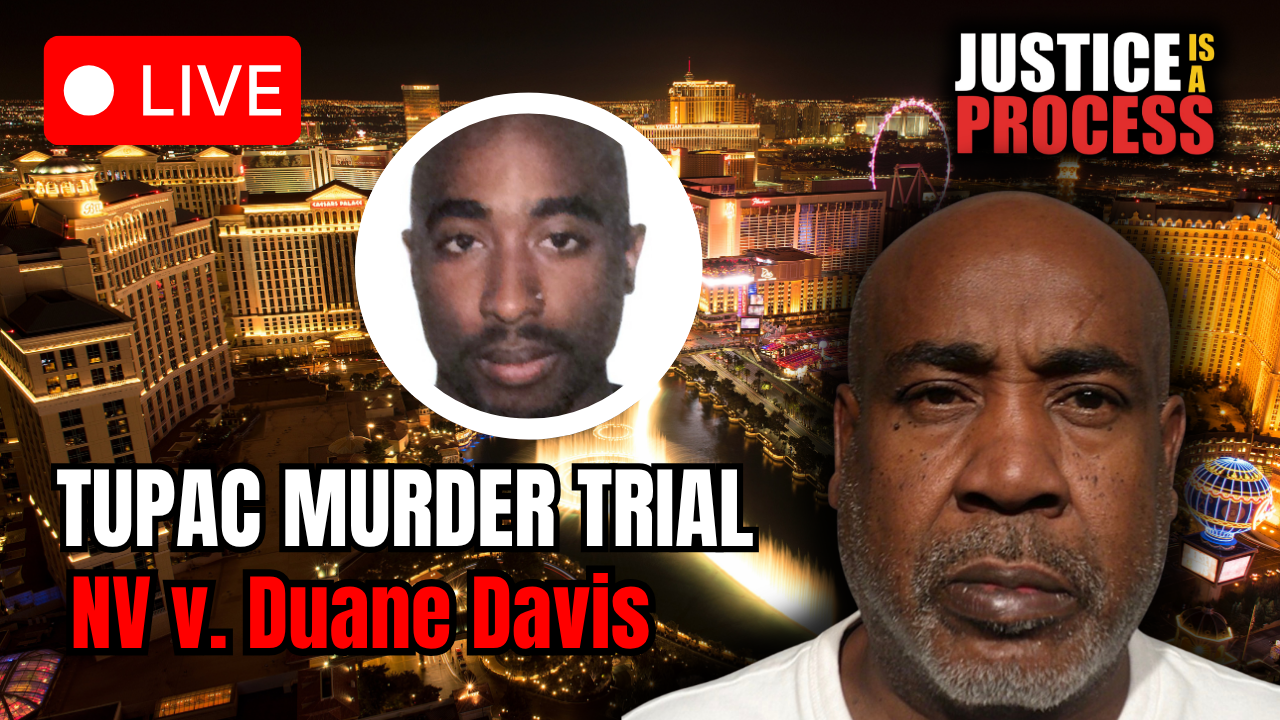
Thirty years, no gun, no DNA, no living eyewitness. The State's best evidence is a book the defendant wrote about himself.
August 2026 | Justice Is A Process
On the night of September 7th, 1996, a black BMW sedan sat at a red light on East Flamingo Road in Las Vegas, a few blocks off the Strip. It was a little after eleven o'clock. The car was full. Suge Knight was driving. In the passenger seat sat a twenty five year old man who had already changed American music and was not close to finished.
A white Cadillac pulled up on the right side.
Someone inside that Cadillac fired thirteen shots. Four of them hit Tupac Amaru Shakur. One went through his lung. He fought for six days at University Medical Center in Las Vegas, and on September 13th, 1996, his heart stopped. He was twenty five years old.
For twenty seven years, nobody was charged. Not one person. The case sat in a Las Vegas evidence room and turned into something else, something worse than an unsolved murder. It turned into a story. It became documentary fodder and message board theory and conspiracy content and album mythology. The man in the passenger seat stopped being a person who was killed and started being a legend who vanished, which is a very convenient thing to happen to a homicide file that nobody was closing.
Then, in 2023, the Clark County District Attorney's office did something nobody expected. They indicted a sixty year old man from Compton named Duane Keith Davis, who goes by Keffe D. They did not say he pulled the trigger. They have never said he pulled the trigger. They say he was the one who gave the order and handed over the gun.
And here is the part that makes this trial unlike almost any murder trial you will ever watch.
The State's case is built, in large part, out of Duane Davis's own mouth. He sat down with law enforcement in 2008 and talked. He went on YouTube interviews and podcasts and talked. And in 2019 he published a memoir called Compton Street Legend, a book that opens in Las Vegas on the night of September 7th, 1996, and walks the reader through his account of how a confrontation with Tupac Shakur and Suge Knight was planned and carried out.
He told this story for years. Now the State of Nevada intends to read it back to him in front of twelve jurors and ask them to call it a confession.
His defense is going to be, in essence, that he was lying the whole time. That the book was a hustle. That the interviews were a man selling a persona to people who wanted to buy one. That he inflated his role in the most famous unsolved murder in American popular culture because that is what sold, and a jury should not send a sixty three year old man to prison for the rest of his life over a story he told to move units.
That is the case. That is the whole fight.
Opening statements begin Monday, August 17th, 2026, in Clark County District Court in Las Vegas. Duane Davis has pleaded not guilty. He is presumed innocent, and that presumption is not a formality we recite before we get to the fun part. In this case it is the entire question. The State has to prove this beyond a reasonable doubt, and it has to do it without the gun, without DNA, without the alleged shooter, and without a single living eyewitness who will get on that stand and say they watched Duane Davis order a murder.
We are not here to convict him and we are not here to acquit him. We are here to watch whether the State of Nevada can actually carry a burden this heavy, this long after the fact, with the evidence it actually has.
This is Justice Is A Process. Let's begin.
To understand the charge, you have to understand that the State is not telling a story about a man with a gun. It is telling a story about a man with authority. Everything the prosecution intends to prove flows from that distinction, so let's walk it in order.
September 7th, 1996 was a fight night in Las Vegas. Mike Tyson fought Bruce Seldon at the MGM Grand Garden Arena for the WBA heavyweight title. Tupac Shakur and Suge Knight, the head of Death Row Records, had front row seats. The fight itself was over in under two minutes. Tyson knocked Seldon out in the first round.
Around 8:50 that evening, in the public area between the arena and the casino floor, the night turned. Somebody in Shakur's group spotted a man named Orlando Anderson. Anderson was, according to law enforcement, associated with the South Side Compton Crips. There was existing bad blood involving a Death Row associate and an incident at a mall in Lakewood, California.
What happened next was captured on hotel surveillance and has been public for decades. Shakur confronted Anderson and struck him. Anderson went down. Members of the Death Row entourage, according to accounts of the video, joined in while Anderson was on the ground. The beating lasted seconds. Security broke it up. Anderson did not file a complaint that night and Shakur was not arrested.
The State's position is that everything that happened two hours later happened because of those seconds.
Prosecutors allege that Duane Davis, then in his thirties and described by the State as a leader within the South Side Compton Crips, was in Las Vegas that weekend, learned that his nephew Orlando Anderson had been beaten down in public by Tupac Shakur's group, and set out to answer it.
According to the indictment and the State's public filings, Davis obtained a firearm, and he and three other men, including Anderson, got into a white Cadillac. The allegation is that Davis was the one who put the gun into the car and directed what happened with it. Chief Deputy District Attorney Marc DiGiacomo has described Davis in court as the on ground, on site commander who ordered the death of Tupac Shakur.
That phrase matters. Commander. Not shooter.
Shortly after eleven o'clock, the black BMW carrying Knight and Shakur stopped at the intersection of East Flamingo Road and Koval Lane, near the Maxim Hotel. The white Cadillac pulled alongside on the passenger side. Shots were fired from the Cadillac into the BMW.
Shakur was struck four times, in the chest, in the arm and in the thigh, with one round entering his right lung. Knight was grazed. The BMW attempted to flee and was stopped a short distance away. Shakur was taken to University Medical Center of Southern Nevada, where surgeons removed his right lung. He survived six days on life support. On September 13th, 1996, he died of respiratory failure and cardiopulmonary arrest connected to his gunshot wounds.
The Cadillac was never recovered in a way that produced a prosecutable case. The gun has never been found. No physical forensic evidence has ever publicly tied any specific individual to the shooting.
The Las Vegas Metropolitan Police Department investigated in 1996 and got almost nothing it could take to a grand jury. Witnesses would not talk. The people in the BMW would not cooperate in a meaningful way. Orlando Anderson denied involvement, was questioned, and was never charged. Shakur's mother, Afeni Shakur, filed a civil suit against Anderson, but it was never resolved on the merits, because in May of 1998 Orlando Anderson was himself shot and killed in Compton in a dispute that police said was unrelated.
The man most widely suspected of firing the shots died twenty five years before this trial. He cannot confirm anything. He cannot deny anything. He cannot be cross examined. Hold onto that, because it shapes everything about how this case has to be proved.
It is tempting to treat the thirty year gap as a mystery. It is not much of one, and understanding why matters, because the failures of 1996 are the reason the evidence in 2026 looks the way it does.
Start with the victim's own side. Tupac Shakur was shot in a car full of people, on a public street, in a city full of cameras, in front of witnesses. And the people closest to him would not talk to police. The relationship between Death Row Records and law enforcement was, to put it gently, not cooperative. Suge Knight, who was in the driver's seat, did not give investigators the kind of account that builds a case. Members of the entourage scattered. A security detail that was following the BMW did not produce the breakthrough either.
Then there is the wider environment. In the community where investigators needed to work, talking to police carried real and immediate danger. That is not an abstraction and it is not a stereotype. It is why nobody who could have identified the occupants of that Cadillac in 1996 was willing to sit down and do it. The murder of Christopher Wallace six months later in Los Angeles, also unsolved, also surrounded by the same wall of silence, tells you the same story from the other direction.
And then there is the police work itself, which has been criticized for decades. The Cadillac was not recovered in time to be useful. Physical evidence that a modern investigation would have preserved was not preserved. Leads went cold while jurisdictions argued about who owned what. Some of the officers who did the original work are now dead.
So when the defense stands up on Monday and starts listing what the State does not have, remember that most of what it does not have was lost in 1996, not in 2026. That cuts both ways. It explains why the prosecution is leaning on a memoir. It also means the man on trial is being asked to defend himself against a case built out of a record that the State itself allowed to decay.
The case sat. And in the years it sat, Duane Davis began to speak.
In 2008 and 2009, Davis was interviewed by law enforcement in connection with a federal and Los Angeles task force effort that was looking at, among other things, the murder of Christopher Wallace, known as The Notorious B.I.G. Davis has consistently maintained that he talked in that setting under a proffer arrangement, the kind of session lawyers sometimes call a queen for a day, in which a person's statements are supposed to be shielded from being used against them. In that interview, Davis discussed the night of September 7th, 1996, and his account of who was in the Cadillac and how the gun got there.
That interview was not public at the time. It sat in a file. What changed everything was that Duane Davis decided to say the same things with a camera running.
In February 2018, BET aired a documentary series called Death Row Chronicles. Davis appeared in it. On camera, he described being in the front seat of a white Cadillac in Las Vegas in 1996 when someone in the back seat opened fire on a black BMW carrying Tupac Shakur and Suge Knight.
That broadcast is the hinge of this entire case. According to reporting on the investigation, the Las Vegas Metropolitan Police Department responded to that documentary by spending months pulling the entire case back apart and reviewing it from the beginning. A cold case that had been effectively dormant for two decades became active again because the man now on trial went on television and put himself in the car.
Then, in February 2019, he published Compton Street Legend. It is not a coded book. It opens on that night in Las Vegas. It gives the reader a first person account of the retaliation plan, including obtaining a firearm and going out to look for Shakur and Knight. A Las Vegas detective working the reopened case came across the memoir and used material from it in the investigation.
He also kept giving interviews. Video interviews, podcast appearances, the kind of content that gets clipped and circulated. Over and over, for years, he positioned himself as the last man alive who knew what happened to Tupac Shakur.
On July 18th, 2023, Las Vegas police executed a search warrant at a home in Henderson, Nevada, connected to Davis's wife, as part of the reopened investigation. Two months later a Clark County grand jury returned an indictment. On September 29th, 2023, Duane Davis was arrested while out on a walk near his home. He was charged with one count of murder with use of a deadly weapon. On November 2nd, 2023, he pleaded not guilty.
Since his arrest he has given at least one jailhouse interview asserting his innocence, which means the man whose recorded words are the centerpiece of the prosecution has continued to generate recorded words while awaiting trial on them.
He was twenty five years old when he died, and it is worth stopping on that number, because the cultural weight of the name can make people forget how young he actually was.
Tupac Amaru Shakur was born in East Harlem in 1971 and named after an eighteenth century Peruvian revolutionary. His mother, Afeni Shakur, was a Black Panther who represented herself in a criminal trial in New York and was acquitted while pregnant with him. He grew up between New York, Baltimore and the Bay Area, and he trained as a performer at the Baltimore School for the Arts, studying acting, poetry and ballet.
By the time he was killed he had released a run of albums that remain foundational to American music, and he had acted in a half dozen films. He was also, in the last years of his life, a man moving through real legal jeopardy and real danger, including a 1994 shooting in New York and a criminal conviction that sent him to prison before Death Row Records posted his appeal bond.
None of that is why this trial matters. This trial matters because he was a human being who was shot four times at a stoplight and died six days later, and for thirty years the legal system did not answer for it. His family has waited thirty years. Whatever the jury decides, that wait is the true measure of this case.
We are going to be careful about something in this coverage. There is an enormous industry built on Tupac Shakur's death, and a lot of it treats him as content rather than as a homicide victim. We are not doing that. He is the reason there is a courtroom.
There is also a family here that most coverage forgets. Afeni Shakur spent years trying to get someone held responsible for her son's killing, including a civil suit against Orlando Anderson that never resolved. She died in 2016, seven years before anyone was charged. She never saw an arrest. Whatever this jury decides, it decides it too late for the person who fought hardest for it.
Duane Keith Davis is sixty three years old. He is from Compton, California. Law enforcement has for decades described him as a figure of authority within the South Side Compton Crips in the 1990s. He is the uncle of Orlando Anderson, the man long suspected of firing the shots that killed Shakur.
He has serious health problems. He has told the court he has battled cancer. He has spent the bulk of the time since his 2023 arrest in custody.
He is also the author of a book about his own life in which he places himself in the middle of this killing, and that fact is the reason he is on trial rather than at home.
He has pleaded not guilty. He is presumed innocent. Under Nevada law and under the United States Constitution, he does not have to prove anything, he does not have to testify, and if he never says a word in that courtroom the jury may not hold it against him. The entire burden sits with the State.
Orlando "Baby Lane" Anderson was in his early twenties in 1996. He denied any involvement in Shakur's death. He was never charged with it. He was killed in Compton in May 1998 in what police described as an unrelated shooting.
He is the ghost in this trial. The State's theory requires the jury to accept a great deal about what Anderson did in that Cadillac, and Anderson is not available to be examined by anyone.
The Judge: District Court Judge Carli Kierny is presiding. She has already made the rulings that shaped this trial, including the decision that Davis has no immunity from prosecution in Nevada and the decisions admitting the memoir and the 2008 law enforcement interview into evidence.
The Prosecution: Chief Deputy District Attorney Marc DiGiacomo is leading for the State. DiGiacomo is one of the most experienced homicide prosecutors in Clark County and has handled some of the highest profile cases in the jurisdiction.
The Defense: Attorney Michael Sanft is representing Davis, and has said publicly that he is doing so without charging a fee.
The Witnesses: More than two hundred names were released on the witness list, and roughly forty witnesses are expected to actually be called. Two are worth flagging now. Marion "Suge" Knight, who was driving the car, is on the list. So is Joe Lombardo, the sitting Governor of Nevada, who was a Las Vegas Metropolitan Police officer in 1996 and later served as Clark County Sheriff during the investigation that produced this indictment.
Marion "Suge" Knight was driving the BMW. He was hit by shrapnel or a fragment that night. He was three feet from Tupac Shakur when Tupac Shakur was shot. He is, as far as anyone knows, the only living person who watched the drive by happen from inside the target vehicle.
He is sixty one years old and he is serving a twenty eight year sentence for voluntary manslaughter arising out of a 2015 hit and run that killed a man in Compton. That case is entirely unrelated to this one, but it means the State's most obviously important eyewitness arrives, if he arrives at all, as a convicted felon in custody.
And he has said publicly that he will not help.
In an interview from prison ahead of the trial, Knight said this trial has nothing to do with him, and warned that if somebody brings him in, it is going to hurt whoever brings him. He framed his refusal in terms of loyalty and principle: that his loyalty to Tupac cannot be compromised, and that he will not be responsible for sending another man to prison for the rest of his life.
Sit with the strangeness of that for a second. The man who was driving the car when Tupac Shakur was shot is refusing to help convict the man accused of ordering it, and is invoking his loyalty to Tupac as the reason.
Whether Knight is called, whether he refuses on the stand, whether the court compels him, and what happens if he simply will not answer are among the most consequential open questions of this trial. A hostile or silent Suge Knight in front of that jury would be one of the most extraordinary moments in an American courtroom in years. It would also tell the jury something the defense very much wants them to notice: that the people who were actually there are not the ones building the State's case.
There is one count. That is unusual for a case this size, and it is worth understanding exactly what it does and does not require.
What it means: The State alleges that Duane Davis is criminally responsible for the killing of Tupac Amaru Shakur, and that a deadly weapon was used in that killing. Nevada law does not require the State to prove Davis personally fired the gun. Under theories of aiding and abetting and conspiracy, a person who helps plan, orders, or provides the means for a killing can be held responsible for it as though they committed it themselves.
What the State must prove: That Tupac Shakur was unlawfully killed. That the killing was willful, deliberate and premeditated, or otherwise qualifies as first degree murder under Nevada law. That Duane Davis participated in that killing by aiding, abetting, counseling, encouraging or conspiring in it, with the intent that it happen. And that a deadly weapon was used.
The enhancements: The grand jury added sentencing enhancements for the use of a deadly weapon and for the allegation that the act was committed with the intent to promote, further or assist a criminal gang. These are not separate crimes. They are add ons that increase the sentence if there is a conviction on the underlying count.
Potential sentence: Prosecutors have said they are not seeking the death penalty. A conviction on first degree murder in Nevada carries potential sentences up to life in prison, and the enhancements can add substantial additional time on top of whatever the base sentence is. For a sixty three year old man, any of those outcomes is functionally a life sentence.
The burden: Entirely on the State, beyond a reasonable doubt, on every element. Davis proves nothing.
People are going to hear that the State does not claim Davis fired the gun and assume that ends the case. It does not, and it is important that our audience understands why.
In Nevada, as in nearly every state, the law treats the person who plans a murder and the person who carries it out as equally responsible. If you drive the car, hand over the weapon, pick the target, and tell someone to go do it, the law does not give you a discount for keeping your own hands clean. That is what aiding and abetting means. That is what conspiracy liability means.
So the fight is not really about whether Davis was the shooter. The fight is about whether the State can prove that Davis did any of those other things, and whether the evidence it is using to prove them is worth believing.
The gang allegation is doing more work in this case than most people will realize, and it deserves its own explanation.
On its face, an enhancement for acting with intent to promote, further or assist a criminal gang is a sentencing add on. If the jury convicts and finds the enhancement true, the judge can stack additional years on top of the murder sentence. That is the formal function.
The practical function is different and more important. The gang allegation gives the State permission to put an entire world in front of the jury. Testimony about the South Side Compton Crips, about how such organizations are structured, about what status and authority mean inside them, about the obligation to answer a public humiliation with violence. That is the connective tissue the State needs, because without it, a beating at a casino and a shooting two hours later are just two events on the same night. With it, they become cause and effect, and Duane Davis becomes a man with both a motive and the standing to give an order.
The defense sees the same thing from the other side, which is why gang evidence is fought so hard in pretrial motions. Evidence about gangs is powerful, prejudicial, and can invite a jury to convict a man for who he associated with thirty years ago rather than for what the State actually proved he did on one specific night. Watch how much of the trial is spent on the organization versus on the individual. That ratio tells you a lot about the strength of the underlying case.
Every case that reaches a jury reaches it for a reason. Something is genuinely contested. Here, the contested thing is unusually clean, and you should carry it with you through every day of testimony.
This case is at trial because the only evidence strong enough to charge anyone, thirty years later, is the defendant's own voice. Duane Davis spent years telling the story of how he says he orchestrated the killing of Tupac Shakur, in a published memoir and in a recorded interview with law enforcement, and the State is betting that a jury will believe the boastful storyteller over the defendant now sitting at counsel table insisting that none of it was true.
That is the whole trial. Not forensics. Not eyewitnesses. Not a murder weapon. A man's words about himself, and the question of whether words spoken to sell a book and build a reputation can carry the weight of a first degree murder conviction.
There is a second, honest reading of this case, and we are going to hold it alongside the first rather than pretend it does not exist. It can also be read as a cold case prosecution of convenience. The alleged shooter has been dead since 1998. There is no gun, no DNA, and no living eyewitness who will name Davis from the stand. The State may simply be reaching for the last living, talking figure connected to the most famous unsolved murder in American culture, in a case that produced enormous public and institutional pressure to close it. Whether that reading holds up is exactly what the evidence over the next several weeks will tell us.
The prosecution's theory is straightforward and it has the advantage of being a story a jury can follow. A man's nephew got beaten in public. That man had status in an organization built on answering exactly that kind of humiliation. Within two hours, the person who administered the beating was shot at a stoplight. And for the next twenty three years, the man in question told people, on tape and in print, that he was the one who made it happen.
DiGiacomo will ask the jury a simple question: why would a man confess repeatedly, in detail, to a murder he did not commit?
The State's evidence will center on the 2008 law enforcement interview, the 2019 memoir, and the various recorded interviews Davis gave over the years. Around that core it will build the 1996 context: the surveillance of the MGM Grand fight, the responding officers, the medical evidence of how Shakur died, and whatever witnesses remain who can establish who was where that night.
Michael Sanft's position, telegraphed through years of pretrial motions and public statements, is that Duane Davis is a storyteller, not a killer, and that the State has confused the two.
The defense argument runs roughly like this. Davis was selling a product. In the true crime and hip hop media economy, the man who claims to know what happened to Tupac Shakur is worth something, and the man who claims he made it happen is worth more. The book was written for money. The interviews were given for attention. He inflated, embellished, and in places invented. And a jury should not convert a hustle into a homicide conviction, particularly when the State cannot corroborate the confession with a single piece of physical evidence.
Expect the defense to hammer relentlessly on the gaps. No gun. No DNA. No fingerprints. No ballistics tying anything to anyone. No surviving eyewitness. A dead alleged shooter. A thirty year old investigation whose original witnesses are dead, unavailable, or have told different stories at different times.
Expect them, too, to attack the reliability of memory and of the record itself. Thirty years is a very long time. Documents get lost. Officers retire and die. The State's ability to prove what was said in 1996 is not what it would have been in 1997.
We should be honest about the difficulty of the position Michael Sanft is in, because it is not a comfortable one.
The "I was lying for money" defense is legally coherent and it is factually plausible. People absolutely do embellish their proximity to famous crimes. There is a whole economy that rewards it. Sanft can point to a real financial motive for exaggeration, and he can point to the fact that Davis's accounts have not been identical every time he has told them.
But it asks the jury to do something psychologically hard. It asks twelve people to accept that a man voluntarily confessed, in print and on camera, to helping murder one of the most famous people in the world, knowing that police in two states were still interested in that murder, and did it anyway because a book advance was worth the risk. Jurors have to believe not just that he lied, but that he lied in the single most dangerous way a person could possibly lie.
The counter to that is the counter the defense will lean on hardest: he did it because he did not believe he could ever be charged. He thought he had immunity from the 2008 session. He thought the case was dead. He thought he was safe, so he sold the story. That is a coherent explanation and it may well be the truth. It is also, notice, an explanation that requires the jury to conclude he was a man knowingly monetizing a murder he did not commit, which is not exactly a sympathetic portrait either.
That is the defense's needle. Convince the jury the words are worthless without making the jury hate the man who said them.
Before a single juror was seated, this case was substantially shaped by rulings Judge Kierny made, and the defense lost the big ones.
The immunity fight. Davis argued that his 2008 statements to law enforcement were made under a proffer agreement and could not be used against him. This was the most powerful argument the defense had, because if it had succeeded, a large piece of the State's case would have disappeared. On January 21st, 2025, Judge Kierny declined to dismiss the case and ruled that Davis did not have immunity from prosecution in Nevada. Efforts to overturn that through the Nevada Supreme Court did not succeed.
The memoir. The defense argued that Compton Street Legend was a commercial product, effectively fiction written for money, and should not be treated as an admission. Judge Kierny ruled the book admissible. The jury will hear it.
The June 2026 motions. On June 30th, 2026, Judge Kierny denied a defense motion to sequester the jury and denied further efforts to suppress evidence.
Bail. Bail was set at $750,000 with the possibility of house arrest and electronic monitoring. In 2024 the court rejected a proposed bond arrangement after questions were raised about whether Davis and the person putting up the money stood to profit from the sale of his life story. Davis has spent most of the pretrial period in custody. At the final pretrial hearing in early August 2026, the court indicated release on bail remained possible.
Read those rulings together and you see what happened. The defense tried to keep Davis's own words away from the jury on every available ground, and failed on every available ground. That is why we are having this trial at all. The words are coming in, and the defense now has to beat them in front of twelve people instead of in front of a judge.
This is where we do the thing other coverage will not do. Everyone else is going to cover this trial as a celebrity mystery finally getting solved. We are going to cover it as a test of whether the system can carry a burden it took thirty years to pick up.
There is a principle in American law, expressed differently in different states, that a person should not be convicted on their uncorroborated confession alone. The reasoning is old and it is sound: people confess to things they did not do, for money, for status, for attention, out of mental illness, under pressure, or because they are protecting somebody else. A legal system that convicts on words alone will eventually convict innocent people.
The question in this trial is how much corroboration exists, and whether it reaches what the law requires. The State will say the 1996 record corroborates Davis plenty: the fight happened, Anderson was beaten, Shakur was shot two hours later, and the details in Davis's account line up with facts he would have had no reason to know otherwise. The defense will say that everything in the book was publicly available to anyone with a library card and an internet connection, and that a man rewriting well known public facts in the first person has corroborated nothing at all.
That argument is the spine of this case. Watch for it in every witness.
Nevada has no statute of limitations on murder, and there is good reason for that. But the absence of a time limit does not make a thirty year old prosecution automatically fair, and there is a real constitutional question underneath this trial about what a defendant can actually do to defend himself after three decades.
Think about what Duane Davis has lost to time. Witnesses who might have said he was somewhere else are dead. Records that might have helped him are gone. The alleged shooter, the one person who could definitively describe who did and did not direct anything that night, was killed in 1998. Physical evidence that might have excluded him was never collected, or was collected and degraded.
Delay does not only hurt the prosecution. It hurts the accused, and it hurts him in ways that are almost impossible to show a jury, because you cannot point at the witness who is not there.
A defendant has a constitutional right to confront the witnesses against him. That is the Sixth Amendment, and it exists because the framers understood that accusations made outside a courtroom, by people who never have to face cross examination, are how innocent people get destroyed.
This case is thick with people who cannot be confronted. Orlando Anderson is dead. Many of the 1996 witnesses are dead or unavailable. Watch carefully every time the State attempts to introduce what an absent person said, and watch how the defense responds and how Judge Kierny rules. Those rulings are where trials are won and lost, and they are also where appeals are born.
There is a Fifth Amendment question sitting underneath this trial that is worth understanding, because it is going to be misunderstood constantly in the public conversation about this case.
The right against self incrimination protects you from being compelled to be a witness against yourself. Compelled is the operative word. It stops the government from forcing testimony out of you. It does not stop the government from using things you said freely, on your own initiative, to a television producer or a publisher or a podcast host. A man who voluntarily writes a book about his own conduct has not been compelled by anyone.
That is why the defense fought so hard on the 2008 interview specifically and lost on it. The proffer argument was the one genuine legal shield available, because that was the one conversation that happened in a law enforcement setting where protections might attach. Judge Kierny ruled it does not shield him in Nevada. The book and the documentary appearance never had that argument available in the first place. He walked into those rooms voluntarily.
So the constitutional protection most people assume covers this situation does not, and the reason is worth stating plainly: the Constitution protects you from the government making you talk. It does not protect you from yourself.
This is uncomfortable and we are going to say it anyway.
Tupac Shakur is not an ordinary homicide victim in the eyes of the public. He is a cultural institution. Millions of people have an emotional relationship with him and have wanted somebody held responsible for thirty years. Every juror in that box walked in knowing who he was.
The presumption of innocence is hardest to protect exactly when the public most wants a conviction. Watch how the court handles publicity. Watch whether the State argues the case or argues the legend. Watch whether the verdict, whatever it is, reads like it came from the evidence or from the pressure.
There is a second failure available here, and it is the one that gets less attention. The system took thirty years. If the answer at the end of all this is that the case was never actually provable and the State charged it anyway because the pressure to close it became unbearable, that is not a story about a clever defendant beating the system. That is a story about a homicide investigation that failed in 1996 and a prosecution that tried to paper over the failure in 2023.
Both failures are possible. We are going to name whichever one we see.
Expect several weeks, not several days. Expect the State to spend the early portion rebuilding 1996 for a jury, some of whom were not alive when it happened, using responding officers, medical testimony and whatever surviving record exists of the MGM Grand confrontation. Expect the center of the trial to be the moment the State puts Davis's own recorded words and published account in front of the jury, because that is the case.
Expect the defense case to be shorter than the State's, and expect it to be built almost entirely on absence. The absence of a weapon. The absence of forensics. The absence of an eyewitness. And expect the biggest strategic question of the trial to be whether Duane Davis takes the stand in his own defense to tell twelve people that the man who wrote that book was lying. He has no obligation to do it. Doing it would open him to a cross examination from Marc DiGiacomo with his own book in hand. Not doing it leaves his words on the table unanswered in his own voice.
We will be in that courtroom every day this trial is in session.
LIVE BROADCASTS as it happens, gavel to adjournment.
NO BREAKS EDITIONS with every recess removed, so you can watch a full trial day uninterrupted.
CASE STORY BREAKDOWNS that explain what actually happened and what it means.
KEY MOMENTS AND TESTIMONY so you can hear the words yourself instead of taking anyone's summary for it.
This is not speculation and it is not a documentary. It is the record, as it happens, with someone explaining the law in plain English while you watch.
Duane Davis is presumed innocent until proven guilty beyond a reasonable doubt. That is not a technicality. That is the foundation of everything we do here, and in this case it is the actual question the jury has to answer.
Let's watch the system together.
Subscribe to Justice Is A Process on YouTube for live trial coverage, No Breaks editions, and breaking news as it happens.
🔴 Subscribe on YouTube86,000+ subscribers watching the system with us
Discussion