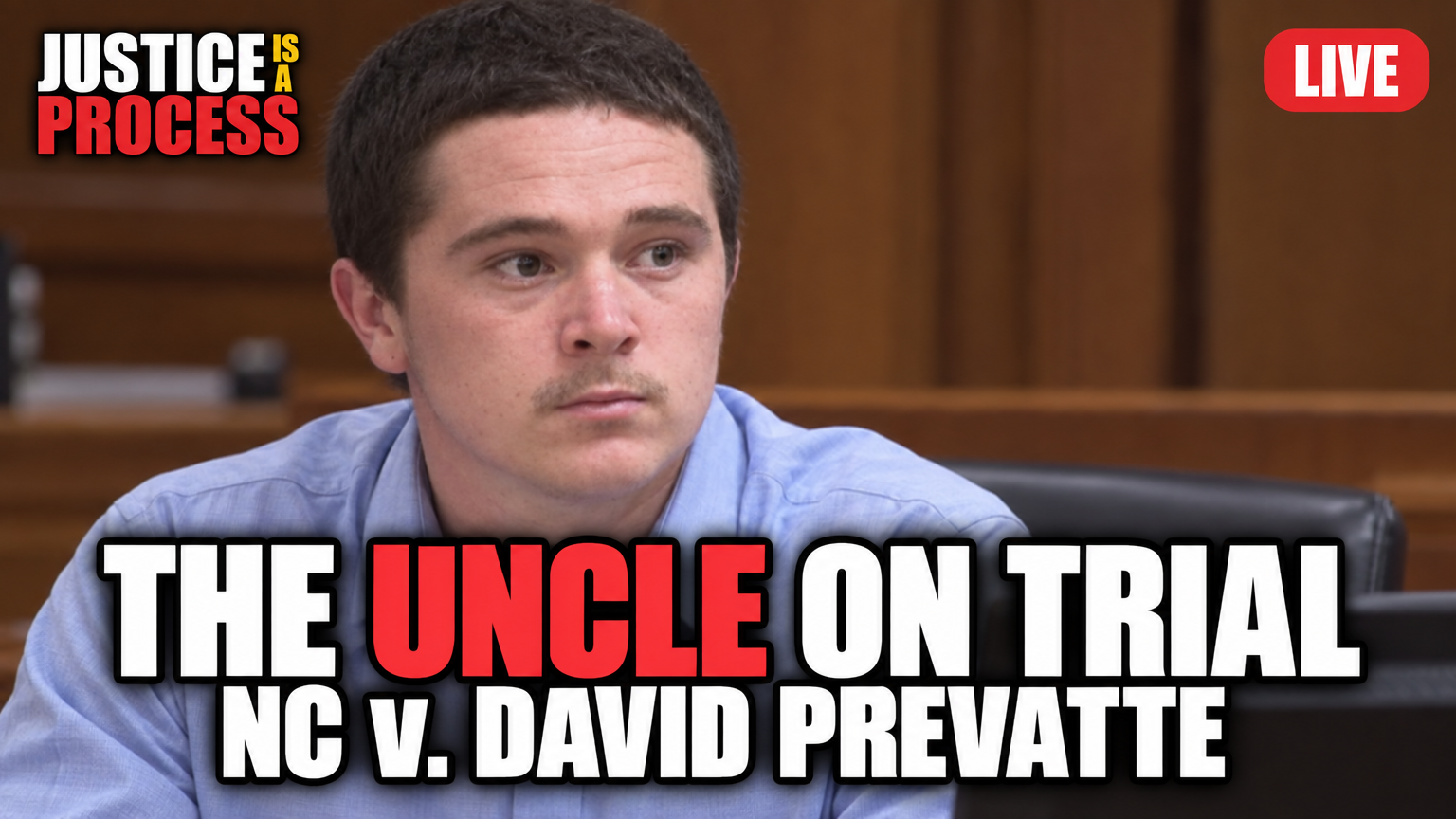
Four Years to a Charge: The Uncle on Trial in Pender County
September 2026 | Justice Is A Process
On the morning of November 13, 2017, a five-year-old girl named Paitin Fields was carried into the emergency department at Pender Memorial Hospital in Burgaw, North Carolina. She had no vital signs. Doctors moved her to New Hanover Regional Medical Center in Wilmington, where she lived for three more days.
She died on November 16, 2017.
The medical examiner later concluded that Paitin was strangled and that she had been sexually abused. Those two findings are the reason this case exists, and they are the only words we will use to describe what happened to her body. The rest of this report is about something else: how a small county in southeastern North Carolina spent more than eight years trying to answer the question of who did it, and how a jury of twelve people is now being asked to answer it for good.
The man on trial is her uncle. His name is David Wesley Prevatte. He is the brother of Paitin's mother. By his own public account, he was in the house that morning. He says he is the one who found her unresponsive, that he performed CPR, and that he and his father took her to the hospital. Seven months later, the Pender County Sheriff's Office named him the only suspect in her death. He sat in a jail visiting room, looked into a television camera, and said, over and over, "I had nothing to do with it."
Then the case went quiet. Not for weeks. Not for months. For more than three and a half years after that interview, David Prevatte was not charged with killing his niece. He pleaded guilty to unrelated crimes, went to prison, and came home. There was, as WHQR later put it, little movement on the case, while a community kept asking why.
In February 2022, sheriff's investigators secured warrants, and deputies in Lafourche Parish, Louisiana, took him into custody. The charges: first-degree murder, and two sex offenses against a child. What changed between 2018 and 2022 has never been said out loud in public. The files were sealed. The sheriff would not take questions. And the answer to that question is, in a very real sense, what this trial is going to be about.
Jury selection began on Monday, September 28, 2026, in Courtroom 1A of the Pender County Courthouse Annex in Burgaw. By Tuesday, twelve jurors were seated, six men and six women, and the court was working on alternates. Opening statements are expected on Wednesday, September 30.
We are not here to convict David Prevatte, and we are not here to acquit him. He is presumed innocent. That presumption is not a courtesy we extend because the rules make us. It is the whole design of the thing. The State of North Carolina has to prove, beyond a reasonable doubt, that he is the person who killed Paitin Fields. He does not have to prove anything. He does not have to say a word.
What we are here to do is watch. Watch whether the State can close a gap it has carried since 2018. Watch whether the defense can show that a nineteen-year-old was fixed on early and never let go. Watch a family that was split down the middle by one terrible morning in one house. And watch whether the system, after eight years, does what it is supposed to do for a little girl who never got to be six.
This is Justice Is A Process. Let's begin.
Let's start with what the public record actually says, because in this case the public record is thin, and every sentence matters.
Paitin Fields lived in rural Pender County, in the Willard area, in a home she shared with members of her mother's family. WWAY reported in 2022 that she lived with her maternal grandmother and her sister. David Prevatte, then a teenager, was part of that household world. He was her mother's brother. That is the relationship at the center of this case: an uncle and a niece, under one roof.
On the morning of November 13, 2017, Paitin was found unresponsive. According to the final autopsy report, which WECT obtained and reported on in June 2018, reports gathered by the medical examiner said she had been well the day before and was found unresponsive and apparently seizing by her uncle. The same report noted that family medical records described a several-day history of an upper respiratory infection. That detail matters, and we will come back to it, because in his 2018 interview Prevatte at first suggested her death was the result of a medical problem.
She was taken to Pender Memorial Hospital. Prevatte's own account is that he and his father drove her there. The autopsy report says she had no vital signs when she was carried into the emergency department. Hospital staff saw signs they associated with strangulation. She was transferred to New Hanover Regional Medical Center, where an examination found evidence of sexual assault. Over the next day she lost her remaining reflexes. On November 15, tests showed no electrical activity in her brain. She died on November 16.
The North Carolina Medical Examiner's Office completed the autopsy. The final report, signed on May 25, 2018, concluded that Paitin's cause of death was strangulation, and it documented findings of sexual trauma. Those conclusions are the foundation of every charge in this case. They are also, as far as the public record shows, not the fight. Nothing reported so far suggests the defense is disputing that Paitin was killed. The fight is over who killed her.
That is an important distinction, and it is worth slowing down on. Some trials are about whether a crime happened at all: was it an accident, a medical event, self-defense. This one, on everything we can see from the outside, is not. A child was killed inside a family home. The question the jury is being asked is whether the State can prove, beyond a reasonable doubt, that the man sitting at the defense table is the one who did it.
For seven months after Paitin's death, no one was publicly named. The investigation was quiet, and the community was not. Local newsrooms were flooded with questions about why nothing was being released. The Sheriff's Office eventually answered in a written statement to WECT: "We want to be able to determine the truth surrounding Paitin's death, while protecting the integrity of our investigation in a manner that will allow the correct individual(s) to face charges and ultimately be convicted for the crimes they have committed." The statement went on: "We understand there are many different opinions circulating in our community as to why more information has not been released concerning this investigation. Our detectives have remained in contact with Paitin's immediate family and will continue to communicate with them concerning the investigation."
In early April 2018, David Prevatte was arrested, but not for anything connected to Paitin. He was charged with breaking into a neighbor's home on March 25, 2018, and stealing a laptop that was later pawned, and with burning a camper trailer that was being refurbished as a residence on April 8, 2018, after an argument with an ex-girlfriend. He went into the Pender County Jail.
On April 28, 2018, from that jail, he called his mother. According to the arrest warrant later made public, he said of the lead investigator on Paitin's case: "when I get out, (the investigator's) got it coming to him and I will probably go back to jail." He also said the investigator "is coming to an end." A version of the warrant quoted by WWAY carried a further line: "I been in here plotting. I hope they know that. That's all I been doing."
In June 2018, the Sheriff's Office charged him with intimidating a witness and communicating threats over that call, set his bond at $115,000, and, in the same announcement, publicly named him as a suspect in Paitin's death. He was nineteen years old. He was not charged in her death. He was the only person the Sheriff's Office ever named.
In July 2018, WECT sat down with Prevatte inside the jail for a nearly ten-minute interview. It is, to this day, the only extended public account he has ever given, and it will almost certainly shadow this trial.
"I had nothing to do with it," he said, again and again.
He explained why he believed he had been named: "The reason that (the investigator) said I'm a suspect is because, he simply just that I was 19 years old, so that automatically made me a suspect for it." He said he made the threats because he "was mad at the time" and that he did not mean them.
He did not dispute that he was there. He leaned on it. "I was there and, like, everything that happened you know happened, and I did CPR and all that on her you know. I'm the one that took her to the hospital, me and my dad did. And I sat there all the time, you know."
He pointed to his cooperation. "I didn't do nothing," he said. "It's been how long since this happened? Seven, eight months now? I gave them my DNA and all that. There would have been something by now that would have led me to it. I didn't do it, and I can't say nothing else, you know, because I didn't do it."
And he made a promise that, eight years later, is being kept: "Well, one thing, if they charge me with it, I'm going to take it to trial, because I didn't do it. I know for a fact, I don't feel that I'm innocent, I know that I'm innocent. There's a difference in that."
The interview was not simple, and a fair account has to say so. Prevatte first suggested Paitin's death was the result of a medical issue, then said he had "suspicions" about who could have caused it. He denied the autopsy's finding of sexual assault, saying he "knew for a fact" it had not happened, and would not explain how he knew. Asked what he would say to a community shaken by her death, he answered: "Let them think what they think. Only God and Paitin know what happened. And that's that."
A jury may hear some or all of that interview. How it lands will depend on who is listening and what else they have heard by then. A prosecutor may call it the account of a man who knew too much. A defense lawyer may call it the account of a frightened nineteen-year-old who had just been publicly labeled a child killer and who was still, months later, waiting for evidence that never came.
The same day as the jailhouse interview, WECT reached Paitin's mother, Lora Flowers. She is David Prevatte's sister. Her answer was one sentence, and it is one of the most important sentences in this entire case: "There is no way that my brother did this, I believe he is innocent and the detective has it out for him."
Think about the position she was in. Her daughter was dead. The only person named in her daughter's death was her own brother. And she stood with him, in public, and pointed at the investigator. We do not know whether she still holds that view in 2026. We do not know whether she will testify, or for which side. But her words from 2018 are the clearest statement of the defense's theory that exists anywhere in the public record, and they came from the one person who lost the most.
In March 2019, Prevatte pleaded guilty to intimidating a witness, breaking and entering, larceny after breaking and entering, and burning a building under construction. He was sentenced to 13 to 25 months, followed by a consecutive 5 to 15 months, with an additional suspended sentence and two years of supervised probation after release. That same month, the Sheriff's Office and the District Attorney's Office put out a joint statement, meant to answer public concern, that the homicide investigation remained "very active."
In November 2020, then-District Attorney Ben David told WECT: "We never stopped pursuing that case and I can tell you there are dedicated people within this agency and, I know, outside of this within law enforcement that are working with my prosecutors pretty regularly to see what we can do to develop that case to where it can be brought into a courtroom."
By then, Prevatte was already free. He was released from Polk Correctional Institution in January 2020, after serving roughly ten months on the unrelated convictions. He was never charged in Paitin's death while he was in custody.
The words that recur in the reporting from this stretch tell the story on their own. "The only named suspect." "The only person ever named." "Has not been officially charged." "Little movement on the case." A year passed. Then two. Then three.
On Friday, February 4, 2022, Pender County Sheriff Alan Cutler stood at a podium and announced that his office had secured warrants for David Wesley Prevatte on charges of first-degree murder, first-degree statutory rape, and statutory sex offense with a child by an adult. Deputies from the Lafourche Parish Sheriff's Office had taken Prevatte into custody in Bayou Blue, Louisiana, an unincorporated community southwest of New Orleans. He was twenty-three. Reporting at the time said it was not clear what he was doing in Louisiana.
"This has been an ongoing investigation and I am extremely proud of the effort that has been put into this investigation by my personnel," Cutler said. "I also would like to express my thanks to Sheriff Craig Webre and his staff in Lafourche Parish for assisting our investigators with taking Prevatte into custody."
"Today's arrest is the culmination of years of hard work," said District Attorney Ben David.
Cutler did not take questions. WHQR reported that he made no further comment on the investigation. Law&Crime reported that it was "immediately unclear what additional evidence was cited to support the murder charge." At the first court appearance two weeks later, WWAY reported that the sheriff was unable to say why Prevatte was now facing charges after being the only suspect since 2018. "We can't really discuss the details of the case," Cutler said, "but like I said we're just pleased to get to this stage."
That is where the public record stops. More than four years after Paitin's death, the State charged the man it had named in 2018, and it has never said publicly what it learned in the meantime. It may have been new forensic testing. It may have been a witness. It may have been something else entirely. We do not know, and we will not guess. The jury is going to find out, and so are we.
Paitin Renee Fields was five years old. She lived in Pender County, a place of small towns and farm roads between Wilmington and the rest of the state. She lived with her sister. In the days before she was found, she had been sick with a respiratory infection, the kind of ordinary childhood thing that fills a family's days and then, suddenly, becomes a line in a medical examiner's report.
We want to be honest with you about something. The public record says very little about who Paitin was as a person: what she liked, what made her laugh, what she was going to be. Families in cases like this one often keep those things close, and they are entitled to. We will not fill that silence with invention. What we can tell you is that her death shook an entire county. A neighbor told WECT at the time, "She had her whole life ahead of her and they cut it short. You hear about it all over the country, but you never think it's going to happen in your own backyard." Public interest in her case never faded across four years without an arrest. At Prevatte's first appearance after the arrest, the sheriff called it "justice for Paitin Fields."
A word about how this channel will handle her. Paitin was a child. Her name belongs in the record of her own case, and you will read it here. But she will never be the face of our coverage. Her photograph will not appear on our thumbnails. Her name will not be used to sell a video. And we will not dwell on the details of what was done to her beyond what the evidence requires us to report. She is not content. She is the reason the courtroom is full.
David Wesley Prevatte grew up in Pender County and was living in the Willard area in 2018. He was nineteen when the Sheriff's Office named him a suspect and twenty-three when he was arrested in Louisiana. One report at the time of the arrest described him as a Wilmington resident. He is now in his late twenties, and he has been held without bond since his first appearance in February 2022.
His record is part of this story, and we will describe it plainly. He has prior convictions, entered by guilty plea in March 2019, for intimidating a witness, breaking and entering, larceny, and burning a building under construction. The witness-intimidation conviction arose directly from this investigation: the recorded jail call about the lead detective. Whether a jury hears about any of those convictions is a legal question for the trial judge, governed by North Carolina's rules of evidence, and it may be one of the early fights of this trial.
At his first appearance in February 2022, he answered "Yes sir" when asked whether he understood the eight felony charges he faced. According to WECT, he turned to look at the courtroom several times, and at the end he waved at loved ones and wiped away a tear as deputies led him out.
He has never admitted any role in Paitin's death. His only public statement is a denial. In 2018 he said that if he were charged, he would take it to trial. He has.
David Prevatte is presumed innocent of every charge in this case. Nothing in his criminal history, nothing he said in anger on a jail telephone, and nothing in this report changes that. Only the evidence presented in that courtroom, tested by cross-examination, can.
This case does not have two sides of a family. It has one family, standing on both sides of the courtroom at once. Paitin's mother is the defendant's sister. Prevatte says his own father drove to the hospital with him that morning. WWAY reported that Paitin lived with her grandmother and her sister. Every relative who testifies in this trial will be testifying about their own people.
That is the human weight of this case, and it will color every witness. When a family member takes the stand, listen for who they came to protect.
The Pender County Sheriff's Office led the investigation, and Sheriff Alan Cutler announced the arrest in 2022. But the lead detective, the one who became the target of Prevatte's jail call, is one of the most important figures in this case, even before a word of testimony. He is the investigator the defendant threatened. He is the investigator Paitin's mother said had it out for her brother. If he testifies, his cross-examination may be the defense's best chance to put the theory of tunnel vision in front of the jury, and the State's best chance to show the jury an investigator who kept going for four years because the evidence told him to.
The case is prosecuted by the Office of the District Attorney for Prosecutorial District 6, which covers New Hanover and Pender counties. Ben David was District Attorney at the time of the 2022 arrest. The office is now led by District Attorney Jason Smith. The individual prosecutors trying the case had not been identified in public reporting at the time this report was written.
At the February 2022 first appearance, Johnson Britt, a former District Attorney of Robeson County, spoke on Prevatte's behalf, and Prevatte asked for court-appointed counsel in the event he could not retain Britt. Who is representing him at trial in 2026 had not been confirmed in public reporting at the time this report was written. We will name trial counsel when they are identified on the record.
The trial is being held in Pender County Superior Court, Courtroom 1A of the Pender County Courthouse Annex in Burgaw. Judge Jeffrey Noecker presided over the 2022 first appearance. The judge presiding over the trial itself had not been identified in public reporting at the time of writing, and we will not assume it is the same judge.
Twelve people now hold this case: six men and six women, seated on Tuesday, September 29, 2026, after two days of selection. WECT reported that at least twenty people who were called asked not to serve and all were excused, and that six potential jurors were dismissed and replaced along the way. Alternates were still being chosen at the end of the second day. For a case that has lived in this community's headlines for eight years, finding twelve people who can set all of that aside is not a formality. It is the first test of whether this trial can be fair.
North Carolina has charged David Prevatte with three offenses at the center of this case. At his first appearance, WECT reported that he faced eight felony charges in total; the three below are the ones every report has named as the heart of the case. The charging documents themselves are not public, so where the reporting and the statutes do not line up perfectly, we will tell you.
What it means: North Carolina has two main roads to first-degree murder. The first is a willful, deliberate, and premeditated killing: the State proves the defendant intended to kill and thought about it beforehand, even briefly. The second is felony murder: a killing committed during the commission or attempted commission of certain serious felonies, which by statute include rape and sex offenses. Under felony murder, the State does not have to prove premeditation. It has to prove the underlying felony and that the killing happened in the course of it.
What the State must prove: That Paitin Fields is dead; that David Prevatte caused her death; and either that he did it with premeditation and deliberation, or that he killed her while committing or attempting a qualifying felony such as a rape or sex offense. Every one of those elements, beyond a reasonable doubt.
Potential sentence: First-degree murder is a Class A felony. The only two sentences are death or life in prison without parole, decided in a separate sentencing proceeding under G.S. § 15A-2000.
The burden: Entirely on the State. The defendant does not have to prove anything.
What it means: Reporting has described this charge as "first-degree statutory rape" and as "first-degree statutory rape of a child by an adult." North Carolina has two closely related statutes. Section 14-27.23, statutory rape of a child by an adult, applies when a person at least eighteen years old has vaginal intercourse with a child under thirteen. Section 14-27.24, first-degree statutory rape, covers the same conduct where the defendant is at least twelve and at least four years older than the child. Consent is not a defense under either. The age of the child is the crime.
What the State must prove: That the act occurred; that Paitin was under thirteen; that the defendant met the statute's age requirement; and, above all in this case, that David Prevatte is the person who committed it.
Potential sentence: Both are Class B1 felonies. Under § 14-27.23, the law sets a mandatory minimum of 300 months, twenty-five years, of active prison time, with satellite-based monitoring after release, and allows a sentence up to life without parole in cases of egregious aggravation.
What it means: This is the companion to the rape statute. It applies when a person at least eighteen engages in a "sexual act," a term the statute defines to cover conduct other than vaginal intercourse, with a child under thirteen. Reporting at arrest named it "statutory sex offense with child by adult," and the 2026 trial notice described it as "first-degree statutory sex offense with a child by an adult." The parallel older statute, first-degree statutory sexual offense, is § 14-27.29.
What the State must prove: That a sexual act occurred; that Paitin was under thirteen; that the defendant was at least eighteen; and that David Prevatte is the person who committed it.
Potential sentence: A Class B1 felony carrying, under § 14-27.28, the same 300-month mandatory minimum and satellite-based monitoring, with a sentence up to life without parole available in egregious cases.
Here is why the three charges matter to each other. If the jury finds, beyond a reasonable doubt, that David Prevatte committed either of the sex offenses, and that Paitin was killed in the course of it, that is a direct road to first-degree murder under the felony-murder rule, without any separate proof of premeditation. The State can also argue premeditation on its own. The jury can be asked to consider both theories.
But notice what every road runs through. Every element of every charge comes back to one question: identity. Was it him? If the State cannot prove that, beyond a reasonable doubt, none of the rest matters.
This is reported as a capital case, and it is important to be precise about what we know. In October 2022, the Wilmington StarNews ran a story on the prospect that Prevatte could face the death penalty; its headline, as cited at the time, said the State would seek it. At the 2022 first appearance, WECT reported that the murder charge carries a maximum penalty of death or life without parole. On the eve of trial in September 2026, WWAY reported that if convicted, Prevatte faces "either the death penalty or life in prison without the possibility of parole." We have not seen a 2026 court filing confirming that the State's notice of intent to seek death still stands. Opening day will make that clear, and we will tell you as soon as it is confirmed on the record.
If the case is tried capitally, the structure changes. Under G.S. § 15A-2000, a first-degree murder conviction is followed by a separate sentencing hearing, before the same jury. The State must prove at least one statutory aggravating circumstance beyond a reasonable doubt. The defense presents mitigating circumstances, and a defendant's age at the time of the crime is one the statute names. A death sentence requires a unanimous jury. If the jury cannot agree unanimously on death, the sentence is life without parole.
One more fact belongs here, because it shapes how people talk about capital cases in this state. North Carolina has not carried out an execution since 2006. A death sentence here is a real sentence with real consequences, and it is also, for now, a sentence that has not been carried out in two decades. None of that changes the jury's job. It only means the stakes of that second phase, if there is one, go well beyond the courtroom.
Here is the one sentence we think this whole trial comes down to.
Every witness in this trial is going to do one of two things. They are going to put David Prevatte in that room, or they are going to leave a gap. That is the story. Not the procedure. Not the charges. The gap between 2018 and 2022, and whether the State has closed it.
Why do we read it that way? Look at the shape of the record. Paitin died in November 2017. The Sheriff's Office named Prevatte in June 2018, and it named him in the same breath as charging him with threatening the lead detective, which means the public first heard his name attached to anger at an investigator, not to evidence. He then sat in custody for most of the next two years on unrelated charges, and was not charged in her death. He walked out in January 2020. The murder charge came in February 2022, and at the arrest, the sheriff would not say why now. The files were sealed until trial.
Meanwhile, the defendant's own story has been on the public record since July 2018. He was there. He found her. He did CPR. He gave his DNA. He was suspected, he said, because he was nineteen. And his sister, the child's mother, said the detective had it out for him. On the eve of trial, the outside legal analyst WWAY spoke with, family law attorney Brandon Pettijohn, put the likely defense in almost exactly those terms: "The defense is likely going to try and point out that the identity of the perpetrator has not been identified, and that maybe DNA evidence does not link the defendant to the crime."
That is not a case about whether a crime occurred. It is a case about who.
Fairness requires us to put the other reading on the table, too. It is entirely possible that what happened between 2018 and 2022 is simple: the State got the evidence it had been waiting for. Forensic testing takes time. Cold evidence is sometimes retested with newer methods. A witness can come forward years later. If the 2022 charges rest on a piece of evidence the defense cannot meaningfully contest, then this trial will look less like a fight over tunnel vision and more like a case where the State will not deal on a capital child murder and the defendant, as he promised in 2018, wants his day in court.
We do not know which reading is right. Nobody outside that courtroom does. Opening statements should tell us a great deal, because both sides will have to show their hand on the one question that matters: what, exactly, puts David Prevatte in that room.
The State has not publicly laid out its theory, and we will not invent one. What we can say is what it has to do. It has to prove that Paitin was killed, which the medical examiner's findings speak to. It has to prove the sex offenses or premeditation, or both. And it has to prove identity, beyond a reasonable doubt, in a house where the defendant's presence is not in dispute.
That last point is the State's central challenge. By his own account, the defendant was in that household that night and that morning. He says he found her and gave CPR. That means ordinary signs of his presence in the home, and anything that could have come from his efforts to help her, may each have an innocent explanation that the defense will offer. For the State, the question is whether it has evidence that cannot be explained by an uncle who was simply there: evidence that ties him to the crime rather than to the house.
The State will also likely want the jury to hear about the 2018 jail call. The threats against the lead investigator may be offered as evidence of consciousness of guilt, the idea that an innocent man does not talk about "plotting" against the detective on his case. Whether that evidence comes in, and in what form, is exactly the kind of ruling that can shape a trial before the first witness finishes.
The defense has not stated its theory in open court, as far as the public record shows. What we have are signals.
The first is the defendant's own 2018 account: that he found Paitin, tried to save her, drove her to the hospital, and cooperated with investigators, including giving his DNA. If the defense builds on that, it becomes a story of a young man who did everything right that morning and was punished for being closest.
The second is the mother's 2018 statement that the detective "has it out for him." That is the seed of a tunnel-vision defense: an investigation that settled on the most convenient suspect, stayed there, and never seriously looked at anyone else. Expect the defense to ask every investigator who else was in or around that house, what was done to rule them out, and when.
The third is the four-year gap itself. A defense lawyer does not need to explain why the State waited. A defense lawyer only needs the jury to wonder about it. If the evidence that produced the 2022 charges has weaknesses, in how it was collected, stored, tested, or interpreted, the gap gives the defense a frame to hang those weaknesses on.
And the fourth is the one Pettijohn named: DNA. The defendant told the world in 2018 that he gave his DNA and that if it pointed to him, he would have been charged by then. If DNA evidence is part of the State's case, the fight will be over what it shows, how it got there, and whether it can distinguish an attacker from a relative who lived there and tried to help.
Here is a gap we have to name plainly. The case files were sealed after the 2022 arrest and were expected to stay that way until trial. We have not found public reporting on any significant pretrial ruling between 2022 and 2026: no reported suppression ruling, no reported ruling on the 2018 interview or the jail call, no reported ruling on the prior convictions. Those fights may have happened out of public view, or they may happen during trial. When the rulings surface, we will tell you what they are and what they mean.
This is where our coverage is different. Other channels will tell you what a witness said. We are going to ask whether the system did its job. Here is what we will be watching, every day, and why each one matters.
In a case this painful, the pull toward a conviction is enormous. A child is dead. The community has waited eight years. The defendant has a record, and his own words from a jail phone are hard to hear. None of that is proof. The burden is on the State from the first word of opening statements to the last word of closing arguments, and it never shifts. The defendant is not required to explain the four-year gap, to testify, or to point to anyone else. We will be watching whether the jury is reminded of that, and whether the State's case can carry it on its own.
North Carolina, like every American jurisdiction, generally forbids using a person's past bad acts to argue that he is the kind of person who commits crimes. Evidence of other crimes can come in for specific, limited purposes, and the fight over that line is one of the oldest in criminal law. In this case, the line runs straight through the jail call and the 2019 convictions. The threat against the investigator is connected to this investigation, and the State may argue it shows consciousness of guilt. The burglary and the fire are not connected at all. Watch closely how the court handles that line, and how each side talks about it in front of the jury.
The defense does not need to prove that someone else did it. But if it can show that investigators decided early and stopped looking, it can argue that the State's case is built on a conclusion rather than on evidence. We will be watching the investigators on cross-examination: what they collected in November 2017, who they interviewed, who they ruled out and how, and what happened to the evidence over the eight years since. A long case is not a flawed case. But a long case has more places where things can go wrong, and the jury is entitled to hear about every one of them.
If forensic evidence is at the center of the 2022 charges, and many observers expect DNA to be, the jury is going to be asked to evaluate science. We will be watching how the evidence was collected, how it was preserved, when it was tested, whether it was retested, and what the experts actually say it can and cannot show. In a household case, the most important question about forensic evidence is often not whether it matches, but what a match means.
A defendant's recorded words can be the most powerful evidence in a trial, and they can also be the most misunderstood. If the jury hears the 2018 jailhouse interview, it will hear a nineteen-year-old who was angry, defensive, sometimes contradictory, and adamant. We will be watching whether the court lets the jury hear it in full or in pieces, and whether each side is fair to what he actually said.
Every family witness in this trial is testifying about their own people. That can produce loyalty, grief, anger, and fear, sometimes all in the same answer. We will be watching for changes in the family's accounts over eight years, and for how the jury is asked to weigh them. A mother who defended her brother in 2018 may say something very different in 2026, or exactly the same thing. Either way, it will matter.
Pender County is not a big place, and this case has been in its news for most of a decade. Twenty-plus prospective jurors asked to be excused and were. We will be watching for any sign that the jury's impartiality is challenged during trial, and for how the court protects it.
If the case is tried capitally, the jury was selected with that in mind, and the stakes of every ruling are higher. Capital cases carry heightened protections for a reason: the sentence cannot be undone. We will be watching whether those protections are respected at every step, and if the case reaches a sentencing phase, we will explain every stage of it as it happens.
This channel honors the legacy of Steven M. Askin, a West Virginia criminal defense attorney, and the lesson of his work is simple: the Constitution does not protect the guilty or the innocent. It protects everyone, because nobody knows in advance which one is standing at the defense table. That is the lens we bring into Courtroom 1A. A little girl deserves the truth about what happened to her. A defendant deserves a trial that finds it fairly. Those are not competing goals. They are the same goal.
The length of the trial has not been announced publicly. Neither side has published a witness list. Based on what the record does show, we expect the State's case to walk the jury through that morning in November 2017: the people in the house, the first calls for help, the hospitals, the medical findings, and then the investigation, from the first detectives on scene through whatever produced the 2022 charges. We expect forensic witnesses. We expect the lead investigator. We expect members of Paitin's family, and we expect those may be the hardest hours of the trial for everyone in the room.
We expect the defense to test every link in that chain, with special focus on the investigation's early decisions and on whatever evidence the State says ties David Prevatte, and not just the household, to the crime. Whether the defense puts on its own case, and whether David Prevatte testifies, are decisions that belong to him and his lawyers, and he is under no obligation to do either.
If there is a conviction for first-degree murder and the State is still seeking death, a separate sentencing phase would follow before the same jury. If there is an acquittal, the case ends. Either way, we will be there for every part of it.
Starting with opening statements, we will be following this trial day by day, from the public record and the courtroom itself.
Here is what you will get from us:
Live coverage of the proceedings whenever the courtroom feed is available, so you can watch the testimony as it happens.
No Breaks Editions, the full day's testimony with the dead air removed, for anyone who wants every word without the waiting.
Case Story episodes, the trial told in order, witness by witness, so you can follow the chain of evidence the way the jury hears it.
Key moments and testimony segments, so the most important exchanges are easy to find and easy to share.
Analysis from Justice, where we step back and ask the question at the heart of this channel: is the system doing what it is supposed to do?
You will not get speculation dressed up as fact from us. You will not get Paitin's photograph on a thumbnail. And you will not get a verdict before the jury gives one.
David Wesley Prevatte is presumed innocent until proven guilty beyond a reasonable doubt. That is not a technicality. That is the foundation of everything we do here.
Eight years ago, a five-year-old girl in Pender County did not come home from the hospital. The State says it knows who is responsible. The man it accuses says it has the wrong person. Twelve people are going to decide. Let's watch the system work, together.
Opening statements are expected Wednesday, September 30, 2026, in Pender County Superior Court.
Live coverage where the courtroom feed allows. No Breaks editions. Case Story episodes. Analysis every step of the way.
The defendant is presumed innocent until proven guilty beyond a reasonable doubt.
Let's watch the system together.
Subscribe to Justice Is A Process on YouTube for live trial coverage, No Breaks editions, and breaking news as it happens.
🔴 Subscribe on YouTube86,000+ subscribers watching the system with us
Discussion