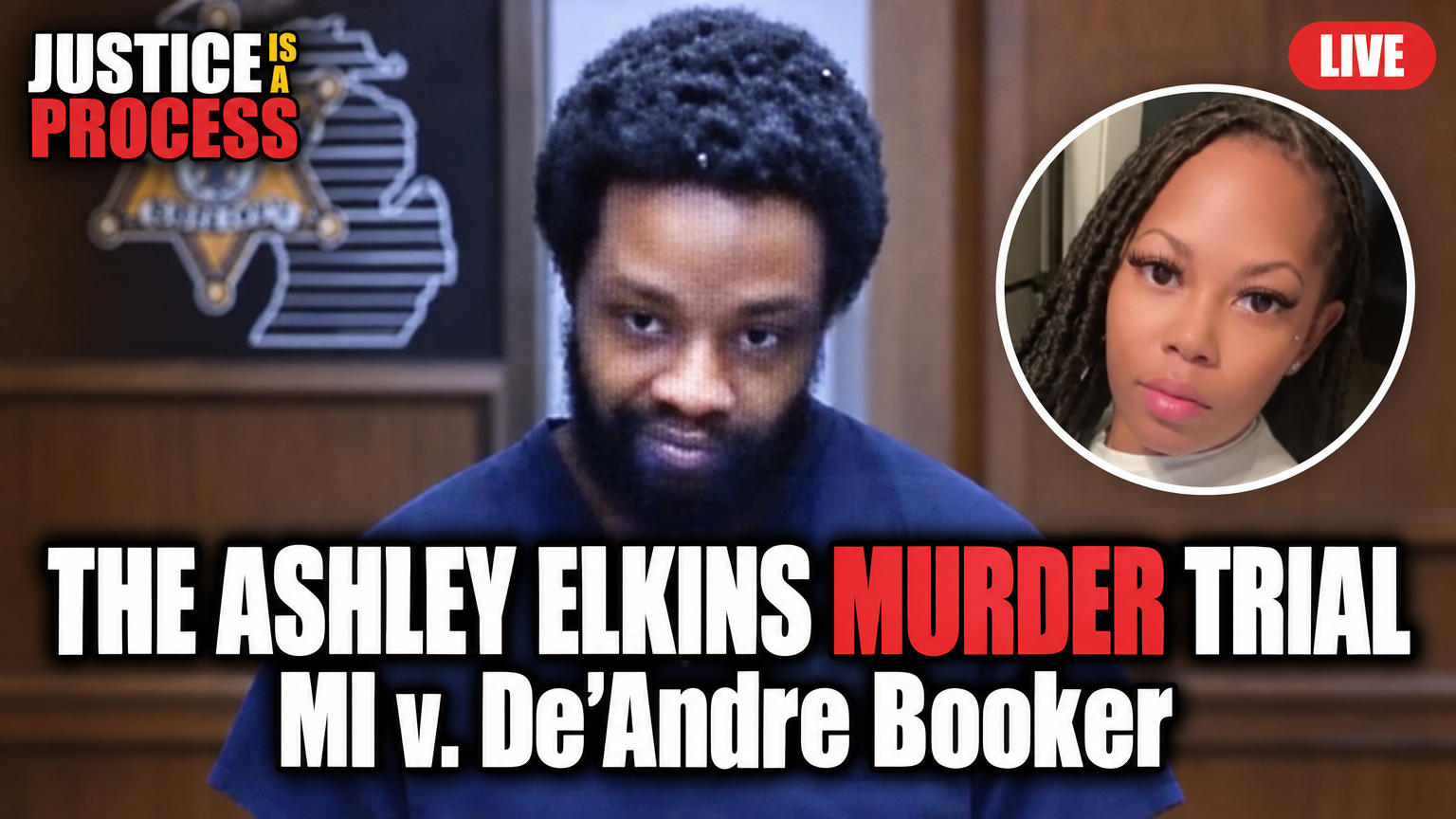
The Ashley Elkins murder trial: a missing mother, no body, and a jury asked to believe the blood
November 2026 | Justice Is A Process
On January 2, 2025, a thirty-year-old hairstylist and mother of two drove to an apartment building in Roseville, Michigan, and went inside.
Security cameras caught her arriving. Her phone was there. Her car was parked outside. Her sister had a text from her earlier that day, written on the way home from a beauty supply store, and the two of them spoke every single day. That message was the last anyone in her family would ever get.
Her name was Ashley Lashay Elkins. She lived in Warren. Her two young sons were at her apartment with her sister while she was out running errands. When she did not come back, her mother, Monika Elkins, called the police. Her family tracked her phone through the Find My app, and it led them to the building where the man she used to date lived.
Nearly two years later, Ashley Elkins has still not been found. Her body has never been recovered. There is no confession in this case that the public knows of. There is no eyewitness who says they saw what happened inside that apartment. And yet on Friday, November 13, 2026, a jury in the Macomb County Circuit Court in Mount Clemens heard a prosecutor tell them that the man on trial, De'Andre Booker, killed Ashley Elkins, and that the proof is what he left behind: her blood in his bathtub drain, her blood in a dumpster outside, her blood on clothing he was wearing the night he was arrested, and a trail of video, internet searches and purchases.
Booker did not come to court to hear it. He let the court know he did not want to be there. The judge started the trial without him.
The defense, led by attorney Robbie Lang, stood up and told the same jury something very different. They said the State is asking twelve people to convict a man of murder when no one can say that Ashley Elkins is even dead. They said the case is built on speculation and assumptions. They said it has "gaping holes." And they told the jurors, in a sentence the prosecution will spend this entire trial trying to answer: "They do not have any viable proof."
That is the whole case in two sentences. Can the State prove a murder when it cannot produce the person who was murdered? Can a jury be asked to believe the blood?
This is the story we are going to follow. We are not here to convict Booker and we are not here to acquit him. We are here to watch whether the system does what it is supposed to do: make the State prove every piece of its case beyond a reasonable doubt, while treating a missing woman and her family with the dignity they are owed. A defendant who has refused to appear in his own courtroom is still presumed innocent. A family that has waited nearly two years without a body to bury is still owed the truth. Both of those things are real at the same time.
This is Justice Is A Process. Let's begin.
Everything in this section is what prosecutors allege, or what witnesses and officers have said in court or in public records. None of it has been decided by a jury. We write "prosecutors say" and "police say" because that is what these statements are.
According to what prosecutors told the jury, Ashley Elkins and De'Andre Booker dated for about a year. The relationship ended in the second half of 2024. Prosecutor Carrie Seward told the jury that Booker became obsessive and could not let Ashley go. In her opening statement she said his internet searches escalated over time, beginning with questions like what it means when someone gives a thumbs up to an apology text and moving on to silencers for guns, where to buy them, and how to disappear. The defense answers that those searches were unrelated to Ashley or were about suicide, not murder.
Booker lived in an apartment complex in Roseville, a Macomb County city just north of Detroit, near Frazho Road and Gratiot Avenue. One local report names the complex as Hampton Court Apartments. Ashley lived in Warren, the next city over, with her two sons.
Thursday, January 2, 2025, is the day the State says Ashley Elkins died. Security camera footage, as described by police and by the prosecutor in court, shows her arriving at Booker's apartment in the early morning hours. In her opening, Seward said Ashley parked her car outside and the cameras show her going inside. She was never seen again.
Later that day, police say, the cameras show Booker leaving the complex in her car with an unidentified woman, and then returning with that woman but without the car. Roseville's police chief, Mitch Berlin, has said publicly that investigators believe Booker acted alone and that the second woman was looked into and was not involved.
A neighbor, Devin Christmas, testified on the first day of witness testimony that he was woken around four in the morning by banging on the stairs outside Booker's apartment. He said it sounded like someone or something fell down the stairs. He told the jury he only learned later what had happened.
Prosecutors also say there is surveillance video of Booker making trips to dumpsters. In the State's description, video shows him removing boxes and trash bags from his apartment and putting them in dumpsters at his complex and at others nearby, and shows a final trip to a distant dumpster while pushing a shopping cart.
Ashley's family reported her missing on Friday, January 3, 2025. Her sister Aniya Elkins told the jury that the two spoke every day, that she was watching Ashley's sons at Ashley's apartment when Ashley did not return, and that she used the Find My app, linked to Ashley's iCloud account, to see where Ashley's phone last was. That location was Booker's apartment building. She and their mother went there to look for her.
A childhood friend of Ashley's testified that she also went to the apartment after Ashley disappeared, with the father of Ashley's children, and found the door ajar. She said she saw a phone on the arm of the couch and, looking through it, saw a late-night food delivery order placed around eleven thirty at night that included bleach, gloves and garbage bags. (Her last name is spelled two ways in the press, LaShawn and Lasean, and we will use the spelling the record settles on.) In her opening statement the prosecutor described the purchases as thirty-gallon garbage bags, forty-three ounces of bleach and latex gloves.
Detective Daryl Bagiano of the Warren Police Department's Special Victims Unit described the early search for Ashley: checking local hospitals and jails, reviewing license plate camera footage for her car, and searching Booker's apartment more than once. He testified that during the January 3 search he found a black puffer jacket that matched the jacket Ashley's mother said she last saw her daughter wearing. Under cross-examination by Lang, he agreed that he found no signs of a struggle or foul play during that January 3 search.
On January 4, Roseville officers went to the apartment after a report of a possible break-in. Officer Zachary Bennefield told the jury they did a protective sweep, not an evidence search, to make sure no one who should not be inside was inside. They found yellow rubber cleaning gloves, a gun under a couch, and what appeared to be dried blood. Bennefield said he saw a large bottle of bleach-type cleaning solvent in the bathroom. A fellow officer pointed out what looked like dried blood on the tile or grout around the tub.
On January 7, 2025, investigators executed a search warrant. An officer later testified at the preliminary exam to finding a large amount of blood in the bathroom. In their opening statement, prosecutors described what they say they found: latent blood throughout a bathroom that had been stripped down, an earring, a clump of hair, and a fired nine-millimeter frangible bullet in the bathtub drain. An investigator told the jury about "swirl marks" on the bathroom walls that appeared to have been recently cleaned with a cleaning agent, and said towels were missing from the towel rack.
Ashley's car was found a few miles from the apartment that same day, January 7.
The Michigan State Police crime lab tested the blood. On January 30 and 31, police announced that the DNA matched Ashley Elkins. Roseville Police Detective Sergeant Anthony Coraci said: "DNA confirms that the blood did in fact belong to the victim." Michigan State Police Detective Sergeant Jacob Escott later told the jury that a cadaver dog gave a final alert at the bottom of the bathroom door, indicating to the handler the odor of human remains, and that the dog also alerted to a dumpster at the complex, where he said he saw what appeared to be human tissue and blood.
The investigation did not stop at the apartment door. Detectives followed a trash bin from the apartment complex, using GPS data from the garbage trucks that serve the area, and the trail led to the Pine Tree Acres Landfill in Lenox Township. A search began the following week with dozens of officers, in freezing temperatures. It lasted about six days and was called off. Ashley Elkins was not found.
For prosecutors, a missing body is not an absence of evidence. It is what they say a person trying to hide a killing would do. For the defense, it is the whole point: no body, no known cause of death, no proof she is dead at all.
Booker was arrested on the evening of Wednesday, January 8, 2025, in Flint. He was first charged with lying to police during a violent crime investigation and was arraigned the next day. Prosecutors say DNA testing tied Ashley's blood to clothing he wore that night, which they say was recovered when he was arrested in Flint. Local reports on the preliminary exam also say officials told the court that, around the time of his arrest, he searched online for the fastest routes to Ohio, how to evade capture, whether blood is traceable, how to beat a polygraph, and how to delete a search history. Those are allegations from testimony. The defense has said Booker's searches were not what the State says they were.
On January 31, 2025, the charges were upgraded to include murder. Defense attorney Robbie Lang argued at the bond hearing that Booker was not a flight risk and asked for a lower bond with a GPS tether and no contact with the family. The prosecutor asked for roughly five million dollars cash. The judge denied bond. Booker has been in the Macomb County Jail ever since.
Ashley Elkins was thirty years old when she disappeared. She lived in Warren, Michigan, worked as a hairstylist, and was the mother of two young boys. Those are the facts that most outlets agree on. What the courtroom has added is the shape of her days. She spoke to her younger sister every day. When she went out on errands that Thursday, her sister was at Ashley's apartment watching the boys. Her last message went to that sister, about heading home from a beauty store. Her mother, Monika Elkins, was the first witness the State called, and she told the jury about the moment she realized her daughter was not answering and called the police.
We say her name and we say what she did for a living and we say she was a mother because she is more than the word "victim" in a case caption. She had a family that has now sat through a murder trial without a body to bury. Her sons are children, and we will not name them or show them. They are not part of this story except as the two reasons a daughter, a sister and a friend are still looking for answers.
The defense has said things about Ashley in court, and we will report them where they matter to the legal question. In his opening, attorney Robbie Lang told the jury that Ashley was not close with her family and had a felony drunk driving charge months before she vanished, and he argued that people go missing for many reasons. Her sister told the jury the opposite: that they spoke every day. A jury will weigh both. What we ask of you, as a viewer, is the same thing we ask of ourselves: do not let a missing woman's private life become a verdict on whether she was murdered.
De'Andre Booker is from Roseville, Michigan. Outlets give his age as thirty-two, thirty-three and thirty-four, so we will not guess; the county prosecutor's office says thirty-three. The county's own releases spell his first name "Deandre," while FOX 2 Detroit and most court coverage write "De'Andre," and we use the apostrophe form in titles and the plain form in search tags because that is how viewers type it.
Booker pleaded not guilty. He has been held without bond in the Macomb County Jail since early 2025. Reporting on the preliminary exam in August 2025 described erratic behavior and a refusal to cooperate in court. In the spring of 2026 a competency evaluation was done. On May 20, 2026, a report from the Center for Forensic Psychiatry found him competent to stand trial, and at a June 3, 2026 pretrial conference the attorneys agreed to that report and Judge Joseph Toia adopted it.
At trial he has not been in the courtroom. A Macomb County jail sergeant testified about his decision, and the judge said the case would go on without him. For three straight days of testimony he stayed at the jail. We do not read anything into that. A person is allowed to stand on his rights, and a jury is supposed to decide this case on the evidence, not on who showed up. But it is part of what this trial looks like, and we will keep reporting it plainly.
The People are represented by the Macomb County Prosecutor's Office. Peter J. Lucido is the elected prosecutor. Assistant Prosecuting Attorneys Carmen DeFranco and Carrie Seward are the lawyers on the case; Seward gave the opening statement. The defense is Robbie Lang. The trial is in the Macomb County Circuit Court in Mount Clemens before Judge Teri Lynn Dennings, according to FOX 2 Detroit's trial coverage. Earlier hearings in the circuit court, including the arraignment and the competency finding, were before Judge Joseph Toia, and the preliminary exam was before Judge Joseph F. Boedeker in the 39th District Court in Roseville. We have not seen an explanation of why the trial judge differs from the earlier circuit judge, and we are leaving it exactly as reported rather than guessing.
The first days of testimony have introduced the people who put this case together. Monika Elkins, Ashley's mother, was first. Devin Christmas, a neighbor, described the banging on the stairs before dawn. Ashley's sister Aniya and a childhood friend described the search and what they saw in the apartment. Detective Daryl Bagiano of Warren police, Roseville officers including Zachary Bennefield, Michigan State Police Detective Sergeant Jacob Escott, an evidence investigator and two forensic experts followed. The prosecution has said it plans about twenty more witnesses. At the end of the week CBS Detroit reported testimony from a woman about a conversation she had with the suspect. We are still working through the later days in full, and as they are released here we will say what the record shows.
Booker is charged with five felonies. Michigan's county press releases name the charges and their penalty classes but do not list statute numbers. We read the Michigan Compiled Laws on the Legislature's own website and matched each charge to the section whose text fits the county's description. That match is our reading, not the county's citation.
What it means: The law covers "any other willful, deliberate, and premeditated killing." In plain English, the State has to show that Ashley Elkins is dead, that De'Andre Booker is the person who killed her, that he meant to, and that he thought about it beforehand. The judge's instructions to the jury will control the exact wording.
What the State must prove: Every one of those pieces, beyond a reasonable doubt. The defense does not have to prove anything, including that she is alive.
Potential sentence: The statute says "imprisonment for life without eligibility for parole."
What it means: Knowingly and intentionally removing, altering, concealing, destroying or otherwise tampering with evidence meant for a present or future official proceeding. We expect the State to point to the cleaning of the bathroom and the removal of bags and boxes from the apartment.
Potential sentence: A felony of up to ten years and a fine of up to twenty thousand dollars when the underlying offense is serious enough, which the county describes as a ten-year felony.
What it means: Without lawful authority, wilfully digging up, removing or conveying away a human body or its remains, or mutilating, defacing, removing or carrying away part of a dead body. The charge only makes sense if the jury is convinced there was a dead body and that the defendant moved it. We expect the State to tie this one to the dumpsters and the landfill.
Potential sentence: A felony of up to ten years or a fine of up to five thousand dollars.
What it means: A person who knows or has reason to know that someone is dead and does not tell police, a funeral home or 911, doing so "with the purpose of concealing the fact or cause of death." This charge sits in Michigan's public health code, not the penal code.
Potential sentence: A felony of up to five years or a fine of up to five thousand dollars, and the law lets a judge run the sentence consecutively to others from the same events.
What it means: Knowingly and willfully giving a police officer a statement the person knows is false or misleading about a material fact, during an investigation of an offense like murder. The county describes this as a charge from a related case.
Potential sentence: A felony of up to four years or a fine of up to five thousand dollars.
Notice how the charges stack on top of the central question. Counts 2, 3 and 4 all depend on a death. If the jury is not convinced Ashley Elkins is dead, those counts fall with the murder count. If the jury is convinced she is dead and convinced the defendant dealt with her body, the fight moves to premeditation and identity.
Every case that reaches a jury is there for a reason. Here the reason is the missing body. A conviction for murder with no body, no known cause of death and no one who saw it requires the State to build a bridge of circumstantial evidence from a bathroom in Roseville to a death, and from a death to a particular man. Prosecutor Peter Lucido said it himself when the case was bound over: "While Ms. Elkins remains missing, the evidence supports moving forward to trial." He has also said publicly that he is hopeful the body will be found, and that convictions without a body have happened before. We do not need to cite a case to tell you the plain point: the lack of a body is a hurdle the State chose to try to clear, not a rule that ends the case.
The State's strongest evidence is the science and the timeline. It says the Michigan State Police crime lab matched blood in the bathtub drain, in a dumpster and on clothing to Ashley Elkins, and that the match is overwhelming: prosecutors told the jury the dumpster blood is thirty-seven septillion times more likely to be Ashley's DNA than anyone else's, and that the bathtub drain swab is about fifteen octillion times more likely. Those are the State's figures, described in opening. They also say none of Booker's DNA was found on that dumpster. They say cameras show her walking in and her car leaving without her, that his searches and purchases show planning, and that a bullet, an earring and hair were pulled out of the drain.
The prosecution's story, as Seward told it, is a short chain. A man cannot move on from a breakup. He searches for ways to kill and to disappear. On January 2 the woman he cannot let go of walks into his apartment and is never seen again. Afterward he cleans the bathroom, orders bleach and garbage bags, hauls bags and boxes to dumpsters, and the blood in the drain and the dumpster is hers. It is a case with no single moment that proves everything, and it is meant to be believed as a whole.
Robbie Lang's opening laid out the other side. The defense says there is no proof Ashley Elkins is dead, no cause of death, no accepted manner of death. It says the bullet in the drain was "old, rusty and corroded" and was ruled out as having been fired from the gun in the apartment. It says the searches were unrelated or about suicide, not about killing anyone. It says that police showed bias against Booker, pointing to a message sent to Ashley's family claiming she was being held at a building in Detroit. In Lang's telling, officers found spent bullets at that building but were not given access and never got a search warrant. And on cross-examination so far the defense has gone after the apartment itself: a damaged front door and a broken lobby window at Booker's building, which Lang suggested could have been caused by family members looking for Ashley before police arrived, and which a Roseville officer said could have been caused by "anybody" at an unknown time.
One thing to watch closely is the argument over the gun. Prosecutors say a gun was found under the couch and a fired bullet was in the bathtub drain, and on the third day two forensic experts testified about yellow residue on both the gun and the bullet, with prosecutors trying to connect the gun to what happened to Ashley. The defense says the bullet is old and was ruled out. That means the phrase "no weapon" is contested. We do not use it in our titles, because we do not know yet whether a jury will treat it as true.
The preliminary exam stretched across four days in August 2025 and, in the reporting, involved hundreds of pieces of evidence. After written briefs and oral argument, Judge Boedeker bound Booker over on every count on January 7, 2026. The circuit court found him competent in June 2026. The trial, first set for November 10, opened on November 13 with a jury already seated earlier in the week. And the most visible ruling in front of the jury is the judge's decision to proceed without the defendant, who declined to attend.
Every Justice Is A Process case runs on the same few questions. In this one they come into focus quickly.
Is the burden staying where it belongs? This channel is dedicated to the memory of Steven M. Askin, a criminal defense attorney, and the principle we carry from him is plain: the burden of proof belongs to the State, and it never moves. In a no-body case that principle is under real strain, because a jury may feel the pull of a missing woman and a family in the gallery. The State must prove she is dead and that he did it. The defense does not have to explain where she is.
Does the circumstantial chain hold, link by link? There is no single piece here that shows a killing. There is blood, and where it was found; video, and what it shows and does not show; searches, and who made them, when, and from which device; purchases; a dog's alert; a landfill that came up empty. A circumstantial case is not a weak case, but it is only as strong as its weakest link. We will be watching how the lab work was done, how items were collected and kept, and what was handled by police before anyone had a warrant, such as the January 4 protective sweep that came before the January 7 search warrant and happened while the family had also been in and out of the building.
Was the investigation fair? The defense says officers favored one theory and ignored a message pointing somewhere else. Sometimes a tip is nothing. Sometimes it is the thing a jury needs to hear about to understand why they were handed a case with holes in it. A missing-person case also means a family running their own search, and the defense has already raised the question of what that did to the evidence. We will report what the witnesses say about it and let you weigh it.
What does it mean that the defendant is not there? A person charged with a crime has a right to be present at his own trial. He can also decide not to use that right. The judge has said the trial goes on. What we will watch for is how the court handles it in front of the jury, what the jurors are told, and whether a defendant who will not come to court can still be treated as the presumption of innocence requires: innocent until the State proves otherwise.
Is the process fair to a grieving family? The other side of the presumption of innocence is the family's right to be treated as people and not as exhibits. Ashley's mother and sister have already sat in the witness chair and been cross-examined. We will report what is said in court. We will not speculate about who Ashley Elkins was, and we will not say what we do not know.
One more note of caution on our part. Some of what we know about the earlier days comes from news coverage, and not every outlet agrees. A spelling, an age or a time may differ from one report to the next. When it does, we say so. When we cannot confirm something, we say that too, and we will correct the record when the transcript settles it.
The prosecution has about twenty more witnesses planned and has indicated it expects to finish its case on or about Tuesday, November 24. After that the defense decides whether to call anyone. It has no duty to. If the defense rests without a witness, the trial moves quickly to closing arguments and the jury's decision, and the whole case comes down to the single question the defense asked at the very start: do they have proof?
We were not in the courtroom live. We covered the preliminary exam as it happened, and you can watch those days in our MI v. De'Andre Booker playlist. The trial is different. The days have already aired, so we are working from FOX 2 Detroit's full-day broadcasts, day by day, in order, and releasing each day as soon as it is finished. Expect uninterrupted No Breaks editions, Case Story parts, key testimony clips and our own commentary.
The broadcasts have two gaps we cannot fix and will not hide. Day five begins in the middle of a witness's testimony, and one day ends on a frozen screen from the broadcaster's transmitter that never comes back. Where that happens, we tell you.
The defendant is presumed innocent until proven guilty beyond a reasonable doubt. That is not a technicality. It is the foundation of everything we do.
Let's watch the system together.
Subscribe to Justice Is A Process on YouTube for live trial coverage, No Breaks editions, and breaking news as it happens.
🔴 Subscribe on YouTube86,000+ subscribers watching the system with us
Discussion