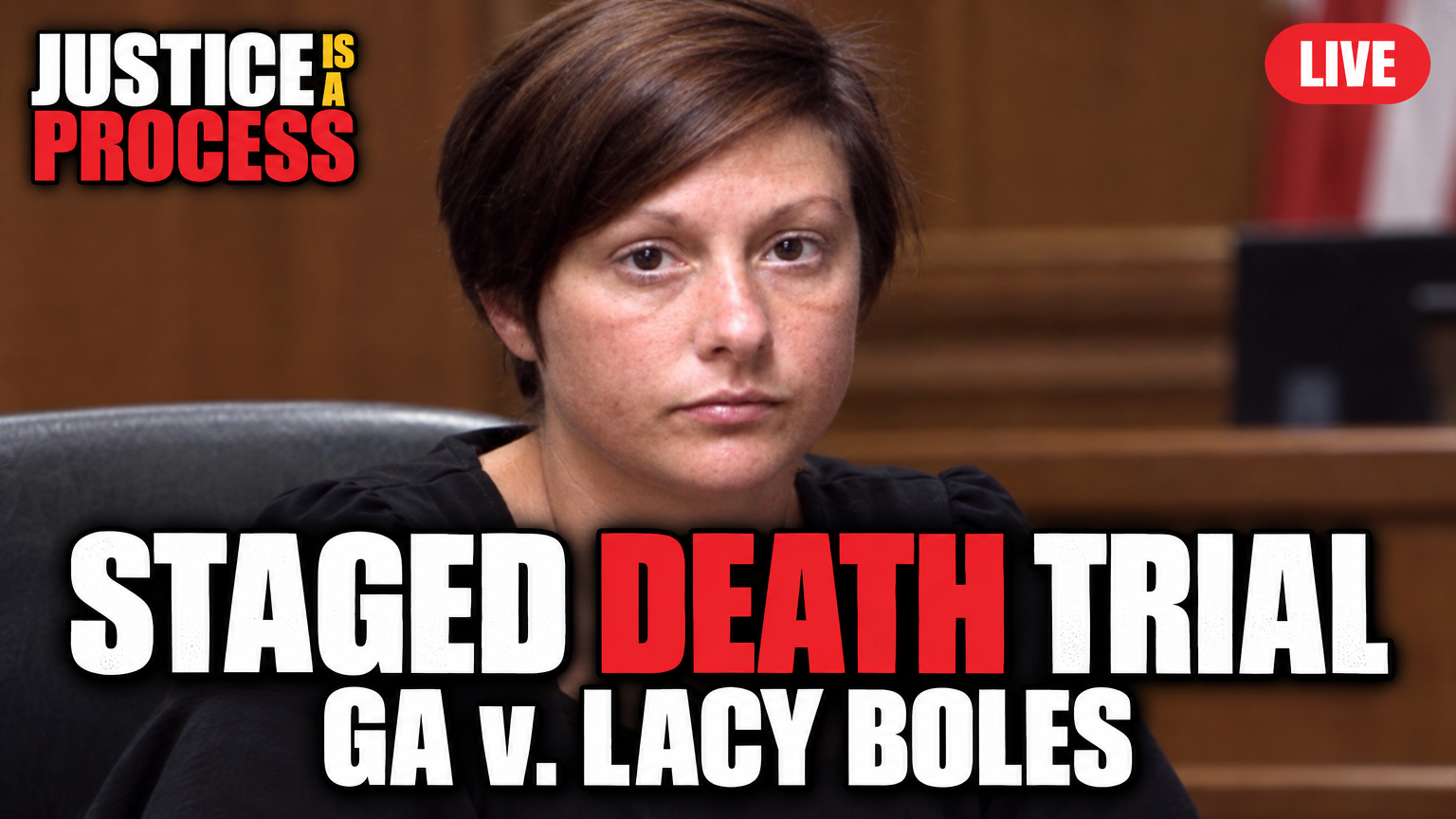
The Staged Death Trial. One gunshot in a Dallas, Georgia home, three days before Christmas. His wife called 911 and said he shot himself. Five months later the state medical examiner said he did not. Now a Paulding County jury decides which story the evidence tells.
November 2026 | Justice Is A Process
It was three days before Christmas, 2019. Shortly after 12:44 in the morning on Sunday, December 22nd, a 911 call went out from a house on Braemill Court in Dallas, Georgia, a quiet street in Paulding County about forty minutes west of downtown Atlanta. The caller was a woman. The call, the sheriff's office would later say, "came in as a suicide."
Deputies and firefighters went to the house. Inside they found Daniel Lee Akers. He was 36 years old. He was a father of five. He worked for a local sheet metal union. He had been shot once in the head, and he was dead.
The woman who made that call was his wife, Lacy Jolee Boles. She told the people who came to the house that her husband had shot himself.
For most families, a call like that is where the story ends. A tragedy, a funeral, a Christmas that never feels the same again. But the detectives who walked through that house that night saw things that bothered them. In the words of the sheriff's spokesman, they "noticed some things at the crime scene that were inconsistent with that." They did not close the case. They sent Daniel Akers to the Georgia Bureau of Investigation's crime lab and waited.
They waited five months. On May 29th, 2020, the GBI Medical Examiner's Office gave its answer. The gunshot wound, it found, was not self-inflicted. It ruled the death a homicide. That same day, Paulding County detectives arrested Lacy Boles. She was charged with murder.
Daniel's family says they never believed he killed himself. They told reporters he loved life, and that he would never have left his children alone. Lacy Boles says the opposite. She has pleaded not guilty, and she maintains that Daniel Akers took his own life.
That is the whole case in two sentences. One gunshot. Two stories. One of them is a suicide. The other is a suicide that, the State says, was staged.
Almost seven years later, the question finally goes to a jury. It almost went to one in June of 2026, until a prospective juror asked ChatGPT about the case and told the people around him what it said. The judge threw out the whole panel. Jury selection started over on Monday, November 9th, 2026, in the Paulding County Superior Court in Dallas, and opening statements are expected as soon as Wednesday, November 11th.
Sitting beside Lacy Boles at the defense table is Brian Steel, one of the best-known criminal defense lawyers in Georgia, the attorney who represented Jeffery Williams, the rapper known as Young Thug, through the longest trial in the state's history. His job in this courtroom is simple to say and hard to do: make twelve people unsure that Daniel Akers did not pull that trigger himself.
We are not here to convict Lacy Boles, and we are not here to clear her. She is presumed innocent. That is the law, and it stays the law until twelve jurors, all of them, say otherwise. What we are here to do is watch whether the State of Georgia can prove what it has charged, beyond a reasonable doubt, in a courtroom open to the public. Every day of it.
This is Justice Is A Process. Let's begin.
Here is what the public record tells us about that night, and it is important to be honest about how little that is.
We know the address: a home on Braemill Court in Dallas, the Paulding County seat. We know the time: the 911 call came in shortly after 12:44 a.m. We know how the call was coded: a "possible suicide attempt." We know that Paulding County sheriff's deputies and fire and rescue crews responded, and that they found Daniel Akers dead of a single gunshot wound to the head.
We know that Lacy Boles, then 37, was in the house, and that she told investigators her husband had shot himself. A petition started by friends of the Akers family in June 2020 says that three of the youngest children were also in the house that night. We have not confirmed that from an official source, and we will not name or describe any of the children in this coverage.
And we know that the detectives did not accept the suicide account at face value. In June 2020, Paulding County Sheriff's Office spokesman Sergeant Ashley Henson put it this way to the Atlanta Journal-Constitution: "The call came in as a suicide. But when detectives got there, they noticed some things at the crime scene that were inconsistent with that." The sheriff's office said that Lacy Boles' statements did not match the physical evidence, and that "the evidence lead detectives to believe that something else had occurred in the home."
What were those things? The sheriff's office has never said publicly. Not what was out of place, not what she said that did not fit, not where the gun was, not which hand it was near. That is the first thing this trial will show us, and it may be the most important. Everything the State believes about that night was built from what those detectives saw in that house in the first hours, and none of it has been laid out in public yet.
Daniel Akers' body went to the GBI crime lab for an autopsy. In an ordinary case, a medical examiner's preliminary findings come within days. This one did not. The sheriff's office blamed two things: the complexity of the case, and the COVID-19 pandemic, which in the spring of 2020 slowed government offices across Georgia to a crawl.
For five months, the death of Daniel Akers sat officially unresolved. His family waited. Lacy Boles went on with her life. Then, on May 29th, 2020, the GBI Medical Examiner's Office delivered its finding: the gunshot wound "was not self-inflicted." The manner of death was ruled a homicide.
Detectives arrested Lacy Boles that same day, May 29th, 2020, without incident. The sheriff's office listed five felony charges: malice murder, murder, aggravated assault, making false statements, and tampering with evidence. Those last two charges tell you the theory in plain words. The State was not only saying she fired the gun. It was saying she lied about it, and that she changed the scene to make it look like something it was not.
Within a week she was out. On June 5th, 2020, the Paulding County Superior Court granted her bond of $100,000. She was released from the Paulding County Jail the next day, June 6th. Daniel's family told the Atlanta Journal-Constitution they were never told about the bond hearing and never got the chance to argue against her release.
The family's anger did not stay private. On June 9th, 2020, a family friend started an online petition asking the governor and the sheriff to revoke her bond. It drew more than ten thousand signatures. The bond was not revoked. Lacy Boles has remained free, on that bond, for the nearly six and a half years since.
In December 2020, a Paulding County grand jury returned an indictment. It charged Lacy Boles with three crimes: malice murder, felony murder, and aggravated assault. The grand jury did not indict her on the two charges about the cover-up, false statements and tampering with evidence, according to the Atlanta Journal-Constitution.
That detail matters, and we will come back to it. The theory that the scene was staged is still at the heart of the State's case, because it is the State's explanation for why a homicide was called in as a suicide. But the State will have to prove that theory as part of a murder case, not as a separate crime of its own.
Before he was a case number, Daniel Akers was a working man and a father. He was 36. He worked in the sheet metal trade, a member of a local union, the kind of job that starts before sunrise and ends with sore hands. He had five children.
The people who knew him describe a man who loved being alive. His family told reporters, in the days after the arrest, that they never believed he had killed himself, that he loved life, and that he would not have left his children alone. The friends who started the petition for his family wrote that they knew "he would never harm himself or anyone else." They gave the petition a name that says what they think this case is about: justice for Danny.
We say his name in this coverage because he is the reason there is a trial. He is not an exhibit. He is a man who did not live to see Christmas 2019, and whose children have grown up for almost seven years without him while the courts worked out how he died. Whatever the jury decides, that loss is real, and we will treat it that way.
Lacy Jolee Boles was 37 when she was arrested and is 43 now. She lived in Dallas with Daniel Akers, her husband. Some early news reports spelled her first name "Lacey"; the court and most recent coverage use "Lacy," and that is the spelling we use.
She has pleaded not guilty to every charge. Her account has not changed since the night she called 911: her husband shot himself. She has spent the last six and a half years free on bond, waiting for this trial, and she has the same right as anyone in this country to make the State prove its case.
Here is what we do not know about her, and will not guess at: we do not know her account of the evening in any detail, we do not know whether she will testify, and we do not know what she told detectives beyond the bare fact that she said it was a suicide. A defendant never has to testify, and a jury may not hold her silence against her. If she takes the stand, it will be one of the most important moments of this trial. If she does not, it means nothing about her guilt.
Lacy Boles is presumed innocent. Read every word in this report with that in mind.
The trial is in the courtroom of Judge Dean Bucci of the Paulding County Superior Court, part of the Paulding Judicial Circuit. Judge Bucci has already made two decisions that shape this trial. He ruled part of a recording from Daniel Akers' phone inadmissible, which we explain below. And in June 2026, when a prospective juror researched the case with an artificial intelligence program and spread what he found, Judge Bucci held that juror in contempt and released the entire jury pool rather than risk a tainted jury.
Brian Steel is the reason a lot of people outside Paulding County know this case exists. He is an Atlanta criminal defense attorney who became nationally known as lead counsel for Jeffery Williams, the rapper Young Thug, in the YSL racketeering trial in Fulton County, the longest criminal trial in Georgia history. He is known for exhaustive preparation, relentless cross-examination, and a willingness to fight a judge when he believes his client's rights are on the line.
His position here is clear from every public report: Daniel Akers took his own life. That puts Brian Steel up against a medical examiner's finding and the crime scene work behind it, rather than an eyewitness. Expect him to go after both, line by line.
Any co-counsel at the defense table has not been named in the reports we have read. We will name them when the court record does.
The case is brought by the Office of the District Attorney for the Paulding Judicial Circuit. The prosecutors who will try the case have not been named in any public report we have found. We will not guess. We will name them from the courtroom once the trial begins.
The Paulding County Sheriff's Office investigated the death, and the GBI Medical Examiner's Office performed the autopsy. Sergeant Ashley Henson spoke for the sheriff's office in 2020. The detectives who worked the scene, and the medical examiner who ruled the wound was not self-inflicted, have not been named publicly. They are almost certain to be among the State's most important witnesses.
Lacy Boles is on trial on three counts, as the grand jury returned them in December 2020. Here is what each one means in plain English. In every one, the burden is on the State, all of it, the entire time. The defendant does not have to prove anything, including that her husband took his own life.
What it means: Georgia's most serious form of murder. A person commits malice murder when they unlawfully, and with malice aforethought, cause the death of another human being. Malice can be "express," a deliberate intention to kill, or "implied," where the circumstances show an abandoned and malignant heart.
What the State must prove: That Daniel Akers is dead; that Lacy Boles caused his death; that she did so unlawfully, meaning not in self-defense, not by accident, and not by his own hand; and that she acted with malice.
Potential sentence: In Georgia, murder carries life in prison, life without parole, or death. No public report says the State is seeking the death penalty in this case.
What it means: A person commits felony murder when they cause someone's death while committing a felony, whether or not they meant to kill. Here, the underlying felony is the aggravated assault in Count 3.
What the State must prove: That Lacy Boles committed an aggravated assault on Daniel Akers, and that the assault caused his death. The State does not have to prove intent to kill on this count.
Potential sentence: The same range as malice murder. Georgia law does not allow two murder sentences for one death, so if the jury convicted on both murder counts, only one murder conviction would stand at sentencing.
What it means: An assault made with a deadly weapon, here the gun, or with an object likely to cause serious bodily injury.
What the State must prove: That Lacy Boles assaulted Daniel Akers with a firearm.
Potential sentence: Generally one to twenty years in prison. If the jury convicted her of murder, this count would ordinarily merge into the murder conviction for sentencing.
Notice what ties all three counts together. Every one of them requires the State to prove a single fact first: that Lacy Boles, and not Daniel Akers, fired the gun. If the jury has a reasonable doubt about that one fact, it does not matter how the other elements look. All three counts fall together.
Notice too what is not on the list. The original arrest charges of false statements and tampering with evidence were not indicted. Some posts online by friends of the family describe a firearm count as well; we have not been able to confirm one from the indictment, and the reports of the indictment we have read list only these three counts. We will report the counts exactly as the judge reads them to the jury.
This case is at trial because his wife, who made the 911 call, says Daniel Akers shot himself, and the GBI medical examiner says the wound was not self-inflicted. There is no confession. No one, as far as the public record shows, saw the shot fired. There are two explanations for one gunshot, and only one of them can be true.
That is what makes this a hard case, and an important one. In most murder trials, the question is who did it. Here, if the State is wrong, there was no crime at all. A man took his own life, and the woman who called for help has spent nearly seven years accused of killing him. If the State is right, a man was shot to death in his own home, and the person who did it called it in as a suicide and nearly got away with it.
Investigators call this kind of case an "equivocal death," a death where the evidence could point toward suicide or toward homicide, and where the answer depends on reading the physical details correctly. Those cases are won and lost on science, on crime scene work, and on whether the first people through the door did their jobs right.
From what has been made public, the State's case rests on three pillars.
First, the medical examiner. The GBI found that the wound was not self-inflicted. A finding like that is usually based on the wound itself: where on the head the bullet entered, the angle it traveled, and how far the muzzle was from the skin when the gun fired. Self-inflicted gunshot wounds tend to follow recognizable patterns. They are usually contact or near-contact wounds, in locations a person can reach, at angles a person's own arm can produce. When a wound breaks those patterns, a medical examiner may conclude someone else fired the gun. We do not yet know which of those details drove the ruling here. We will learn it when the medical examiner testifies.
Second, the scene. The detectives said they saw things that did not fit the suicide account. In cases like this, investigators look at where the gun was found and whether it could have landed there; whether there is blood on the gun or the hands in the places you would expect; whether there is gunshot residue on the dead man's hands; whose fingerprints or DNA are on the weapon; and whether the blood patterns in the room match where the person was when the shot was fired. Any one of those, the State will argue, can expose a staged scene.
Third, her account. The sheriff's office said from the start that Lacy Boles' statements were inconsistent with the evidence. Her 911 call, and what she told deputies and detectives that night and afterward, will almost certainly be played or described for the jury. The State's argument will be that a true account of a suicide matches the evidence, and that hers did not.
There is one more piece of evidence we know about, and it is one the jury will only partly hear. According to Court TV, prosecutors obtained a 13-minute audio recording from Daniel Akers' phone that appears to capture a conversation between him and Lacy Boles. Part of that recording reportedly contains statements suggesting that she had been unfaithful.
Judge Bucci ruled that portion of the recording to be hearsay, and barred prosecutors from playing it to the jury.
That ruling matters in two ways. It tells us the State had a possible motive theory: a marriage in trouble, and an accusation of infidelity. And it tells us the jury will not hear that part of it. What remains of the recording, and whether the jury hears any of it, is something we will be watching from the first day. When it was recorded, how it came to be on his phone, and how close in time it was to his death are questions the public reports do not answer.
The defense has told the court and the public the same thing from the start: Daniel Akers took his own life.
To win, Brian Steel does not have to prove that. He has to make the jury doubt the State's proof that it was not. Expect the defense to work on several fronts.
Two pretrial events stand out. The first is the hearsay ruling on the recording, described above. The second is the collapse of the first trial.
Jury selection first began on Monday, June 15th, 2026. On its second day, according to Court TV, the court clerk told Judge Bucci that a prospective juror had asked ChatGPT about Lacy Boles' case, and then shared what it told him with other members of the jury pool, despite the court's instruction not to research the case or discuss it. The State and the defense jointly asked for a mistrial. Judge Bucci granted it, held the juror in contempt, released the panel, and set the case for November.
It is rare for a judge to hold a prospective juror in contempt. It is rarer still for a trial to be derailed by artificial intelligence. That is why this case drew national attention before a single witness was sworn, and why Judge Bucci can be expected to give this jury some of the most pointed instructions about outside research that any Georgia jury has ever heard.
My father, Steven M. Askin, was a criminal defense attorney in West Virginia. The thing he taught me that I come back to more than anything else is that the system is not supposed to find the most likely story. It is supposed to find out whether the government has proven its story beyond a reasonable doubt. Those are not the same thing, and this case is a perfect example of why.
Georgia has a rule written into its evidence code for cases built on circumstantial evidence. When the State's case depends on circumstantial evidence, the facts it proves must not only be consistent with guilt; they must exclude every other reasonable explanation except the guilt of the accused (O.C.G.A. § 24-14-6).
In this case, the other reasonable explanation has a name. It is suicide. The jury will be asked, in effect, whether the State's evidence rules it out. If the jury believes suicide remains a reasonable explanation of the evidence, the law says it cannot convict. If the State's science and scene work close that door, the case turns. Whether a given explanation is "reasonable" is the jury's call, and that is where this trial will be fought.
When a medical examiner rules a death a "homicide," it means a death caused by another person. It does not mean murder, and it is not a finding that any particular person committed a crime. The jury will hear that word over and over. It is our job, and the judge's, to make sure no one confuses a medical examiner's opinion with the jury's decision. The medical examiner will be a witness in this trial like any other: questioned, cross-examined, and judged by the jury on how well the conclusion holds up.
The fight over the recording from Daniel's phone is about one of the oldest rules in our law. The hearsay rule exists because a jury should judge statements by people it can see, under oath, facing cross-examination. Daniel Akers cannot take the stand. His words on that recording cannot be tested. Judge Bucci has already drawn one line around what the jury may hear. We will watch where the remaining lines get drawn, and whether they hold on both sides.
The Sixth Amendment promises every defendant a trial by an impartial jury, and the law expects jurors to decide a case on the evidence in the courtroom and nothing else. In June, one juror's question to a chatbot was enough to end a trial before it started. That should worry everyone, whatever side you are on. A tool that answers any question in seconds, with no rules of evidence and no cross-examination, is exactly what the rule against outside research is meant to keep out of the jury box. Watch how carefully this second jury is questioned, and how plainly the judge tells them what they may not do.
Daniel Akers died in December 2019. This trial is starting in November 2026. Some of that delay belongs to the pandemic, some to a busy court calendar, and some to the June mistrial. Friends of the family have publicly blamed the defense's schedule. Whatever the reasons, long delays are hard on everyone. Memories fade. Witnesses move. A family waits for an answer, and a defendant lives under an accusation she says is false. Neither side gets those years back.
Lacy Boles has been free on bond since June 2020. Some people find that hard to accept in a murder case. But a bond decision asks only whether a person will come back to court and whether she is a danger while she waits. It says nothing about guilt. She has come back. She will walk into that courtroom presumed innocent, exactly as the Constitution requires, and the jury may not hold it against her that the State charged her.
The court has not announced how long the trial will run. A single-victim murder trial in Georgia with a forensic dispute at its center often lasts one to three weeks. Expect the State to begin with the 911 call and the first deputies on scene, then the detectives, the crime scene and firearms evidence, and the GBI medical examiner. Expect Daniel's family to testify about who he was. Expect the defense to test every one of those witnesses and, very likely, to call its own forensic expert.
The jury will be twelve people from Paulding County. In Georgia, a verdict in a criminal case must be unanimous. If even one juror is left with a reasonable doubt, there is no conviction.
From the first gavel, we will be in that courtroom with you. Every day.
We will tell you what the evidence shows when it shows it, and what it does not. When I tell you what I think the evidence proves, I will say that it is my opinion, and I will remind you that we are not the jury. Only the twelve people in that box decide this case.
Lacy Boles is presumed innocent until proven guilty beyond a reasonable doubt. Daniel Akers deserves a true answer about how he died. Both of those things are true at once, and the only way to honor both is to watch the process work, from the first witness to the last.
Let's watch together.
Live broadcasts. No Breaks editions. The Case Story, Part by Part.
The defendant is presumed innocent until proven guilty beyond a reasonable doubt.
Let's watch the system together.
Subscribe to Justice Is A Process on YouTube for live trial coverage, No Breaks editions, and breaking news as it happens.
🔴 Subscribe on YouTube86,000+ subscribers watching the system with us
Discussion