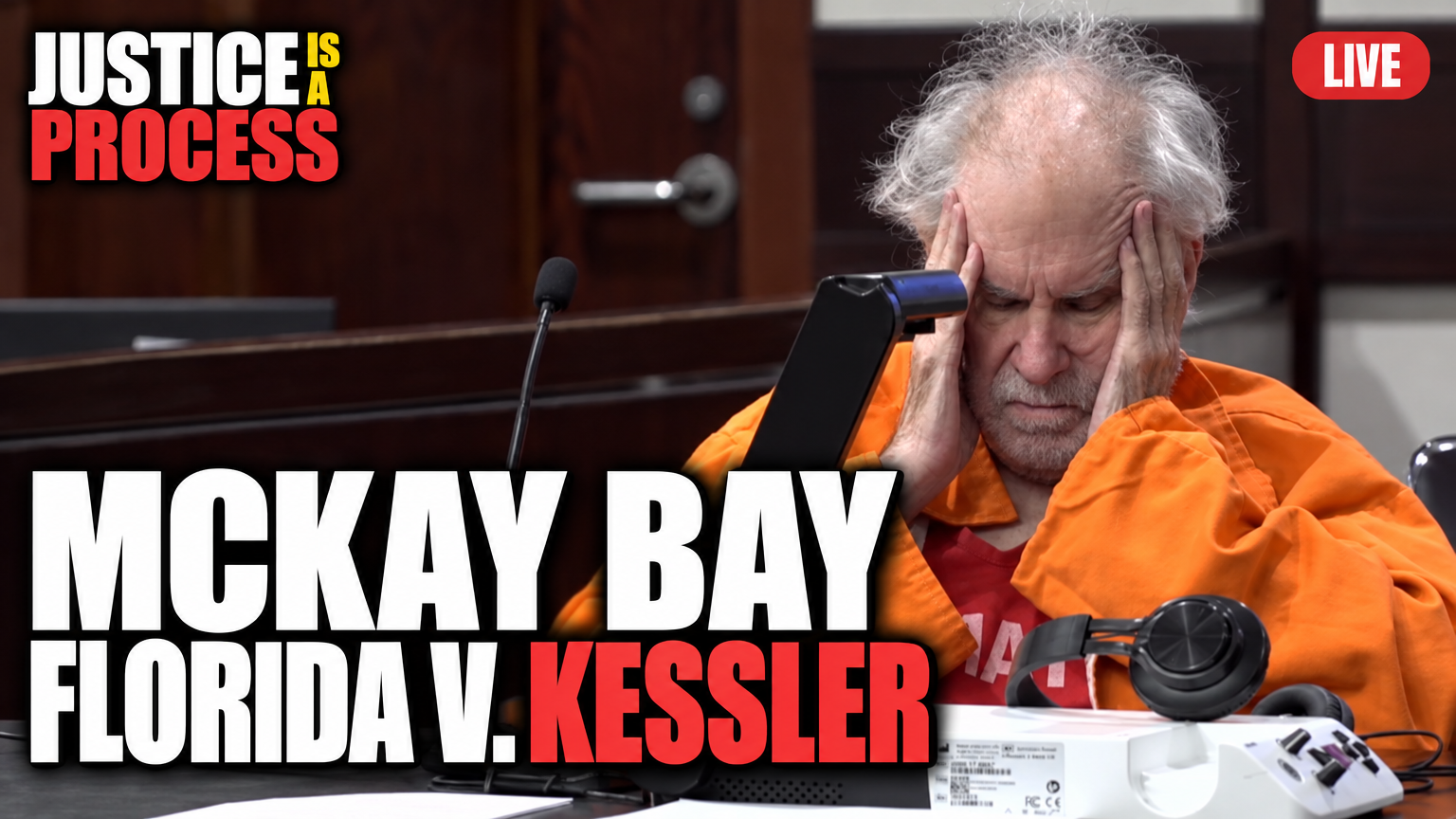
The McKay Bay Case. A 47-year-old woman from Erie, Pennsylvania disappeared in November 2021, and her remains surfaced in Tampa's McKay Bay. The State says Robert Kessler is responsible. It must prove who killed her when it cannot fully show how she died.
October 2026 | Justice Is A Process
On Friday, November 5th, 2021, a 47-year-old woman from Erie, Pennsylvania, made what investigators say was her last phone call. Her name was Stephanie Crone-Overholts. She had moved to the Tampa area about a year earlier. She had children, and a mother back in Pennsylvania who was used to hearing from her.
Six days later, on November 11th, a man fishing in Tampa's McKay Bay saw something floating in the water. It was a human leg. The same day, in Erie, Stephanie's mother called the police to report her daughter missing.
Over the next two days, more of Stephanie's remains came out of the bay. A tattoo on her leg, three hearts with the names of her children, is how police say they learned who she was. Investigators then traced her to a house in Lutz, a community north of Tampa, where she had been staying for about a week. The man who lived there, Robert Lee Kessler, was arrested in November 2021. A Hillsborough County grand jury indicted him for first-degree murder and for abuse of a dead human body. He has pleaded not guilty, and he is presumed innocent. Nothing in this report should be read any other way.
That was almost five years ago. The man who was 69 when he was arrested is 74 now. He has spent nearly all of that time in the Falkenburg Road Jail. His eyesight has failed to the point that, according to his own lawyers, he sees only shapes, and the Tampa Bay Times described him this fall as blind, pale and frail. For a stretch of the case, a judge found him not mentally competent to stand trial. The case became, in the words of the court, the oldest pending case in Hillsborough County.
Now the wait is over. On Monday, October 26th, 2026, jury selection began in a Hillsborough County courtroom in Tampa, and Law&Crime says it will stream the trial. Here is the thing you need to understand before a single witness takes the stand. The State has a great deal that points toward the bay. It has surveillance video. It says it has Stephanie's blood in her car and in the home. It has fishermen who say they saw a man throwing bags into the water. What the State may not be able to fully show is what happened to Stephanie before her remains went into the water. Her remains were recovered in pieces. At the time of Kessler's detention hearing in 2021, prosecutors told the judge they had not recovered her head or one of her arms. In January 2023, the case sat stalled while lawyers waited on a forensic anthropologist's report on how she died.
So this trial comes down to a question that sounds simple and is not. The State must prove who killed Stephanie Crone-Overholts when it cannot fully show how she died. That is the burden, and it is the State's alone.
This is Justice Is A Process. We are not here to convict Robert Kessler, and we are not here to acquit him. We are here because a woman from Erie is gone, and because a 74-year-old man who cannot see the courtroom is about to find out whether the system can prove its case against him fairly. Let's begin.
A word before the timeline. Everything in this section is an allegation. It comes from court filings, hearing testimony and news reports, and none of it has been proven to a jury. Where the reports disagree about a date or a detail, we will say so.
Stephanie Crone-Overholts was an Erie native. According to the Erie Times-News, she lived in Erie, in Millcreek Township, and in the Girard and Lake City area before she moved to Tampa in the fall of 2020. In early November 2021, she was staying at Robert Kessler's home in Lutz. Reports describe her as his housemate. According to reporting on the case, she had been there about a week, and she stayed in the bedroom of his young daughter, who was eight.
That detail matters for two reasons. First, the girl became a source for investigators. According to a police account reported by FOX 13, she told detectives that Stephanie and her father argued over money on November 5th, and that her father told Stephanie to leave. Second, we are going to treat that child with care. She has not asked to be in the news, and she will not be named here.
Prosecutors allege that Kessler killed Stephanie at his home on November 5th, 2021. Phone records, according to the reporting, placed both Kessler's phone and Stephanie's phone near the same cell tower when her last call was made that day. The daughter told detectives that her father later said Stephanie had been picked up by a boyfriend. Stephanie's car, according to the same reporting, stayed where it was.
Kessler told police a different story. In an interview on November 14th, he said she had left without telling him, and that he had not seen her since November 5th. The Tampa assistant police chief, Ruben Delgado, said at the time that his account "didn't add up."
The accounts of what happened next vary slightly from report to report, which is normal in a case this old and this widely covered. Here is the common thread. Witnesses told police they saw a man throwing black garbage bags, plastic bins and a red-pink tote into the water of McKay Bay. Some reports date this to November 6th or 7th, others to November 9th. Port of Tampa surveillance video, according to a report relayed by FOX 29, allegedly shows him throwing an object into the water. Police said cell phone photo data placed Kessler at the scene on November 9th.
Three fishermen told police they saw a man dumping containers and trash bags from the 22nd Street Causeway bridge in the days before the remains surfaced. One of them later identified Kessler in court. That identification is now one of the central fights before the jury, and we will come back to it.
On November 7th, surveillance video from a Pep Boys on Bearss Avenue allegedly shows a man parking Stephanie's car and walking away. According to the reporting, the video shows a man resembling Kessler driving the car to a parking lot and removing a white bag.
On Thursday, November 11th, a fisherman found a human leg in McKay Bay. More remains were found on November 11th and 12th. Police released a photograph of a leg tattoo, three hearts with names. Stephanie's family saw it and came forward. Her mother, Susan George, who lives in Girard, had already reported her missing in Erie that same day. Erie police shared what they had with Tampa police, and the two pieces fit.
An autopsy, according to court documents reported at the 2021 detention hearing, found injuries consistent with stab wounds near the neck and defensive wounds on one hand. We are repeating that sentence exactly as it was reported, because it is both the most serious piece of the State's account and the part the defense says the State cannot prove the way it wants to.
Tampa police searched Kessler's home on November 20th, 2021. According to the reporting, investigators found what they believed was Stephanie's blood throughout the home, including in his daughter's room, and on a pair of boots or shoes. Police also said they found her blood inside her car. The State later said DNA tests matched the blood in the house, on Kessler's shoes and in her car to Stephanie. The home was searched more than once. Later reporting says officers who first entered under a warrant for a cell phone noticed what looked like red stains on the walls, stepped out, and waited for a broader warrant. That first entry is the subject of a defense motion, and the judge has ruled on it.
Kessler was taken into custody around 5:30 p.m. on Tuesday, November 23rd, on an unrelated felony cocaine charge, according to Oxygen's reporting, and he was in the Hillsborough County jail when Tampa police announced the murder charge just before Thanksgiving. At first he was charged with second-degree murder and abuse of a dead human body. A grand jury indicted him the next month on first-degree murder, the charge he faces now.
His first appearances were unusual. According to the Tampa Bay Times and FOX 13, he refused to leave his jail cell for his first court appearance, and then he did not attend his detention hearing. His public defender waived his appearance both times.
Stephanie Crone-Overholts was 47 years old. She was an Erie native, a mother and a daughter. Her mother, Susan George, has been in the courtroom for this case through years of delays, and she told the Erie Times-News after one hearing, "We have been waiting for justice, and we are glad that we are moving toward justice." She added: "It is not going to be an easy trial." Because she filed the missing-person report, she is expected to be a witness.
Stephanie left Erie for Florida in the fall of 2020. People move for all kinds of reasons: work, weather, a clean start. We do not know hers, and we are not going to guess. What we know is that she did not come home, and that her children's names were the thing that finally told police who she was.
We say this at the top of every case, and we mean it every time. Stephanie is not the plot of a true crime story. She is a person whose life, and whose death, a jury now has to treat with exactness.
Robert Lee Kessler was 69 when he was arrested and lived in Lutz, Florida. He is 74 today. That is nearly all the public record gives us about his life. Reporting we have seen says little about his work, his family beyond his daughter, or his history, and we are not going to fill the silence with speculation. He was in the county jail on a drug charge when the murder case was filed. He has pleaded not guilty.
What the record does show is how the case has treated him. In 2023, according to the Tampa Bay Times, he was found incompetent to proceed, which in Florida means a judge decided he could not understand the proceedings or help his lawyers. He spent time in a state hospital. After treatment, a judge found him competent. Circuit Judge Robin Fuson made that finding on Friday, March 21st, 2025, and ordered another evaluation before a May status conference. The Times reports that a judge ruled him fit for trial roughly a year before this September.
Then the blindness. His vision has declined steadily since his arrest, and his hearing is, in the words of the Times, "not the best." Cataract surgery is part of the story: according to prosecutors, he refused the medication prescribed after it. His lawyer says that whatever the cause, he now sees only shapes. We will return to the constitutional questions that raises.
The lead prosecutor, according to the Tampa Bay Times, is Assistant State Attorney Scott Harmon of the Hillsborough County State Attorney's Office. Through most of the case, Kessler was represented by Assistant Public Defender Maria Dunker. We will report who sits at the defense table, and who speaks for Kessler, as the court confirms it.
A judge is not named in every report we have seen, and the reports we have seen disagree. Hillsborough County Judge Catherine Catlin ordered him held without bond in December 2021. Judge Robin Fuson handled the competency ruling and the trial date in 2023 and 2025. The Tampa Bay Times reported in September that Circuit Judge Nick Nazaretian would rule on the final pretrial matters, while another outlet attributes a September evidence ruling to Circuit Judge Christopher Sabella. We will name the judge presiding over the jury trial once we see him or her on the bench. Until then, we are not going to guess.
What it means: Florida law (section 782.04) calls a killing first-degree murder when it is premeditated, meaning the State proves the killer formed a conscious decision to kill, even if only a moment earlier, and then did it. It also covers certain killings during other serious crimes, but the reporting on this case describes a premeditated theory.
What the State must prove: That Stephanie Crone-Overholts is dead. That Robert Kessler is the person who caused her death. And that he did it with premeditation. All of it beyond a reasonable doubt.
Potential sentence: The State is not seeking the death penalty. A conviction on this count carries a mandatory sentence of life in prison without the possibility of parole.
The burden: Entirely on the State. Kessler does not have to prove anything, and does not have to say a word.
What it means: Florida law (section 872.06) makes it a crime to willfully and knowingly abuse a dead human body. It is a separate offense from the killing itself, and it can apply even to someone who did not cause the death.
What the State must prove: That the body was abused in that way, and that Kessler is the one who did it.
Potential sentence: It is a third-degree felony, with a maximum of five years in prison.
Read that second count again, because it explains the shape of this trial. Count 2 is the count the evidence of the bay speaks to most directly. The videos, the fishermen, the bins and the phone data all go to who disposed of Stephanie's remains. Count 1 is the count that needs the State to prove who killed her, and how, and with what intent. Florida Gulf Coast University law professor Pamella Seay, who has no connection to the case, said when the charges were filed in 2021 that the evidence seemed clearer on who disposed of the remains than on who caused the death. That sentence, said by an outside lawyer four years ago, is still a fair map of what this trial will test.
One more note on how the charge changed. The original arrest was for second-degree murder, which Florida defines as a killing showing a depraved mind without premeditation. The grand jury raised it to first-degree in December 2021. When prosecutors seek an indictment, they are the ones who choose the grand jury route, and a grand jury hears only the State's side. That is how the system is designed. It is also a reason why the trial matters: it is the first place the other side gets heard.
This case is going to trial because the State must prove who killed Stephanie Crone-Overholts when it cannot fully show how she died. Let's break down what that means, piece by piece, because it is the lens we will use for the entire trial.
First, the body. Stephanie's remains were found in pieces over two days. When Kessler was ordered held in December 2021, prosecutors said they had not recovered her head or one of her arms. In January 2023, the case stalled, and both sides said why. The prosecutor, Scott Harmon, said, "There is an issue because of the condition of the victim's body," and told reporters the State was waiting on a forensic anthropologist's report. The public defender, Maria Dunker, said, "We can't move forward too much without a cause or manner of death." That is a defense lawyer and a prosecutor, on the same day, agreeing that how Stephanie died was an open question.
The autopsy findings reported in 2021, injuries consistent with stab wounds near the neck and defensive wounds on a hand, are the State's best evidence on that point. A medical examiner will explain to the jury what the findings do and do not establish. The defense will have the chance to ask what the medical examiner can say, with confidence, about a body that was recovered incomplete and had been in the water.
Second, the identification. A fisherman told police he saw a man throwing items into the bay, and one of the three fishermen later identified Kessler in court. The defense says that identification was unduly suggestive, because detectives showed the witness a single photograph instead of a lineup of similar faces. Courts have long worried about that practice. A witness who is shown one photo and asked "is this him" will tend to say yes, and the memory that results can feel certain even when it started as a guess. The jury will hear how the identification happened and decide how much weight it deserves.
Third, the search. The State's physical evidence, the blood, comes from the home. The defense argued that investigators went beyond the scope of their warrant, which covered a phone and not the house at large. In September, the judge denied the motion to suppress and ruled the items were legally obtained and admissible. According to WTSP, the judge found the red stains were in plain sight when officers entered. That ruling means the jury will hear about what was found. It does not mean the jury has to believe it proves what the State says it proves.
The State's theory, as reported, is that Robert Kessler killed Stephanie Crone-Overholts at his home on November 5th, 2021, after an argument about money, then dismembered her body and disposed of it in McKay Bay. It points to the argument his daughter described, the phone data placing both phones near one tower, the blood in the home and in the car, the video of the car being parked, the fishermen, the Port of Tampa video, and Kessler's own account, which police say changed and which the assistant chief said did not add up.
The State also wants to put a text message in front of the jury in which Stephanie said she wanted to leave Kessler's home. The State has acknowledged that Florida law treats an out-of-court statement like that as hearsay, so it has to fit an exception. Expect a fight before the jury ever hears it.
The defense has said, publicly and in court, that it does not believe the State can show how Stephanie died. It has attacked the eyewitness identification and the search. It asked the court to dismiss the case entirely because of Kessler's blindness, arguing that he cannot meaningfully take part in his own defense. The judge heard that motion on Thursday, October 15th, called the argument a "fascinating discussion," and denied it.
The prosecution's response, filed October 5th, argued that the Constitution does not require a defendant to be able to see the witnesses against him, that the degree of his blindness is unknown, and that he refused post-surgery medication. The court is now looking for a qualified reader to describe visual evidence and courtroom proceedings to Kessler as the trial goes on.
One more detail from the last hearing. The judge asked, more than once, whether the two sides could reach a deal that would avoid a jury. Kessler himself raised the possibility of a plea and, according to the reporting, quoted Mark Twain. Both sides said a deal was not happening. A plea would have ended the case without a verdict. Its absence means twelve people will decide.
My father, Steven M. Askin, was a criminal defense attorney in West Virginia for decades. He taught me that a trial is not the State proving who did it. A trial is the State proving each charge, every element, with evidence that holds up under questioning. That is the lens we will hold up to this courtroom every day.
Watch what the medical examiner and the forensic anthropologist say, and how carefully they say it. A good expert tells a jury the limits of what a body can show. A cause and manner of death that rests on injuries in an incomplete set of remains is a harder thing to prove beyond a reasonable doubt than a death in a hospital bed. The question to watch is not whether Stephanie's body was treated horribly. The question is whether the evidence of her death is as strong as the evidence of what happened to her remains.
Identification evidence has sent innocent people to prison, and courts have spent decades learning why. Watch the cross-examination of the fisherman who named Kessler in court. Watch what the detectives say about how that identification happened.
The Sixth Amendment gives every defendant the right to confront the witnesses against him. The Fourteenth Amendment promises him due process. What do those rights mean for a man who sees only shapes? Prosecutors say the Constitution does not require that he see a witness's face. The defense says that without it he cannot take part in his own defense. The judge denied the motion, but the question does not go away at the courthouse door. It goes with Kessler to every witness. Watch how the court handles the reader it is seeking, how visual exhibits are described to him, and whether the jury sees a fair process. A conviction that rests on a trial the defendant could not follow is a conviction that can be reversed on appeal. That should concern everyone, including the family of the woman who died.
The jury may never hear about the years Kessler spent in a state hospital, but it is part of the case's story. A defendant found incompetent and later restored to competency is a lawful process, and Florida uses it often. Watch for any sign that the question comes back in front of the judge during trial. A trial cannot go forward if the defendant stops being able to understand it.
And watch the gallery. Susan George has waited almost five years. She was 70 when she spoke to the Erie Times-News in 2023. She is expected to testify about the day she reported her daughter missing. Whatever else happens, this trial is the first time anyone in her family gets to hear the evidence in public. That is the part of the process that does not make the headlines. It is the part we owe the most care.
Trials run on a vocabulary of their own. Here are the terms this case is going to put in front of you, in plain English, so that when a lawyer says one in the middle of a witness's testimony you know why the room just got tense.
Plain view. Police generally need a warrant to search a home, and a warrant has limits. But if an officer is lawfully standing where he is allowed to stand and sees something obviously connected to a crime, he can act on it. In this case, officers who entered under a warrant for a phone say they saw what looked like blood on the walls. The judge accepted that. What you will watch for now is not whether the evidence can be used. It is what the evidence actually shows once it is in front of the jury.
Hearsay. A statement made outside the courtroom, offered to prove that what it says is true, is usually barred, because the person who said it cannot be cross-examined. The text message in which Stephanie said she wanted to leave Kessler's home is a classic example. The State has acknowledged the rule. Whether it fits an exception is a question for the judge, and the answer will decide whether the jury hears her words in her own voice.
Confrontation. The Sixth Amendment guarantees a defendant the chance to confront the witnesses against him. The traditional picture is a witness who has to look the accused in the eye. Kessler's lawyer argued that a man who sees only shapes cannot confront anyone in that sense. The State answered that cross-examination is the confrontation, and that it does not depend on the defendant seeing a face. This is a real constitutional question, and we do not claim to know how an appeals court would rule.
Cause and manner of death. A medical examiner decides two separate things. The cause is the physical reason a person died, such as a wound. The manner is the category: homicide, accident, suicide, natural or undetermined. A forensic anthropologist is a specialist who studies bones and damaged remains to help answer those questions when a body is not intact. The defense has said that without an answer here, the case cannot move forward. Whatever the experts say, the jury decides what it is worth.
Competency. This is not the same as sanity at the time of the crime. Competency asks a different question: today, can this defendant understand what is happening in court and help his lawyer? A judge answered yes in 2025. The question can be raised again at any point, and a trial can stop if the answer changes.
Reasonable doubt. It does not mean any doubt at all. It means a doubt a reasonable person would have after weighing everything, one that comes from the evidence or from its absence. If the evidence leaves a juror with a real doubt about how Stephanie died, or about who caused it, the law tells that juror what to do: vote not guilty on that count. That is not a loophole. That is the job.
Ten days to two weeks is a short trial for a murder case this old, and that tells you something. This is a focused trial about one set of days in November 2021, one body, and one question. Expect the State to open with Stephanie's life and the day she went missing, bring her mother to the stand, move through the investigators, the fishermen, the video and the phone data, and build to its medical experts. Expect the defense to press hardest on how Stephanie died and on how the witnesses were shown Kessler's picture. The remains and the autopsy findings will be difficult. We will handle them with care, and we will tell you what the evidence shows without showing you anything that does not honor Stephanie.
No Breaks editions of each day. The Case Story every night.
The defendant is presumed innocent until proven guilty beyond a reasonable doubt.
Let's watch the system together.
We will follow this trial from the stream of the court's coverage through verdict. You will get No Breaks editions of each trial day, the testimony without the dead air; the Case Story trial podcast, which walks through what the jury heard piece by piece; and Top Moments, the exchanges that matter most. Members of the channel get the case notebook, where you can question the record yourself, every day's transcripts included.
This is not about deciding what happened in that house in Lutz before the jury does. It is about watching whether the State can prove what it says it can prove, and whether the system gives Robert Kessler every protection the Constitution promises while giving Stephanie Crone-Overholts, and the family that has waited five years for her, the honest answer they deserve. Those two things are not in conflict. A trial done right delivers both.
The defendant is presumed innocent until proven guilty beyond a reasonable doubt. That is not a technicality. That is the foundation of everything we do here.
Subscribe to Justice Is A Process on YouTube for live trial coverage, No Breaks editions, and breaking news as it happens.
🔴 Subscribe on YouTube86,000+ subscribers watching the system with us
Discussion