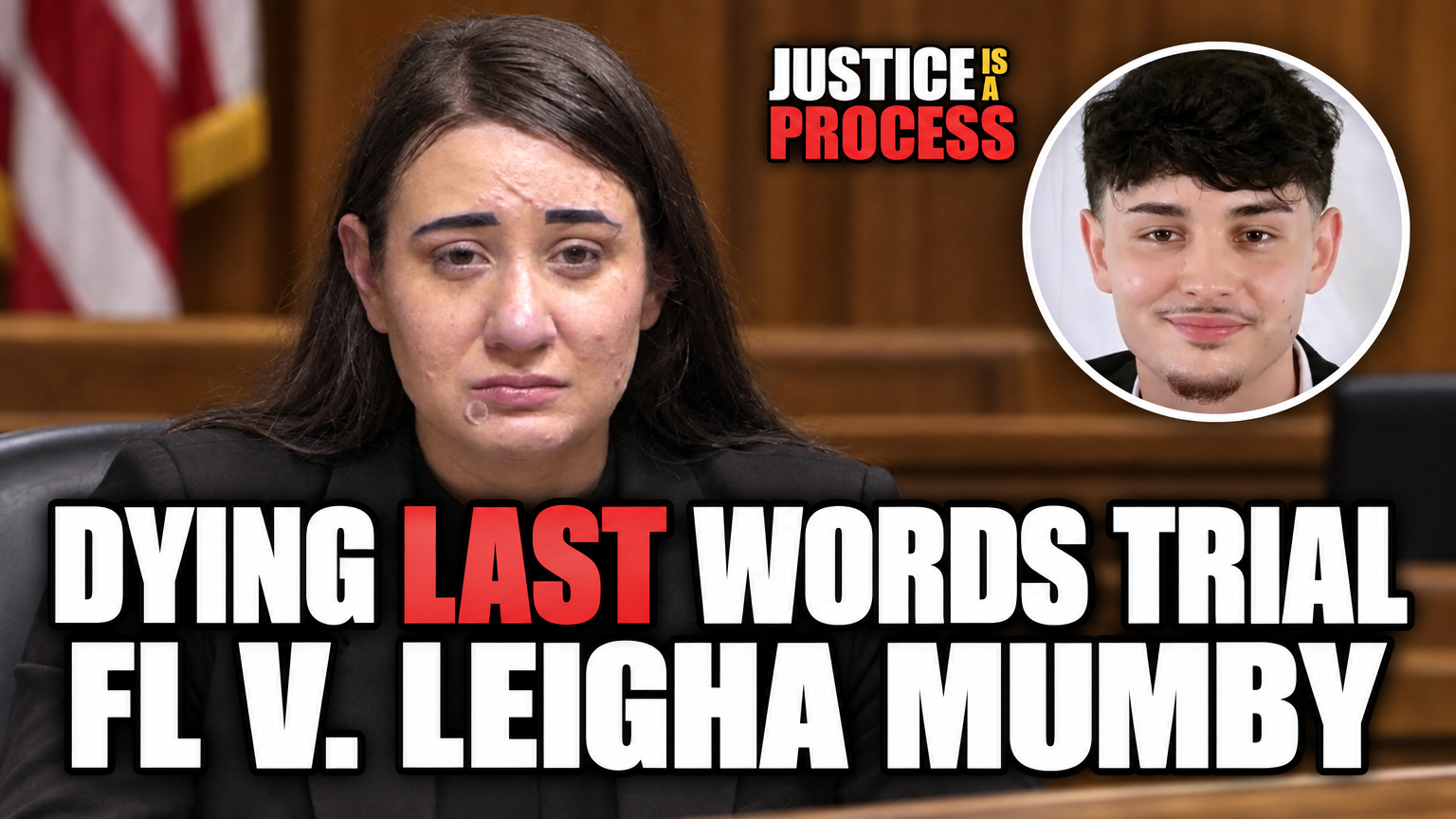
The Dying Last Words Trial: the jury will not hear him. What else will it not hear?
October 2026 | Justice Is A Process
On the night of February 9, 2025, Super Bowl Sunday, a white Honda Passport left the northbound lanes of Interstate 95 in Palm Coast, Florida, and hit a tree.
Two people were inside. Leigha Mumby was driving. Her boyfriend, Daniel Waterman, was in the front passenger seat. That morning, according to the reporting on this case, she had learned she was pregnant with his child.
Both of them came out of that car alive. Only one of them is alive to see the trial.
Daniel Waterman spent months in a coma. When he woke up, he could not speak. In May 2025, a Florida Highway Patrol investigator sat down with him, and Daniel answered the only way he could: with a letter board, one letter at a time. What he spelled out, according to the account of that interview carried by several news outlets, was an accusation. He said the two of them had been arguing. He said that before the car left the road, she told him this:
Nearly five months after that interview, on October 8, 2025, Daniel Waterman died. He was 22 years old. Within days, according to press reports, his daughter was born.
That interview is where this trial gets the name the public knows it by: the Dying Last Words Trial. That is the name this case carries, and it is the name we will use.
Here is what the name does not tell you.
The jurors who decide this case will not hear those words. Not from the investigator who took them down. Not from Daniel's family. Not from anyone. Before trial, Circuit Judge Dawn Nichols ruled that the statements Daniel Waterman made outside a courtroom are hearsay, and that they stay out. At that same hearing, the State dropped the one charge that required prosecutors to prove she meant to do it.
So here is the question this trial has to answer, and it is the question we will carry through every day of coverage.
Leigha Mumby is 25 years old. She has pleaded not guilty. She told investigators she could not remember what happened. She is presumed innocent, and that is not a courtesy we extend until the evidence gets uncomfortable. It is the rule, and it holds until jurors say otherwise.
We are not here to convict her and we are not here to clear her. We are a watchdog. We show you the process that is supposed to happen, and then we ask whether it is happening. A jury sees a deliberately limited slice of the world: whatever the judge lets in. In this case that limit is not a footnote. That limit is the story.
A family lost a son, and a little girl will grow up without her father. A young mother is on trial for causing his death. Both of those things are true at the same time, and a courtroom in Bunnell, Florida, now has to sort out what the State can actually prove.
This is Justice Is A Process. Let's begin.
Let's start with what the reporting says about February 9, 2025.
FlaglerLive, the local outlet that has followed this case most closely, reports that Leigha Mumby learned that morning that she was pregnant, and that Daniel Waterman was the father. That evening the two of them were at his cousins' house in Palm Coast to watch the Super Bowl.
At some point that night they left together in her white 2019 Honda Passport. She drove. He rode in the front passenger seat.
According to the account of the Florida Highway Patrol investigation that FlaglerLive published, she drove south on Interstate 95, turned around at the Palm Coast Parkway interchange, and headed back north. The crash happened on that northbound stretch, at mile marker 291, between the Palm Coast Parkway and Matanzas Woods Parkway exits. It was a single-vehicle crash. The Honda left the roadway and struck a tree.
We cannot give you a clock time. No source we could reach states one, and we are not going to guess.
Nobody else was in that car. There is no dash camera that we know of. What exists, as far as the public record shows, is a set of phone calls made in the minutes before the crash, and those calls are about to matter a great deal.
One call was with Daniel's cousin, Sarah Stappenbeck. FlaglerLive, describing the pretrial rulings, reports that she is expected to testify that Mumby told her on that call that she was bringing Daniel back to the family's residence "due to the difficulties she was experiencing with him," in the words FlaglerLive quoted.
Another call was with Mumby's roommate, Michael Tolbert. According to the same reporting, he is expected to testify that Mumby told him "the alleged victim was attempting to grab her phone before she hung up," again as FlaglerLive quoted it. The Daytona Beach News-Journal adds that she told the roommate she was driving Daniel home and did not want to be alone with him.
Read those two accounts again, because both sides are going to. A prosecutor can hold them up as an argument that was getting worse by the minute. A defense attorney can hold them up as a woman who was trying to end the night, get him home, and get away from a fight. The same words. Two very different stories. That is why the defense fought to get those calls in front of the jury, and we will come back to that fight.
The Florida Highway Patrol handled the crash. The lead investigator is Traffic Homicide Investigator Darin Harper, and he is expected to testify.
Modern cars keep a record. In the seconds before a crash, the vehicle's own computer logs how fast it was going and what the driver was doing with the controls. According to the published accounts of the Highway Patrol's findings, that data put the Honda at more than 90 miles an hour in the seconds before it left the road, with sharp steering inputs.
There is more in the published accounts about what that data shows in the very last seconds. We are deliberately not repeating it here. The record has not settled it, and that data belongs in front of you the same way it belongs in front of the jury: read by a witness, under oath, and tested on cross-examination. When that happens, we will report exactly what was said.
FlaglerLive reports that Investigator Harper determined Mumby intentionally swerved off the road to crash the car. That is an investigator's conclusion. It is not a finding of fact, and no jury has adopted it. Keep it in mind, though, because what happened to the word "intentionally" is one of the most interesting parts of this case.
As for Mumby, FlaglerLive reports she told a Highway Patrol investigator that she could not remember what happened. Body camera video from the scene reportedly captures her in distress.
For months after the crash, the one other person who was in that car could not tell anyone anything. Daniel Waterman was in a coma.
Then he woke up. FlaglerLive dates the interview to May 15, 2025. Daniel still could not speak, so he used a letter board to answer the investigator's questions. According to the reporting, he said they argued, and he said that Mumby told him, "I don't care what happens, you'll get what you deserve," before the car left the roadway.
We want to be precise about what that is. It is a statement given to a law enforcement investigator, months after the event, by a gravely injured man, and never tested by a single question from the other side. That does not make it false. It does not make it true. It makes it untested, and the entire legal fight in this case grows out of that one word.
Two months after that interview, in mid-July 2025, Leigha Mumby was arrested. The original charges were aggravated battery with a deadly weapon and reckless driving causing serious bodily injury. She was booked and released on a $25,000 bond. Prosecutors filed the formal charging document, called an information, on August 4, 2025.
At that point this was a case about a man who had been badly hurt. On October 8, 2025, it became a case about a man who died.
Late that month, prosecutors amended the information to add a charge of vehicular homicide. In Florida, prosecutors can file felony charges like these directly, without a grand jury, and that is what the reporting says happened here. Mumby turned herself in on October 29, 2025, and was released again, this time on a $150,000 bond.
That is how the case reached the public: a local story about a terrible crash, then a story about a young man's statement from a hospital bed, then a homicide charge against the mother of his newborn child.
Daniel Waterman was 22 years old when he died. His family is from Liverpool, New York, a suburb of Syracuse. He had cousins in Palm Coast, and that is whose house he was at on Super Bowl Sunday.
We are going to be honest with you about a gap. The public record we could reach tells us very little about who Daniel was before February 9, 2025. We do not know what he did for work or what he wanted out of life. What the reporting does show is the eight months after the crash, and those months say something about the people who loved him.
He spent months at Halifax hospital in Daytona Beach, and FlaglerLive describes his family at his bedside through that stretch. He was later transferred to a hospital in Syracuse, closer to home. His mother is Heather Waterman. When the judge made her rulings on September 30, 2026, the News-Journal reported that his family was watching by video.
Daniel never met his daughter. She was born, by the reported accounts, days after he died. After her birth, Heather Waterman filed in court for grandparent visitation and later voluntarily dismissed that filing, according to FlaglerLive.
So when we talk about hearsay and exceptions and the rules of evidence in the sections below, remember who is sitting in that gallery. A mother who watched her son fight for eight months is being told that a jury will not hear the last account he gave. Whatever you think the law requires, do not pretend that costs her nothing.
Leigha Mumby is 25. She formerly lived in Flagler Beach. FlaglerLive reports she has since moved to Clay County, in northeast Florida.
She has been out on bond for the life of this case. She posted bond after her first arrest in July 2025, and again after she turned herself in on the homicide charge that October. No source we found reports any violation or revocation since.
She has pleaded not guilty. Her attorney entered those pleas on her behalf in November 2025.
She is also a mother. The child she learned about on the morning of the crash was born in October 2025. That child is the daughter of the man she is accused of killing, and the granddaughter of the family sitting on the other side of the courtroom. There is no version of this trial that ends cleanly for that little girl.
And here is the part we will keep repeating: Leigha Mumby has not been convicted of anything. An investigator's conclusion is not a verdict. A news headline is not a verdict. A nickname is not a verdict. She walks into that courtroom presumed innocent, the State carries the entire burden, and she does not have to prove a thing.
Circuit Judge Dawn Nichols presides. The case sits in Florida's Seventh Judicial Circuit, in Flagler County, and the trial is being held at the Kim C. Hammond Justice Center in Bunnell.
Judge Nichols made the rulings that define this trial, and she did not pretend they were painless. Court TV reported her words from the bench at the September 30 hearing. She said, "I can certainly understand why individuals would be very upset with the evidentiary ruling," and she said, "The court is bound by the law and the court is bound by the rules of evidence," as she explained why she ruled the way she did.
Assistant State Attorney Melissa Clark is prosecuting the case. She took it over from an earlier prosecutor, according to FlaglerLive.
Reid Hart, a Jacksonville attorney, represents Leigha Mumby. He has not, as far as we could find, made any public statement about the defense theory. Everything we know about where the defense is headed comes from the motions he filed and the arguments he made in court. We will walk through those below.
Darin Harper, the Florida Highway Patrol Traffic Homicide Investigator. He ran the crash investigation, and he drew the conclusion that put this case in motion.
Sarah Stappenbeck, Daniel's cousin, who was on the phone with Mumby before the crash.
Michael Tolbert, Mumby's roommate, who was also on the phone with her, and who has been told by the court that there are things he heard on that call that he may not repeat to the jury.
Anthony Fairbanks, an accident reconstruction expert the defense has listed, according to FlaglerLive. If he testifies, expect him to give the jury a second reading of what the car did.
Two charges go to the jury. A third was dropped twelve days before jury selection. Let's take them one at a time, in plain English.
One caution first. We have not read the charging document, so we cannot tell you which count is numbered one and which is numbered two, or the exact subsections the State cited. What follows is the general Florida law for each charge. The version of each statute that was in force on the date of the crash is the one that governs.
The law: Florida Statutes, section 782.071.
What it means: This is not a murder charge. The State does not have to prove she wanted Daniel Waterman to die. Florida defines vehicular homicide as the killing of a person caused by someone operating a motor vehicle "in a reckless manner likely to cause the death of, or great bodily harm to, another."
What the State must prove: That Daniel Waterman is dead. That his death was caused by the way Leigha Mumby operated that vehicle. And that she operated it recklessly, in a way likely to kill or seriously hurt someone. Not carelessly. Not badly. Recklessly.
Potential sentence: It is a second-degree felony. FlaglerLive reports a maximum of 15 years in prison.
The burden: Entirely on the State, beyond a reasonable doubt, on every one of those elements.
The law: Florida Statutes, section 316.192.
What it means: Florida's reckless driving statute, as it reads online in its current edition, covers anyone who drives a vehicle "in willful or wanton disregard for the safety of persons or property," and when that driving causes serious bodily injury to another person, the offense becomes a felony.
What the State must prove: That she was driving. That she drove with a willful or wanton disregard for safety, which means more than a mistake and more than a moment of bad judgment. And that the driving caused a serious bodily injury, which the statute describes as a physical condition that creates a substantial risk of death, serious disfigurement, or a lasting loss of the use of a part of the body.
Potential sentence: It is a third-degree felony. FlaglerLive reports a maximum of 5 years in prison.
The burden: Entirely on the State, beyond a reasonable doubt.
Add those together and the reported maximum exposure is 20 years. This is not a death penalty case. There is no penalty phase and no second trial on punishment. If jurors convict on either charge, the judge decides the sentence.
What it was: The first and most serious charge filed in July 2025, a second-degree felony.
Why it mattered: A battery is an intentional act. To convict on this charge, the State would have had to prove she meant to do it. This was the charge that matched the investigator's conclusion and matched what Daniel Waterman said from his hospital bed.
What happened to it: The State dropped it at the September 30, 2026 hearing. The Daytona Beach News-Journal reported the prosecutor's explanation: that charge depended on Mumby's intent. It came at the same hearing where Daniel's statements were ruled out. While it stood, the maximum exposure reported in this case was 35 years.
Notice what just happened to this case, because it changes everything about how you should watch it. The State's own investigator reportedly concluded she crashed that car on purpose. The trial that is actually happening does not ask the jury that question. It asks a different one: was the driving reckless, and did it cause his death?
Every case that reaches a jury is there for a reason. Something is in dispute that the two sides could not resolve. Here it is.
The State's account of this case began with a voice. A man who was in the car said she did it on purpose and quoted her saying so. That voice produced an investigator's conclusion and an intent charge.
Then the voice was gone. Daniel Waterman died, and under the rules of evidence a man who cannot be cross-examined generally cannot accuse someone from beyond the courtroom. The judge kept his statements out. The intent charge went with them.
What remains is a recklessness case built from circumstantial pieces: what a car's computer recorded, what two people on the other end of a phone heard her say, and what a trooper can testify to. The defense gets to say that is not enough. The State gets to say it is plenty. And we get to ask the question underneath both: when a jury sees this little of what happened inside that car, is it a fair trial for anyone?
Strip away what was excluded and the State's theory still has a clear shape. Prosecutors say this was a couple in the middle of an argument, in a car traveling at more than 90 miles an hour on an interstate at night, and that the car left the road because of how she drove it.
The prosecutor has told the court she does not need intent to win. The News-Journal reported that Melissa Clark said she does not have to prove intent for the vehicular homicide charge. That is correct as a statement of the law. Recklessness is the standard.
Based on the reporting, the State's proof will likely include the vehicle's recorded data, Investigator Harper's testimony about the scene and the investigation, the testimony about the phone calls, and medical evidence. FlaglerLive reported that Daniel Waterman's autopsy report was added to the State's evidence list after his death.
The defense has not announced a theory, and it does not have to. A defendant can sit silent through an entire trial and argue only that the State failed to carry its burden.
But the motions tell a story. Reid Hart fought to keep Daniel's statements out, arguing they were hearsay and that using them would violate Mumby's Sixth Amendment rights. He fought to get the phone calls in. Court TV reported his argument that the roommate's call offers insight into what was happening inside the car and into her state of mind. He has pointed to a 911 recording from after the crash, which the News-Journal reported he says shows her asking for help, as evidence she did not crash on purpose. He has listed an accident reconstruction expert. And his client told investigators she does not remember.
Put those together and you can see the room the defense has built for itself. FlaglerLive's reporter read it this way: the defense has space to argue the car left the road accidentally. That is a journalist's reading and not a statement from the defense, so treat it as a possibility. We will know the real theory when Hart stands up for his opening statement.
The hearing on September 30, 2026 decided what this jury will and will not be told. Here is each piece, as reported.
Out: everything Daniel Waterman said. The judge granted the defense motion. "The out of court statements are considered hearsay," the order says, as FlaglerLive quoted it. That covers the letter board interview with the Highway Patrol, and by the reported accounts it covers statements to his family as well.
What makes this ruling unusual is what the State said about it. Court TV reported that the prosecutor at the hearing told the judge, "I would like to use them," and then conceded the point: "I don't have an exception to the hearsay rule that would allow me to use them."
Think about that. The State did not lose a close argument. The State told the court it had no legal ground to stand on.
In: the cousin's phone call. Sarah Stappenbeck may testify about what Mumby told her on the call before the crash. The defense asked for this. What Mumby said goes to her state of mind in those minutes.
In, with limits: the roommate's phone call. Michael Tolbert may testify to some of what Mumby told him. Court TV's phrase is that the statements come in "with limits." The News-Journal reported that the judge ruled some of his statements inadmissible. FlaglerLive and the News-Journal agree on one of those limits: Tolbert may not tell the jury what he heard Daniel Waterman say on that call.
Stop on that one. The same hearsay wall that keeps out Daniel's accusation also keeps out Daniel's voice on the phone in the minutes before the crash. We do not know what he said on that call. We do not know which side it would help. Neither will the jury.
Out: Mumby's personal life. The State wanted to tell the jury about parts of Mumby's life and relationships outside of that car ride. FlaglerLive reports the judge granted a defense motion barring evidence that she was involved in any other "crimes, wrongs, or acts." Court TV reports the judge ruled that discussion of what was described in court as a "unique, interesting relationship" is inadmissible unless testimony at trial opens the door to it.
Out: lawsuits and insurance. FlaglerLive reports the judge granted a defense motion to keep out any matters relating to civil litigation or insurance claims.
Gone: the intent charge. The State dropped aggravated battery at the same hearing.
Not settled, and not described here: the 911 recording. There is a ruling on whether the jury hears it. We are not going to tell you which way it went, because the published record does not settle it and we have not read the order. The moment it is settled in open court, you will hear it from us.
Other coverage will tell you what happened in court each day. We are going to do that too. But the reason this channel exists is to ask whether the process is working, for everyone it touches. Here is what we will be watching, and here are the questions the record supports asking.
The Sixth Amendment gives every person accused of a crime the right to confront the witnesses against them. In plain English: if someone is going to accuse you, they have to do it in court, under oath, where your lawyer can question them and the jury can watch them answer.
Daniel Waterman gave his account to a Highway Patrol investigator. It was not testimony. No one cross-examined him on Leigha Mumby's behalf. And now no one ever can.
It is easy to hear that and think the system is protecting the wrong person. I understand that reaction. I would ask you to hold it up against one fact: this rule does not exist for Leigha Mumby. It exists for you. It is the reason the government cannot convict you with a statement you were never allowed to challenge. I grew up as the family member of a criminal defendant, and I learned early that the rules protecting the accused are the same rules that protect every one of us. They do not get to switch off when the accusation is heartbreaking.
And still. The question we are going to keep asking is the other half: is it a fair trial for the State, and for Daniel Waterman's family, when the most direct account of what happened is one the jury will not hear? Both questions are real. A watchdog asks both.
The law has known for centuries that some people will not live to testify. So the rules of evidence carry a narrow exception for it.
Florida's version sits in section 90.804 of the Florida Statutes, the list of hearsay exceptions that apply when the person who made the statement is unavailable. It covers a statement made by a person "while reasonably believing that his or her death was imminent," about the cause or circumstances of what that person believed was their impending death.
That is the rule. Here is what we know about how it played in this courtroom: the prosecutor told the judge she had no hearsay exception that would let her use the statements. We know Daniel gave his interview in May 2025 and died that October. We have not read the written order, so we are not going to tell you what reasoning the judge put on paper.
What we will watch is whether any piece of this comes back during trial. Rulings made before trial are not always the last word.
This may be the single most important thing to watch in the State's case.
Investigator Harper reportedly concluded that Mumby crashed the car intentionally. The charge that required intent is gone. The statement that most directly supported intent is excluded.
So what does he tell this jury? Does the State ask him for his conclusion at all? If he gives one, what is it based on: the car's data and the scene, or an interview the jury is not allowed to hear about? If an excluded statement shaped an investigator's opinion, and the opinion comes in, has the statement come in through the back door?
We do not know the answers. The record supports asking, and we will be listening closely to every objection during his testimony.
The whole case now rests on one word. The State has to prove recklessness beyond a reasonable doubt, and recklessness is a higher bar than carelessness.
Expect this to become a contest between readings of the same machine. The State's investigator will explain what the car's data shows. The defense has an accident reconstruction expert listed. Watch what each one says about the final seconds, and watch what each one concedes on cross-examination. We will report the data when it is read into the record, in the words of the witnesses who read it.
And remember what the jury has been given to explain why the car did what it did: a pregnancy discovered that morning, an argument, two phone calls, and a defendant who says she does not remember. Is that enough to tell reckless driving apart from a crash during a fight in a moving car? That is for the jurors. It is exactly the kind of question the reasonable doubt standard was built for.
Vehicular homicide requires the State to prove the driving caused the death. Daniel Waterman died eight months after the crash, in a hospital in another state.
No source we found says the defense intends to contest causation, and we are not suggesting it will. But the State carries the burden on that element like every other, and the autopsy report is on its evidence list for a reason. Watch how the medical testimony connects February to October.
Remember the condition attached to the ruling on Mumby's personal life: it stays out unless testimony opens the door.
That is a live wire running through this entire trial. If a witness says something that makes the excluded material fairly relevant, the other side can ask the judge to let it in after all. One loose answer from one witness can change what this jury knows. If it happens, the frame of this trial shifts in a single afternoon, and we will bring it to you the moment it does.
Here is a question about fairness to the accused. This trial is publicly known by a name that describes the very evidence the judge ruled the jury may not hear. The people being asked to serve live in Flagler County, where this case has been local news for about a year.
How did the court ask prospective jurors what they had already read and heard? We have not seen a report of how jury selection went, and we do not know. That is a question and not an accusation. The answer matters, because a ruling that keeps a statement out of the courtroom means much less if the statement is already in the jurors' heads.
The court has taken at least one step to keep outside pressure away from the jury. FlaglerLive reports Judge Nichols signed an order, with both sides' approval, barring clothing or signs in the courtroom that show support for either side. The same report notes a public rally was called at the county courthouse in Bunnell.
Two pieces of this case are deliberately missing from this report: whether the jury hears the 911 recording, and what the car's data shows in the final seconds. Published accounts exist. They are not settled, and we do not put unsettled claims in front of you as fact. Watch for both. We will report each one when the record does.
This channel honors the legacy of my father, Steven M. Askin, a criminal defense attorney. The lesson I took from his life in courtrooms is the one this case tests: a rule of evidence is not a favor to one side. It is a promise about how the government has to prove its case against any of us. Sometimes keeping that promise is painful, and this is one of those times. Our job is to watch whether the promise is kept, and to say so out loud when it is not, no matter which side it cuts against.
We are going to tell you what we do not know, because that is part of honest coverage. No source we could reach gives an expected length for this trial or a witness count. The case number itself was not in any report we read. When the court puts those on the record, we will update you.
Here is what the pretrial record does tell us. The State's case will run through Investigator Harper and the car's data. Sarah Stappenbeck and Michael Tolbert are expected to testify about the phone calls, inside the lines the judge has drawn. The defense has an accident reconstruction expert, Anthony Fairbanks, on its list.
Will Leigha Mumby testify? We do not know. That decision is hers alone, she does not have to make it until the State has rested, and the jury will be instructed that it cannot hold her silence against her if she chooses not to.
There is one trial and one phase. If the jury acquits, it is over. If the jury convicts, sentencing goes to Judge Nichols.
Expect this trial to move in two parts. During the State's case, the question each day is simple: what is this jury being allowed to hear about the last minutes in that car, and is it adding up to recklessness? When the defense takes over, the question turns: what does her side of that car ride look like, through an expert's reading of the data and through the calls?
And through all of it, keep one eye on the door.
Our coverage of State of Florida v. Leigha Mumby begins with Day 1 and runs through the verdict.
You will get NO BREAKS EDITIONS of each trial day, so you can watch the testimony straight through without the dead air. You will get THE CASE STORY, told in parts, so you can follow this trial from the first witness to the last in order. You will get KEY MOMENTS, the exchanges that change the case, cut so you can hear every word. And you will get commentary from me when the record raises a question that needs to be asked out loud.
Every piece will carry the same question you just read: what can the State prove without him, and what is the jury not being told by either side?
We will tell you what the jury heard. We will also tell you what the jury did not hear, and we will always tell you which is which. That line matters in this case more than most.
Here is what I am asking of you while you watch. Keep two lists. On the first, write down what the State proved with a witness on the stand and the other side free to ask questions. On the second, write down everything you know only because you read it somewhere, including in this report. The verdict is supposed to come from the first list alone. That is what the jurors are being asked to do. Try it, and see how hard it is.
This is not about speculation. It is not about picking a side on Day 1. It is about watching the system do its work and asking whether it did that work fairly.
Leigha Mumby is presumed innocent until proven guilty beyond a reasonable doubt. That is not a technicality. That is the foundation of everything we do here. We are not the jury, and only the jurors decide.
Let's watch the system together.
Subscribe to Justice Is A Process on YouTube for live trial coverage, No Breaks editions, and breaking news as it happens.
🔴 Subscribe on YouTube86,000+ subscribers watching the system with us
Discussion