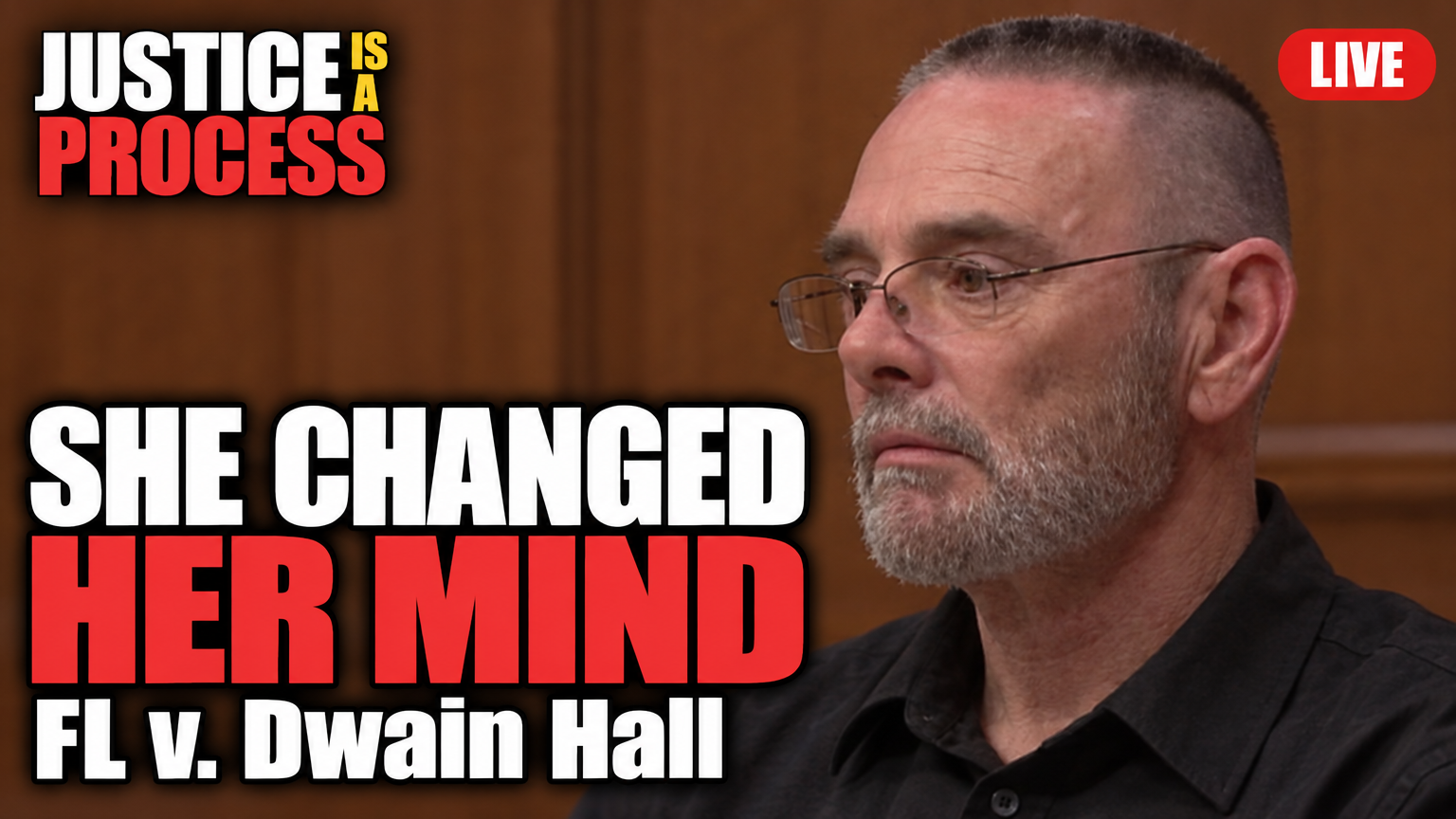
She flew from England to meet him. The State says she changed her mind. Can it prove he held her and killed her anyway?
November 2026 | Justice Is A Process
On October 10th, 2025, Sonia Exelby stepped off a plane at Gainesville Regional Airport in north central Florida. She was thirty-two years old. She had flown more than four thousand miles from Portsmouth, on the south coast of England, to meet a man she had known for about two years but had never stood in a room with.
She was booked to fly home three days later. She never made that flight.
Four days after the plane left without her, investigators from the Florida Department of Law Enforcement and the Marion County Sheriff's Office found her in a shallow grave in the woods of Marion County. The medical examiner counted four sharp-force wounds and ruled her death a homicide.
The man who picked her up at the airport was Dwain Hall, a fifty-four-year-old from Ocala who ran a one-man roadside assistance business. He is now on trial for her murder and for kidnapping her. He has pleaded not guilty to both.
Here is what makes this case unlike almost any other you will watch. According to the State's own filings, Sonia Exelby did not come to Florida for a vacation. The police affidavit says she came intending to die. It says she had tried to make this same kind of trip once before, in 2024, and that British authorities stopped her and got her treatment. And it says she and Hall had talked about it, online, for a long time before she ever boarded a plane.
You might think that ends the conversation. It does not. It is where this trial begins.
Because prosecutors say that within about a day of landing, something changed. They point to messages Sonia sent a friend from inside the rental where Hall had taken her. She wrote that the night had been terrible. She wrote that she was scared, that she was broken and in pain, that all she could do was lie there. She wrote that he had taken her phone and locked her in, because he did not trust her with it. The State says those words are the sound of a woman who changed her mind. And the State says that what happened after she changed her mind is a kidnapping and a premeditated murder.
Hall has told investigators that he knew her, that he was with her, and that he was the last person to see her alive. He has not admitted killing her. He does not have to prove anything to anyone. The burden in that courtroom belongs to the State of Florida, all of it, from the first witness to the last.
So this is the question twelve jurors in Ocala will answer: if Sonia Exelby came to Florida wanting to die, and then wanted to go home, can the State prove beyond a reasonable doubt that Dwain Hall held her there against her will and killed her anyway?
We are not here to convict him. We are not here to acquit him. We are here to watch whether the system does what it promises to do: prove its case with evidence, in the open, while protecting the rights of the accused and honoring the dignity of a woman who cannot speak for herself anymore.
Sonia Exelby was a daughter, a sister and a fiancée. She struggled. People loved her. Her family is coming to this trial from across an ocean. Whatever brought her to Florida, she did not forfeit her right to justice by getting on that plane.
This is Justice Is A Process. Let's begin.
Everything in this section comes from police affidavits, court filings, pretrial testimony and the reporting around them. None of it has been tested in front of this jury yet. When you read "prosecutors allege" or "investigators say," take it literally. These are accusations, and the trial exists to test them.
According to court filings, Sonia Exelby and Dwain Hall first connected in 2023 on a website built around extreme adult content. Prosecutors say they kept talking for roughly two years, on that site and on a messaging app. At a pretrial hearing in November 2026, an FDLE special agent testified that Hall admitted keeping a profile on that site under a username built around the word "sadist," and that his own profile described him that way.
The affidavit says something else about those years, and it is the hardest part of this case to sit with. Investigators say Sonia had been struggling for a long time. They say that in 2024 she messaged people about traveling to the United States so that someone there would kill her, and that the attempt was stopped and she received treatment. The affidavit says evidence on her computer showed that by 2025 she was again in crisis and again planning to travel.
Filings reported in August 2026 add one more piece. Prosecutors say Sonia agreed to pay Hall four thousand dollars, money he wanted toward a debt he owed the Internal Revenue Service.
Sit with that for a moment, because the defense certainly will. The State's own paperwork describes a woman who wanted to die and a man she found who talked with her about it. That is the backdrop the State has chosen to put in front of this jury, and it is not a comfortable one for the prosecution. The State has to explain why a plan she allegedly made with him is not the end of the story.
Investigators say that before Hall ever picked Sonia up, he went shopping. According to the affidavit and later reporting, he bought rope, parachute cord, gun cleaner and deodorant, and a shovel, at a Walmart in Gainesville. Prosecutors will use the timing of those purchases to argue premeditation, meaning that a plan to kill existed before she arrived. The defense may argue the opposite: that items bought before her arrival fit the arrangement the State itself describes, and say nothing about a decision to kill a woman who had changed her mind.
That tension, between what was planned and what the State says happened after the plan collapsed, runs through every piece of evidence in this trial.
On October 10th, 2025, Sonia landed in Gainesville. Investigators say Hall collected her and drove her to an Airbnb in Reddick, a small community in northern Marion County. Police say the two had sex there several times over that weekend.
On October 11th, according to investigators, someone tried again and again to move money out of Sonia's bank account. Seven charges to her British debit card were declined. One payment of about twelve hundred dollars went through, routed through Hall's roadside assistance business, where investigators say he was the only employee. Court records say Hall later told investigators he had become frustrated that only about twelve hundred dollars could be processed. Prosecutors allege those charges came after he discovered she had not brought the cash she promised.
And then come the messages. Prosecutors say that within about a day of arriving, Sonia wrote to a friend online. "Last night was so bad," she wrote, according to filings. She wrote that she was so scared, so broken and in so much pain that all she could do was lie there. She wrote that Hall had taken her phone and locked her in the Airbnb because he did not trust her with it. Another message, reported from the investigation, reads simply: "I can't kill anyone."
Investigators also recovered a deleted video from Hall's phone. Prosecutors say it shows Sonia on a couch, visibly bruised, while a man off camera questions her about what she will agree to. Hall later acknowledged recording a video and said he had deleted it. The State calls that video direct evidence in this case. Expect it to be one of the most difficult moments of the trial, and expect the defense to fight over what it does and does not show.
Sonia was due to fly home on October 13th. She did not board. Back in England, the police received a missing-person report, and British authorities asked INTERPOL to put out an alert that she was missing and endangered. That alert is what pulled the Florida Department of Law Enforcement into the case.
On October 13th and 14th, police called Hall about the card transactions. According to NBC News' account of the affidavit, he first told them an unknown woman had called for roadside assistance and that her cards had been declined. He said he did not know Sonia Exelby.
Investigators say Hall's phone records led them to a wooded area of Marion County. Cadaver dogs alerted on disturbed soil. On October 17th, 2025, officers found Sonia's body there in a shallow grave. Reporting on the investigation says a product label matching the shovel was found in the soil. The medical examiner found four sharp-force injuries and ruled the death a homicide.
That same day, deputies stopped Hall on Interstate 75 near Ocala. In the interviews that followed, investigators say, his account moved. He went from not knowing her, to admitting he had met her, to admitting they had been together at the Airbnb, had sex several times, and had talked about her wish to be killed. An FDLE agent later testified that Hall said Sonia "was happy with what happened with her," and that he described himself as the last person to see her alive. He did not admit to killing her.
Then there is the knife. Investigators say that after they first contacted Hall, he sent a package, including a seven-inch knife and other items, to an associate in Ohio and asked that person to hold it. Investigators recovered the knife. Reporting says blood on it matched Sonia's DNA. Her DNA was also reportedly found on a shovel in Hall's garage. Prosecutors say Hall's messages with the Ohio associate referred to a "storm" coming.
If the jury believes the knife was mailed away to keep it out of investigators' hands, the State will argue that it shows consciousness of guilt: the behavior of a man who knew what the knife would prove. The defense may ask the jury to look hard at the chain of custody, at who handled that package, and at what the person in Ohio knew and said.
Hall was already in custody on charges of fraudulent use of credit cards and unlawful use of a two-way communications device, charges tied to Sonia's card. On November 17th, 2025, FDLE announced that he had been arrested for her murder and kidnapping. FDLE Commissioner Mark Glass said, "This type of violent crime and disregard for human life will not be tolerated in our state." In December 2025, a Marion County grand jury indicted Hall on first-degree murder and kidnapping. He has been held without bond ever since.
It would be easy to let this trial turn Sonia Exelby into a set of messages and a set of photographs. We will not do that here.
Sonia was from Portsmouth, a port city on England's south coast. She was thirty-two, a classically trained musician who, coverage says, taught music. She had two sisters, Gemma Isaj and Sara Exelby, and a fiancé, Stevie Hunt. Her family has spoken publicly about a beautiful young woman they loved and about their nerves ahead of a trial in a country most of them had never visited. Before the trial, the family asked for help just to make the journey to Florida. Prosecutors have said her sisters and her fiancé were asked to testify about her life and her circumstances, and reporting says some of them will give evidence by video link from England for health reasons.
We also know, from the State's own filings, that Sonia carried real pain. Investigators describe a woman who had been in crisis before, who had been helped before, and who was in crisis again in 2025. That is not a detail that makes her less of a victim. If anything, it is the reason the law exists in the first place. The vulnerable are exactly the people the criminal law is supposed to protect.
Her family asked prosecutors not to offer Hall anything less than life in prison. The prosecutor told the court there would be no plea offer below that, at the family's request.
Dwain Hall is fifty-four (some reports say fifty-three) and lived in Ocala, where he ran a roadside assistance business on his own. Before the murder charge, he was arrested on fraud-related charges connected to Sonia's debit card.
What the public knows about Hall comes almost entirely from the State: the affidavit, the testimony of investigators at pretrial hearings, and the accounts of his interviews. Investigators say he admitted the online relationship, the meeting, the Airbnb and the video. They say he told them she was happy with what happened. They say he never admitted killing her.
Dwain Hall is presumed innocent. That is not a courtesy. It is the law. Every allegation in this report is an allegation until twelve jurors decide otherwise, and he has no obligation to testify, to call a single witness or to explain anything. If the State cannot prove its case, the law says he walks out of that courtroom, whatever anyone watching believes.
The case is assigned to Circuit Judge Timothy McCourt of Florida's Fifth Judicial Circuit, sitting in courtroom 4C of the Marion County Judicial Center in Ocala. Judge McCourt has already made the biggest evidentiary call of the trial, on what images from Hall's phone the jury may see, and he will manage a courtroom where some of the most graphic evidence imaginable must be handled without turning the trial into a spectacle.
Assistant State Attorney Amy Beth Berndt leads the prosecution for the Office of the State Attorney for the Fifth Judicial Circuit. At the November 3rd hearing she argued that video and images of Sonia found on Hall's phone are direct evidence of the crime, and that other images recovered from his browser are relevant to his intent.
Hall is represented by defense attorney Junior Barrett. Barrett's pretrial fight focused on keeping prejudicial material away from the jury. "None of these photographs depicts Mr. Hall," he told the court about images recovered from Hall's browser cache. On cross-examination, he got the State's digital forensic examiner to concede that he had not performed the phone extractions himself and had never actually seen Hall's phone.
From the pretrial record: FDLE Special Agent Rebecca McKinsey, who interviewed Hall; digital forensic examiner Brian Hempstead; Sonia's sisters and fiancé; the friend Sonia allegedly messaged from the Airbnb; and, very likely, the Ohio associate who received the package, the medical examiner and the DNA analysts. The State's witness list has not been published in the reporting we found.
Hall faces two counts. Here is what each one means in plain English, and exactly what the State has to prove. Remember as you read these: the burden is entirely on the prosecution, and it is the highest burden in American law. Proof beyond a reasonable doubt.
What it means: In Florida, first-degree murder is the unlawful killing of a human being either with premeditation, or during the commission of certain serious felonies, kidnapping among them. Reporting describes this count as premeditated murder. If the State also argues felony murder, it would say that a killing during a kidnapping is first-degree murder even without proof of a plan to kill.
What the State must prove (premeditated murder): That Sonia Exelby is dead. That her death was caused by the criminal act of Dwain Hall. And that the killing came from a premeditated design: a fully formed, conscious decision to kill that existed long enough before the act for him to reflect on it. Premeditation does not need days or hours. Florida law says it can form in moments. But it must be proven, not assumed.
Potential sentence: First-degree murder is a capital felony in Florida. The only sentences are death or life in prison without the possibility of parole. The State is not seeking death. Prosecutors agreed not to, reporting says, because British authorities would share crucial evidence only on that condition. So if Hall is convicted of this count, the sentence is life without parole.
Notice what this count does not require. It does not require the State to explain why Sonia came to Florida, or to prove that she never, at any point, wanted to die. It requires proof that Hall killed her and that he decided to do it. The defense, for its part, does not have to offer any explanation of her death at all. It can simply argue that the State has not proven who did it, or that it has not proven a premeditated design.
What it means: Kidnapping in Florida is not only snatching someone off the street. It includes forcibly, secretly or by threat confining or imprisoning a person against her will, without lawful authority, for certain purposes, including to commit or help commit another felony, or to inflict bodily harm on her or terrorize her.
What the State must prove: That Hall confined or imprisoned Sonia, by force, secrecy or threat. That he did it against her will and without lawful authority. And that he did it with one of the purposes the statute lists, such as to inflict bodily harm, to terrorize her, or to commit another felony. Florida courts also require that the confinement not be slight or merely incidental to another crime: it has to have significance of its own (the test from Faison v. State, 1983).
Potential sentence: Kidnapping is a first-degree felony punishable by up to life in prison.
This is where the case turns. Sonia came to Florida willingly. Everyone agrees on that. So the kidnapping count rises or falls on whether, at some point after she arrived, she stopped being there by choice and started being held there. The State's evidence for that moment is her own words: the phone taken away, the door locked, the messages saying she was scared. The defense will test every one of those words. Who wrote them, when, on what device, and what they actually say about whether she was free to leave.
And the two counts connect. If the jury finds a kidnapping, it opens the door to a felony murder theory, under which a killing during a kidnapping is first-degree murder whether or not the State proves premeditation. If the jury does not find a kidnapping, the murder count stands on premeditation and identity alone.
Here is the one question this whole trial is built around. Sonia Exelby may have come to Florida wanting to die, and the State says she changed her mind. Can it prove that Dwain Hall held her there against her will and killed her anyway, when he admits being the last person to see her alive but not the killing?
Every witness who takes the stand will push on one side of that question or the other. The friend who received her messages will speak to the change of mind. The investigators will speak to the purchases, the phone, the grave and the package. The DNA analysts will speak to the shovel and the knife. The family will speak to who she was. And the defense will ask, over and over, whether any of it proves beyond a reasonable doubt what happened inside that rental and in those woods.
Prosecutors are building a chain, and each link is meant to close off a different escape route.
Identity: the shovel in Hall's garage with her DNA, the knife with her blood mailed to Ohio, the phone records that led to the grave, the product label in the soil, and his own admission that he was the last person to see her alive.
Premeditation: the rope, the cord and the shovel bought before she landed, and the gun cleaner and deodorant bought alongside them.
Kidnapping: her messages saying her phone was taken and she was locked in, and the video of her bruised on a couch while he questions her.
Motive and consciousness of guilt: the money he allegedly expected, the card charges that failed, the denials, the shifting story, and the package sent out of state.
And intent: the images and conversations from his devices that the judge has now allowed the jury to see.
Junior Barrett has not laid out his theory publicly. Defense lawyers rarely do before opening statements, and they are under no obligation to. But the pretrial record gives us real signals.
First, the fight over evidence. Barrett argued that images found in Hall's browser cache were irrelevant and inflammatory, and that none of them showed Hall. He drew out that the State's forensic examiner had not personally extracted the phone and had never seen it. Expect that line of attack to continue: who handled the digital evidence, how it was pulled, and whether what was found on a phone is proof of what a man did.
Second, the hole in the confession. Hall admitted a great deal, but never the killing. Without an eyewitness or an admission, the State's proof of how and when Sonia died is circumstantial. Circumstantial evidence can convict. Juries convict on it every day. But it has to point to guilt beyond a reasonable doubt, and the defense will look for every gap.
Third, the backdrop the State itself put in the record. The affidavit describes a woman who traveled intending to die. The defense may use that history to challenge the State's reading of her messages, or to argue that the evidence of a plan she joined does not prove a confinement against her will. It must tread carefully. Jurors can turn hard against a defense that seems to blame a victim. But a defense lawyer's job is to hold the State to its proof, and that may mean asking uncomfortable questions about what the evidence shows.
On November 3rd, 2026, Judge McCourt held what Florida lawyers call a Williams rule hearing. Named for a 1959 Florida Supreme Court case, the rule governs when a jury may hear about other acts, beyond the crime charged, that the State says prove something like intent, plan or motive. The rule is strict for a reason: evidence of other bad acts can make a jury convict a defendant for being a bad person instead of for the crime in front of them.
The State asked to show the jury two kinds of material. First, the video and images of Sonia herself found on Hall's phone, which prosecutors called direct evidence. Second, images depicting extreme violence recovered from Google Chrome's cache on his phone, which the State's examiner testified came from websites Hall visited, not from advertisements. "Pop-ups aren't images of nasty things," the examiner said.
The judge pushed back on the defense argument that the browser images were irrelevant, pointing to similarities with the video of Sonia. He took the issue under advisement. On November 11th, WCJB reported that he granted the State's request to admit sexual images and conversations Hall was part of, and denied other evidence. The written order's full scope has not been reported. Watch for how carefully the State uses what it was given, and whether the defense renews its objections when the material comes in.
Other channels will recap this trial. We are going to watch whether the system works. Here is what that means in this case.
In a case this disturbing, there is a quiet pressure on a jury to want someone held responsible. That pressure is exactly why the burden of proof exists. The State must prove every element of every charge beyond a reasonable doubt. Not "probably." Not "he is clearly a bad man." Not "who else could it be." If the State proves it, the jury should convict. If it does not, the jury must acquit. We will be watching for any moment where the courtroom starts to treat Hall's tastes, his online life or his lies to police as a substitute for proof of the crimes charged.
The Williams rule fight is not a technicality. It goes to the heart of a fair trial. The law lets a jury hear other acts only when they prove something specific and relevant, and only when their value is not substantially outweighed by the danger of unfair prejudice. The judge has drawn his line. We will watch how the State walks up to it, whether the judge gives the jury clear instructions on how they may use that evidence, and whether the defense preserves its objections for appeal. A conviction built on inflammatory evidence that should have stayed out is a conviction that may not survive.
The Sixth Amendment guarantees an accused person the right to confront the witnesses against him. Reporting says some of Sonia's family members will testify by video link from England. Courts allow remote testimony in limited circumstances, usually with the defense's agreement or a specific finding of necessity. We will watch how the court handles it, and whether it fully protects both Hall's right to confront and the family's right to be heard.
Much of the State's story comes from what Hall told investigators: the denial, the changing accounts, the admissions. We will be watching how those statements come in, whether any part of them is challenged, and how the jury is told to weigh them. A lie to police can be evidence of guilty knowledge. It is not, by itself, proof of murder.
Hall does not have to testify. If he does not, the jury may not hold it against him, and no one in that courtroom may suggest otherwise. If he does testify, he opens himself to cross-examination about every shifting account he gave. Either way, that choice belongs to him, and we will respect it.
The images and the video in this case are the kind of evidence that can strip a victim of her humanity in front of strangers. The law requires the jury to see what is relevant. It does not require the world to stare. We will cover this trial without exploiting what was done to Sonia Exelby, and we will keep her name attached to a person, not a piece of evidence.
This should be a short trial. Reporting says the court has set aside about four days to a week, with deliberations possibly beginning by Friday. Expect the State to open with Sonia's journey and her messages, move through the investigation and the discovery of her body, and close on the forensic links: the shovel, the knife and the phone. Expect the defense to cross-examine hard on the digital evidence and on the gap between what Hall admitted and what he is charged with.
Whether Hall testifies, and whether the defense calls any witnesses at all, is one of the open questions we will be watching most closely.
Every court day, the full No Breaks edition the same night, so you can watch every minute without the breaks. Case Story chapters that follow the trial as a story, and the day's Top Moments. Justice Breakdowns along the way.
This isn't about speculation. It's about watching the system work.
Dwain Hall is presumed innocent until proven guilty beyond a reasonable doubt. That's not a technicality. That's the foundation of everything we do here.
Sonia Exelby deserves the truth, proven the right way. Let's watch together.
Subscribe to Justice Is A Process on YouTube for live trial coverage, No Breaks editions, and breaking news as it happens.
🔴 Subscribe on YouTube86,000+ subscribers watching the system with us
Discussion