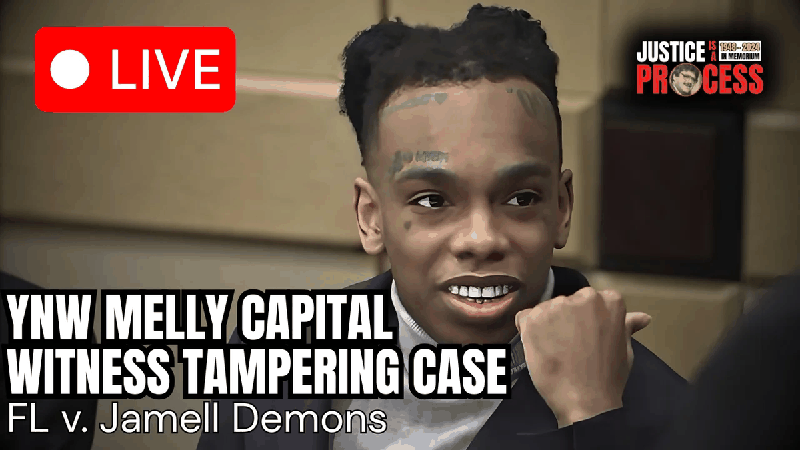
Two friends dead in a Jeep. The State says a staged drive-by hid what happened. A jury has already failed to agree once.
November 2026 | Justice Is A Process
On October 26th, 2018, two young rappers from South Florida, Anthony Williams and Christopher Thomas Jr., were pronounced dead at Memorial Hospital Miramar. They were friends. They made music together under the same banner. A third man, the driver, had brought them in before dawn in a Jeep, and he told the hospital that an unknown car had ambushed them on the road.
Eight years later, a Broward County jury still has not decided what happened in that Jeep.
The man on trial is Jamell Demons, the rapper the world knows as YNW Melly. He is charged with two counts of first-degree murder, the killings of Anthony Williams, who went by YNW Sakchaser, and Christopher Thomas Jr., who went by YNW Juvy. The State of Florida says he shot both of them from inside that Jeep, and that he and the driver then staged the scene to look like a drive-by. He has pleaded not guilty. His lawyers say these men were close friends, that the State has never shown a reason for him to kill them, and that the case against him is built on guesses, on his music, and on gang labels.
We have been here before. In the summer of 2023, a Broward jury heard weeks of testimony in this very case. After fourteen hours of deliberation over three days, that jury could not agree. A juror later told a Miami television station the panel split nine to three in favor of convicting on the lesser charge of manslaughter, after starting out at eleven to one. The judge declared a mistrial on July 22nd, 2023. Under the law, that means the State gets to try again. It does not mean anyone was acquitted, and it does not mean anyone was convicted.
That second trial has been pushed back again and again. It is now set to begin with jury selection on January 6th, 2027. Jamell Demons has been in custody since he turned himself in on February 13th, 2019. By the time a new jury is seated he will have spent nearly eight years behind bars without a conviction, and the State is still asking for the death penalty.
Before the jury, there are the hearings. Starting Monday, November 23rd, 2026, Judge Martin Fein is hearing a stack of motions that will decide what that new jury is allowed to know. The defense wants about fifty-eight of his songs and music videos kept out. It wants evidence about gang affiliation kept out, along with the experts the State would call to explain it. The State has a list of its own. These are not side issues. In a case with no confession and, by the defense's account, no clear motive, what the jury hears may decide the outcome.
So here is the question this trial will put to twelve people: can the State prove who fired and that it was planned, when the first jury could not agree, a judge has already shut out weeks of the evidence taken from his phone, and the fight is still going on over his lyrics?
We are not here to convict him. We are not here to acquit him. We are here to watch whether the system does what it promises to do: prove its case with evidence, in the open, while protecting the rights of the accused and honoring two young men who cannot speak for themselves anymore.
Anthony Williams and Christopher Thomas Jr. had families. They had songs they had not finished. Whatever else this case becomes, it begins with two people who left a recording session on a Thursday night and did not come home.
This is Justice Is A Process. Let's begin.
Everything in this section comes from charging documents, court filings, testimony at the first trial and the reporting around them. None of it has been tested in front of the new jury. When you read "prosecutors say" or "the State alleges," take it literally. These are accusations, and the trial exists to test them. Where reports disagree, or where we could only find a detail in one place, we say so.
According to the State, the story starts at a recording session in Fort Lauderdale. Jamell Demons, Anthony Williams and Christopher Thomas Jr. were there, along with the man who would be driving them afterward: Cortlen Henry, who performs as YNW Bortlen. The four were part of the same circle of young artists around the YNW name, which had been rising quickly in South Florida.
Prosecutors say that after the session, the group rode together in Henry's Jeep. They say Williams and Thomas were shot to death inside it. In the State's telling, the shots came from within the vehicle, and ballistics testing supports that. Then, prosecutors say, Demons and Henry did something that investigators call a staging: they drove toward an area near the Everglades and fired shots at the back and passenger side of the Jeep from the outside, so that the Jeep would look like the target of a drive-by shooting.
The State says the next step was the story. Before dawn, Henry drove the Jeep to Memorial Hospital Miramar. According to court filings reported by the Miami Herald, he told staff that another vehicle had ambushed them along Miramar Parkway. Both men were pronounced dead at the hospital. Police have said that Demons was not at the hospital when the Jeep arrived.
The prosecution's case is that the physical evidence did not fit the drive-by story. Detectives looked at the Jeep. They looked at where the bullet holes were and which way the glass had broken, and they looked at where the victims were sitting. Prosecutors say the shots that killed the two men came from inside the car, and that the holes in the outside of the Jeep were made later.
The defense does not accept any of that. We will walk through the argument in a later section. For now, understand that this is a case about physical evidence and what it can and cannot prove, and not about an eyewitness who saw one man fire a gun. No one has been reported as testifying that they saw it happen.
On February 12th, 2019, police arrested Cortlen Henry. Reporting from the time says he was charged with two counts of first-degree murder and two counts of accessory after the fact. A day later, on February 13th, 2019, Jamell Demons turned himself in, and prosecutors charged him with two counts of first-degree murder. The following day, a Broward judge ordered both men held without bond and ordered them to have no contact with each other.
Demons pleaded not guilty in March of 2019 and demanded a jury trial. In April of 2019, the State filed notice that it would seek the death penalty, citing four aggravating factors. We have not been able to find the court filing itself, so we are relying on reporting from the time for the number. We will update this page if the filing shows something different.
Henry's case is a separate one. Reporting says he will be tried separately and that prosecutors have charged him as an accomplice. Early on, a Broward judge ruled in a bond proceeding that the State had not met its burden against Henry at that stage. We could not confirm what has happened in Henry's own case since then, including whether he has resolved it, and we will not guess. As of this writing, his status is unconfirmed.
Jury selection in the first trial began on April 11th, 2023, and openings came on June 12th. The first trial ran for weeks. The Law&Crime Network streamed it from the first day, and its archive shows at least sixteen trial days. Coverage of the trial describes no clear motive. Prosecutors described the shooting as tied to a gang action. The defense answered that the two men and the defendant were close friends and that the gang claim was not credible.
The jury got the case after those weeks of testimony, and deliberated for about fourteen hours over three days. At one point the judge gave them what lawyers call an Allen charge, a standard instruction that asks a divided jury to keep trying to reach a verdict. They did not. On July 22nd, 2023, Judge John J. Murphy III declared a mistrial.
What happened inside that jury room is not public record, and jurors speaking to reporters afterward are not the same as a verdict. But the reported split matters to how many people read this case. According to one juror, the early vote was eleven to one, and it moved to nine to three in favor of manslaughter, which is a lesser offense than first-degree murder and requires no premeditation at all. If that account is accurate, the jury did not unanimously agree on murder in either direction.
Anthony Williams, known as YNW Sakchaser, and Christopher Thomas Jr., known as YNW Juvy, were young men and young artists. Reporting describes them as childhood friends who came up in the same South Florida music scene as Jamell Demons. They were part of the group of rappers whose YNW name appeared on early tracks and social media pages. Their deaths ended careers that had barely begun.
We will say their names every time. We will not reduce either of them to a case number or to "the victims." They are men with families who have sat through two sets of hearings, one trial and years of delay, and who still do not have an answer a jury has agreed on.
Jamell Demons performs as YNW Melly. He became widely known in 2018 with songs that reached national audiences. Before the events of October 2018, he had been in legal trouble: reporting says that in the summer of 2018 he and Cortlen Henry were arrested on weapons and drug charges and both posted bond, and that he had earlier served a one-year sentence in a case in which he was charged with firing a gun near a high school. Those are old matters that are not before this jury. They are the reason the defense fights so hard about what the new jury can hear about his history, his music and his associations.
He has been in custody since February of 2019. His lawyers have told the court that he has endured harsh conditions for more than seven years, including the last three in solitary confinement, while presumed innocent. A Broward judge denied his request for release before trial in May of 2026, after a four-hour hearing on April 30th at which his lawyers argued he would have twenty-four-hour security, no social media and tight limits on his movement.
Remember what that phrase means. Presumed innocent does not mean the court thinks he is innocent. It means the State has to prove its case beyond a reasonable doubt, and until twelve people say so, Jamell Demons is not a convicted man.
The driver. The State says Henry was in the Jeep, drove it to the hospital and told the story about the ambush. He is the person who can say what happened inside that vehicle, and the person with the most to lose from saying it. Whether he will testify, and under what arrangement with the State, is something we do not know and will not speculate about. Watch for that name. Any witness who was in that Jeep carries a credibility fight with them into the courtroom.
Broward County Circuit Judge Martin Fein has the retrial. Judge John Murphy presided over the first trial and over the pretrial rulings on the evidence; Judge Fein was assigned after that. The case sits in the Seventeenth Judicial Circuit of Florida, in Fort Lauderdale. Reporting on the State's notice of hearing lists the first of the November hearings in Courtroom 4780. We have not seen the notice itself, so we treat the courtroom number as unconfirmed.
The defense team now includes Drew Findling and Carey Haughwout. Over the years the defense has changed, and early on it included several other well-known Florida lawyers. We name only the lawyers we can confirm as of the November 2026 filings.
Jamell Demons faces two counts of first-degree murder, one for each man. Here is what that means in plain English.
The law: Florida Statute 782.04(1)(a). The statute defines first-degree murder, in the part that applies here, as a killing "perpetrated from a premeditated design to effect the death of the person killed or any human being." It is a capital felony, punishable as provided in section 775.082 of the Florida Statutes.
What the State must prove, beyond a reasonable doubt, for each man:
The penalty: The State has said it will seek the death penalty. If the jury convicts on first-degree murder, the case moves to a second phase, and under Florida law the sentence is either death or life in prison. We explain how that phase works below.
The burden: Entirely on the State. The defense does not have to prove anything, call anyone or explain anything.
Jurors in Florida can be told they may convict on a lesser offense when the evidence supports it. The one that matters here is manslaughter. Florida Statute 782.07(1) defines it as "the killing of a human being by the act, procurement, or culpable negligence of another," and makes it a felony of the second degree. It does not require premeditation. A conviction for manslaughter carries a sentence that is nowhere near a conviction for first-degree murder.
That matters because of what the first jury reportedly did. If one juror's account to a reporter is correct, a majority of that panel was not willing to convict on murder, but was willing to convict on manslaughter. A hung jury does not tell us anything official about guilt. It does tell us that twelve people looked at this evidence and did not agree, and it is the reason the State's second attempt is being prepared with such care.
For a time, Jamell Demons also faced a charge of witness tampering, a separate case from the murders, and Law&Crime Trials streamed a hearing in it. Prosecutors dropped the tampering charges in January of 2026, on the cusp of what was then an upcoming murder retrial, according to Rolling Stone. We could not find the State's stated reason in the sources we reviewed, so we do not offer one. The charges are gone, and the jury in the murder case will not be asked to consider them.
Here is why this case is going to trial a second time. A mistrial does not erase anything. It resets the board, and both sides have had years to learn from the first one. Almost every dispute left in this case is about the same thing: what the jury is allowed to see, hear and consider.
The State's theory is that Jamell Demons shot two friends inside a Jeep, that he and the driver then staged the scene as a drive-by, and that the physical evidence shows it. According to reporting on the first trial, prosecutors rely on ballistics that they say show the two men were shot from inside the vehicle, on the position of the damage to the outside of the Jeep, and on the story told at the hospital. Prosecutors have also argued that the shooting was part of a gang action, a theory the defense disputes, and that some of his lyrics speak to motive or intent.
The defense says the State failed to secure a conviction once and will fail again. In May of 2026, his lawyers said publicly that the State "failed to secure a conviction once." Their position, drawn from filings and the first trial, is that the victims and the defendant were close friends, that no one has put the gun in his hand, that the gang claim lacks a clear link to the killings, and that the lyrics are music, not confession. On November 10th, 2026, they asked Judge Fein to keep about fifty-eight songs and related music videos out of the retrial. They told the court that the material has little real evidentiary value and could lead jurors to treat lyrics as confessions and to stereotype Black rappers. They pointed to a Florida Atlantic University study of 523 potential jurors. The song "Murder on My Mind" is the one that has drawn the most attention.
On November 13th, they filed a separate eight-page motion to exclude evidence of alleged gang affiliation and the testimony of gang experts, arguing there is no clear link between gang life and the killings. They also moved to exclude what are called timing-advance records.
The biggest ruling so far did not come in a courtroom full of jurors. It came on paper. Judge Murphy threw out weeks of digital evidence that investigators had obtained with what the defense called an overly broad search warrant: messages from his phone, email addresses and social media accounts. Under that order, the digital evidence allowed at the retrial is limited to the day of the killings and the day after. The State appealed. The Fourth District Court of Appeal ruled that the judge had not abused his discretion and left his order in place. That appeal is one of the reasons the retrial has been pushed back so many times. We could not confirm the exact date of the appellate ruling from the sources we reviewed, and we could not find the opinion itself, so we are not quoting it.
The hearings that begin on November 23rd are about the rest of the evidence. According to reporting, a State notice filed on November 18th lists seven matters it plans to argue before Judge Fein, with hearings set for November 20th, 23rd and 24th at nine in the morning. We have not seen the notice, so we take the dates as reported. They include the defense's motions about rap lyrics and digital evidence, the gang evidence and the timing-advance records. Here is what each of those is.
We will watch each of these rulings as they come. Every one of them changes what a new jury hears in January.
People hear "hung jury" and ask whether he was found not guilty. He was not. They ask whether the State can really do this to someone twice. It can. When a jury cannot reach a verdict, the law treats the trial as one that never reached its conclusion, and the prosecutor decides whether to try again. The State chose to. The law handles a jury that is honestly split this way.
There is a second thing a mistrial does, and it is the part that makes a retrial a different contest. Both sides now know what the other side's best witnesses sounded like. The defense has heard the State's case and has the transcript of every witness for cross-examination. The State has watched which parts of its case worked on twelve real people and which did not. Lawyers on both sides will tell you that a second trial is rarely the same trial. Witnesses are more polished or more tired. Arguments that landed once get dropped, and new ones appear. Remember that when you compare what you read about the first trial to what happens in January.
It also means the pretrial fights matter more than usual. The first jury saw the evidence the first judge allowed. If Judge Fein rules differently on the lyrics, on the gang testimony or on the timing-advance records, the second jury will see a different case than the first one did, and a verdict may follow from that difference alone.
Two words will do a lot of work in this trial, so let us be careful with them. "Staged" is the State's word for what it says happened after the shooting: the shots fired from the outside of the Jeep, the drive toward the Everglades, the story at the hospital. If the jury believes it, it matters twice. It tells the jury that somebody was hiding something, and it points toward the people who handled the Jeep after the shooting. If the jury does not believe it, the State loses the best evidence it has of a cover-up, and the hospital story becomes a driver's frightened account of a night that went wrong.
"Gang" is a different kind of word. It is a label, and labels persuade without proving anything. A juror who hears it may think they have been told why. That is exactly why the defense wants it out of the courtroom, and why the judge's ruling on the gang expert may matter more than any single witness.
This case is at trial because the State says Jamell Demons shot his two friends inside a Jeep and staged the scene as a drive-by, and the first jury could not agree on murder. Can the State prove who fired and that it was planned, with no confession and no clear motive, after a judge shut out weeks of his phone data and with a fight still going over his rap lyrics and gang evidence?
That is what we will be watching in every hearing and every witness. Every witness will either advance that question or complicate it.
Other outlets will recap this case. We will ask a different question: is the process working? Here are the principles we will hold up against everything that happens in that courtroom.
Nothing in the first trial's mistrial changes the starting line. Jamell Demons is presumed innocent. The State must prove each element of each count beyond a reasonable doubt, and the jury must be unanimous to convict. A divided jury returns no verdict at all, and the law lets the State try again. We will keep saying that, because nearly every comment thread about this case treats a hung jury as a win for one side or a sign the system failed. It is a pause.
The ruling on digital evidence is a Fourth Amendment story. The Constitution requires a warrant to describe what police may search for and where, and a warrant that sweeps up weeks of private messages, email and social media is the kind of thing courts look at hard. A judge here decided the warrant went too far for the evidence outside the day of the killings and the day after. An appeals court did not disturb that. Whatever you think about this defendant, that line protects everyone who owns a phone.
Should a person's art be used as evidence of what they did? Florida's Evidence Code, in section 90.403, says that relevant evidence is inadmissible if its value is substantially outweighed by the danger of unfair prejudice, confusion of the issues or misleading the jury. That is the test the judge will apply to the songs. The State will argue the lyrics are about the same kind of violence charged here. The defense will argue that lyrics are performance, and that a jury hearing violent verses will fill in the rest. We will be watching how Judge Fein draws that line, because other rappers and other defendants will live with it.
The right to a speedy trial is in the Sixth Amendment. A man held since February of 2019, with a first trial that ended without a verdict and a retrial now set for 2027, raises the question of how long is too long when the person has not been convicted of anything. The delays in this case have many causes, including appeals the State took and defense motions. We will not pretend they are all one side's doing. But we will keep track of how many years pass, because the cost of delay lands on the person sitting in the cell, and on two families waiting for an answer.
If Jamell Demons is convicted of first-degree murder, the jury will decide whether he lives or dies, under a law that is different from what it was when this case began. Under section 921.141 of the Florida Statutes, a jury must first unanimously find, beyond a reasonable doubt, at least one aggravating factor. If it does not, he is not eligible for death. If it does, then at least eight of the twelve jurors can recommend death, and if fewer than eight do, the recommendation must be life in prison without the possibility of parole. Reporting has noted that he could be among the first to face that eight-of-twelve rule. We will not get ahead of the trial. But anyone watching should understand that the standard for a death recommendation is not the standard for a conviction, and that the two are decided separately.
This case will include crime scene and autopsy evidence about two real people. The law requires the jury to see what is relevant. It does not require the public to see everything, and we will not put graphic images on this channel. Williams and Thomas will be named and remembered as people.
The retrial will be a long one. The first trial ran for weeks and took more than sixteen days of testimony, and nothing suggests the second will be shorter. Expect the same core of witnesses: the investigators and the medical examiner, ballistics and forensic witnesses, people who knew the three men and the circle around them, and the hospital staff who first received the Jeep. Whether Cortlen Henry testifies is the largest open question in the case, and we do not know the answer. We will report what the court record shows and mark everything else as unconfirmed.
We start with the pretrial hearings, because what the judge allows decides what the jury hears. When the retrial begins, we will be in that courtroom with it, every court day we can.
This isn't about speculation. It's about watching the system work.
Jamell Demons is presumed innocent until proven guilty beyond a reasonable doubt. That's not a technicality. That's the foundation of everything we do here.
Anthony Williams and Christopher Thomas Jr. deserve the truth, proven the right way. Let's watch together.
Subscribe to Justice Is A Process on YouTube for live trial coverage, No Breaks editions, and breaking news as it happens.
🔴 Subscribe on YouTube86,000+ subscribers watching the system with us
Discussion