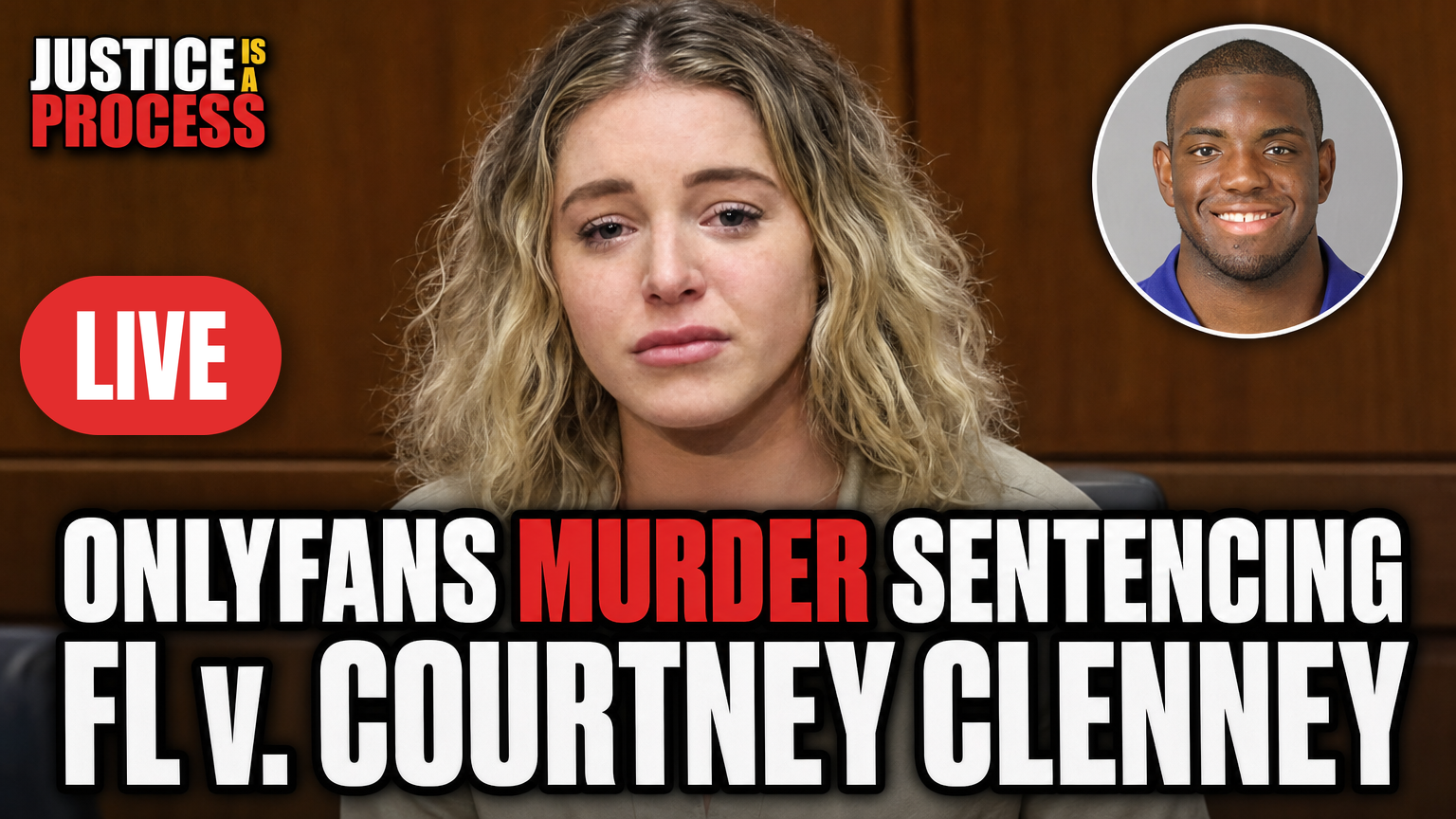
Four years, no trial, and a guilty plea nobody saw coming.
August 2026 | Justice Is A Process
On August 10th, 2022, federal marshals walked into a rehabilitation facility in Laupahoehoe, on the Big Island of Hawaii, and arrested a 26-year-old woman named Courtney Clenney.
On August 10th, 2026, she will stand in a Miami courtroom and be sentenced.
Four years. To the day. And in all four of those years, she never had a trial.
Let that sit for a second, because it is the whole story. Not a single juror was ever selected. Not one opening statement was ever delivered. No witness ever took an oath and faced a cross-examination in front of twelve people whose job it was to decide whether the State of Florida had proven anything at all. Courtney Clenney spent four years in a Miami-Dade jail cell, denied bond every single time she asked, waiting for a day that never arrived.
And then, with trial finally close enough to touch, she pleaded guilty.
I want to be careful here, because this is where a lot of coverage is going to go lazy. The easy version of this story is the one you have already seen in a hundred headlines: OnlyFans model, luxury Miami high-rise, dead boyfriend, beautiful blonde defendant, tabloid gold. That version writes itself and it tells you almost nothing.
Here is the version that actually matters.
Over four years, Courtney Clenney's lawyers built one of the most aggressive attacks on a prosecution I have covered on this channel. They alleged that police ordered a civilian witness to delete photographs of the scene before investigators ever arrived. They alleged the State sat on a witness who would have helped her. And the third one they proved. A judge found, in writing, that Miami-Dade prosecutors read the defense team's own privileged strategy document. Two weeks after that ruling, an entire set of criminal charges against Clenney and her parents collapsed. A year later the lead prosecutor walked away from the case rather than answer questions under oath about what he had seen.
That is not a technicality. That is a prosecution being caught, repeatedly, doing things it should not have done.
And she pleaded guilty anyway.
So the question I am carrying into that courtroom on Monday morning is not whether Courtney Clenney is a sympathetic figure, because that is not my call and it is not yours. The question is this: what happens when a defendant builds a case that the system cheated her, and then decides she cannot afford to find out if a jury agrees?
Because that is what a plea is. A plea is the moment both sides look at twelve strangers and decide the risk is too high. The State avoids a jury hearing about deleted photographs and privileged documents. The defendant avoids a jury hearing about the injuries a medical examiner described. Everybody gets certainty, and the public gets nothing. No findings. No verdict. No answer.
Christian Obumseli was 27 years old. He played linebacker at Abilene Christian University before transferring to Texas Tech to study engineering. His family called him Toby. He died on the floor of an apartment in Edgewater on April 3rd, 2022, and his family has waited four years and four months to hear someone say out loud what happened to him.
On Monday, they finally will. Sort of.
We are not here to tell you Courtney Clenney is a monster. We are not here to tell you she is a victim. We are here because a system that took four years and never produced a trial is a system worth watching very closely, and because the sentence a judge hands down on Monday is going to have to answer for all of it.
This is Justice Is A Process. Let's begin.
One Paraiso is a glass tower at 3131 Northeast 7th Avenue in Edgewater, a stretch of Miami that spent the last decade turning from warehouses into luxury condominiums. Courtney Clenney and Christian Obumseli had been living there for roughly three months.
They had been together since November of 2020. They met in Texas. She was building an enormous online following under the name Courtney Tailor, and by the State's own accounting she had earned somewhere in the range of three million dollars from OnlyFans between 2020 and 2022. He traded cryptocurrency. They travelled. They posted. From the outside it looked like exactly the life the pictures advertised.
Inside the building, people had a very different impression. Depending on which account you read, police were called to that address somewhere between six and nine times in the roughly three months the couple lived there. The count varies by source, and I am not going to pretend to a precision the record does not support. What is consistent across every version is that neighbors complained, staff complained, and by March of 2022 the unit owner had begun eviction proceedings.
At 4:43 in the afternoon on April 3rd, Clenney called her mother. She called again at 4:49. Her mother would later say she could hear shouting, and could hear her daughter telling Obumseli to leave.
At some point in that window, building security called 911 about noise coming from the unit. Prosecutors put that call at 4:46.
At 4:57, Courtney Clenney called 911 herself.
The recording of that call was released publicly, and it is difficult listening. She is screaming that her boyfriend is dying. In the background you can hear Christian Obumseli saying that he cannot feel his arm. You can hear him say he is going to die. And you can hear her saying, over and over, "Baby, I'm so sorry."
Officers arrived around 5:04. They found Clenney covered in blood. They found Obumseli on the floor. He had one wound, to the chest. It was roughly three inches deep, and it had opened the subclavian artery, which is one of the fastest ways a human being can bleed to death.
He did not survive.
Everything in this case, all four years of it, comes down to a disagreement about that single wound.
Clenney told investigators that Obumseli had thrown her down during an argument, and that she grabbed a kitchen knife and threw it at him from roughly ten feet away. Not a lunge. Not a thrust. A throw, across a room, in fear.
The Miami-Dade Medical Examiner reached a different conclusion. The wound track ran downward. The examiner characterized it as a forceful downward thrust and concluded that the depth, the force, and the angle were inconsistent with a knife thrown from across a room. Miami-Dade State Attorney Katherine Fernandez Rundle said publicly that the autopsy pointed to a wound inflicted at close range.
The arrest affidavit added that Clenney gave investigators several inconsistent accounts of the afternoon, and that she did not appear to have injuries consistent with the attack she had described.
Clenney was not arrested that day. She was not arrested that week. Four months passed between Christian Obumseli's death and the moment marshals found her in Hawaii, where she was reportedly in treatment for substance abuse and post-traumatic stress.
That gap generated an enormous amount of public suspicion at the time, and it is worth explaining what it actually reflects. In Florida, a second-degree murder charge does not require a grand jury indictment. Only capital offenses do. What it requires is that the State Attorney's Office decide it can prove the case, and file what is called an information. Four months is the State building a file, running forensics, and reviewing a relationship history that turned out to be considerably more complicated than a single afternoon.
She waived extradition and returned to Florida voluntarily. On August 11th, 2022, Fernandez Rundle stood at a press conference and announced the charge, describing the relationship as tempestuous and combative.
She has been in custody ever since.
He was born Christian Tobechukwu Obumseli on April 12th, 1994, in Dallas, Texas. Everyone called him Toby.
He went to Plano East Senior High School and earned a football scholarship to Abilene Christian University, where he played middle linebacker. He later transferred to Texas Tech to study engineering. By 2022 he was working in cryptocurrency and living in Miami.
His family's obituary describes a radiant personality, a charismatic smile, a free spirit with real wanderlust, and a caring and giving nature. His parents are Igwe Chris Obumseli and Chio Obumseli. He had an older brother, Jeffrey, and siblings Olisa, Gabby, and Jenny.
I want to say something plainly here, because it gets lost. In the enormous volume of coverage this case has generated, Christian Obumseli is frequently reduced to a role: the boyfriend, the victim, the man in the apartment. He was 27. He had a family who is still, four years later, sitting in courtrooms in a city most of them do not live in, waiting for something to be finished.
Their attorney throughout has been Larry Handfield. When the plea agreement was reached, Handfield said this on the family's behalf: "Pleading guilty and accepting full responsibility will begin the process of bringing closure to a very tragic, life-changing event for the Obumseli family."
Read that sentence carefully, because it is the most important quote in this entire case. The family is not describing justice. They are describing the beginning of the process of closure. After four years.
She was born in 1996 in Midland, Texas, and her family moved to Austin when she was seven. Austin is where she grew up.
Online she was Courtney Tailor, and by 2022 she had built an audience approaching two million followers. Prosecutors put her OnlyFans income at roughly $966,000 in 2020 and just over $1.8 million in 2021. That money became a central argument at every bond hearing, because a defendant with millions of dollars and no ties to Florida is, in the State's framing, a flight risk.
By December of 2025, her lawyers came to court with foreclosure letters on her house and a bank statement showing a negative balance of $310.26, charged off by the bank as a loss. Her family had been carrying her mortgage for three and a half years and could not carry it any longer.
Her parents are Kim and Deborah Clenney, and they became defendants in this case themselves, which I will come back to, because what happened to them is one of the more remarkable sequences in the whole file.
Every surface of this case makes it tempting to write about Courtney Clenney as a character rather than a defendant. Resist that. Whatever she is, she is a person who spent four years in a cell without a trial, and the constitutional questions that raises do not depend on whether you like her.
Her defense has been led by Frank Prieto and Sabrina Puglisi, with Dianne Caramés also appearing as counsel. Prieto is the attorney who confirmed the plea agreement publicly on July 31st, 2026.
One note for anyone reading other coverage: at least one outlet has referred to an attorney named "Frank Puglisi." No such person is on this case. Frank Prieto and Sabrina Puglisi are two different lawyers, and conflating them makes a hash of who did what.
On the State's side, the office is led by Katherine Fernandez Rundle. The case has been carried most recently by Assistant State Attorney Shawn Abuhoff and Chief Assistant State Attorney Kathleen Hoague. The original lead prosecutor was Khalil Quinan, and his departure from this case is a story of its own.
Three judges have touched this file. Judge Diana Vizcaino ruled on an early fight over the release of evidence in 2022. Judge Laura Shearon Cruz handled the 2022 bond order and, critically, the 2024 privilege ruling. The judge of record now, the one who will decide what happens on Monday, is Judge Andrea Ricker Wolfson.
Wolfson is worth knowing something about. She was appointed to the circuit bench in 2018, and before she was a judge she spent nine years as a prosecutor in this same circuit. She is also a judge with a documented willingness to sanction prosecutors: in an unrelated capital case in March of 2024, she disqualified two of them, citing witness testimony manipulation and severe recklessness. One of them resigned. That history matters when you evaluate what she did, and did not do, with the misconduct claims in this case.
The statute: Florida Statute 782.04(2), reclassified upward under Florida Statute 775.087 because a weapon was used.
What it means in plain English: Second-degree murder in Florida is an unlawful killing caused by an act that is imminently dangerous to another person and that shows what the statute calls a depraved mind, without premeditation. Premeditation is the dividing line with first-degree murder. The State was never claiming she planned this.
What the State had to prove: That Christian Obumseli is dead. That Courtney Clenney caused his death. And that she did it through an act imminently dangerous to another, evincing a depraved mind regardless of human life.
Potential sentence: Reclassified as a life felony because of the weapon, the statutory maximum is life in prison.
The burden: Entirely on the State. Always. She never had to prove anything.
The phrase that carried this whole case is "depraved mind." It is an old phrase and it does a lot of work, and if you want to understand why the defense fought the way it did, you have to understand what it required the State to show.
A depraved mind is not the same as an intent to kill. It is closer to a profound indifference to whether someone lives or dies. And the State's theory of how Courtney Clenney demonstrated that indifference was built substantially on time. Their position was that Obumseli was injured, that he bled across multiple rooms of that apartment, that he was found in a pool of coagulated blood, and that a meaningful stretch of minutes passed between the wound and the call for help.
That is the depraved mind. Not the wound. The waiting.
Which is exactly why the defense attacked the clock.
Because Monday is a sentencing, it is worth understanding the machinery, since it is not what most people assume.
Florida does not use fixed sentencing guidelines the way the federal system does. It uses something called the Criminal Punishment Code, and it runs on points. Every felony gets a scoresheet. The primary offense generates points based on severity, and second-degree murder generates 240 of them. More points get added for things like victim injury, prior record, other offenses, and legal status at the time.
That total produces a number the court calls the minimum permissible sentence. It is the floor. A judge who wants to go below it needs a legally valid reason to depart downward. The ceiling is separate, and the ceiling here is set by statute: because the weapon reclassified this to a life felony, the maximum is life.
One threshold matters especially: once a scoresheet crosses 363 points, a life sentence becomes permissible. Permissible, not required. The judge still decides.
So the range Judge Wolfson is working inside on Monday depends on two things we do not yet know. First, what charge Clenney is actually pleading to, because a plea to a lesser offense changes the scoresheet entirely. Second, whether the agreement itself fixes the sentence or leaves it open. Those are very different hearings. If the number is already agreed, Monday is a formality. If it is open, Monday is a fight, and both sides will put on evidence about who this woman is and what her life is worth measuring against his.
There is also the arithmetic of time already served. She has been in custody since August 10th, 2022. Four years is not a small fraction of most sentences. No reporting has addressed how, or whether, that credit is built into the deal.
This is the section that matters most, so I want to lay it out carefully.
Courtney Clenney's defense was not one argument. It was four, stacked, and each of them attacked a different load-bearing wall of the prosecution.
The defense retained Dr. John Marraccini, a forensic pathologist, to test whether the wound could have come from a thrown knife. His approach was unusual enough that it made national news. He had a knife-throwing expert throw knives at pig carcasses on video, on the theory that pig tissue behaves comparably to human tissue, and then examined the resulting wounds. He testified at an October 2024 hearing that the wound favored a thrown knife over a thrust, pointing to the absence of the bruising and defensive injuries he would expect from a close-range stabbing, and concluded it was plausible and even likely that Clenney threw the blade.
The State took that demonstration apart on cross. The knives in the video were thrown from six feet, not the ten feet Clenney described. The man throwing them was considerably larger than she is. The actual weapon in this case was never used in the test. Marraccini had never been to the scene.
Separately, an expert retained in the related civil case produced an analysis of the rate of blood loss from the subclavian injury, working backward to place the moment of injury relative to that 4:57 call. The conclusion, presented at the December 2025 bond hearing, was that the wound occurred essentially immediately before she dialed. In the defense's framing, that expert had eviscerated the State's second-degree theory.
If she called for help within seconds, there is no waiting. If there is no waiting, there is no depraved mind. And if there is no depraved mind, this is manslaughter, not murder. That was the argument, made explicitly, in open court: "At best, this was reckless conduct."
Here is where the case stops being about forensics and starts being about the system.
A building employee named Danny Del Valle was the first person to reach that apartment after the 911 call, before fire rescue and before police. He took photographs and video of the scene as he found it.
He later testified in a deposition that responding officers ordered him to delete all of it.
Sit with what that means. The only images of that apartment as it existed before a dozen first responders walked through it were destroyed at the direction of law enforcement. The defense's argument was that those photographs could have captured blood evidence in its original state, and could have preserved Clenney's very first words to another human being who arrived to help. Whatever they showed, nobody will ever see it.
Clenney's lawyers filed a motion to dismiss the entire case, arguing this was a violation under Arizona v. Youngblood, the Supreme Court case governing the State's failure to preserve potentially useful evidence.
The same motion raised a second claim, this one under Brady v. Maryland, the case that requires prosecutors to turn over evidence favorable to the defense.
The defense alleged the State knew about a resident of the building named Arthur Cup, who had reportedly seen Obumseli assaulting Clenney in the days before the death, and did not disclose him.
A witness who saw the man she says attacked her actually attacking her, in the days before, not turned over. That is the allegation.
And this one is not an allegation. This one a judge found as fact.
In 2022, Clenney's father took a laptop belonging to Christian Obumseli from the apartment after police released the scene. What followed was a separate criminal prosecution: Kim and Deborah Clenney were arrested in Texas in January 2024, and Courtney was charged as well, all on counts of unauthorized access to a computer.
To build that case, prosecutors obtained the parents' iCloud account. Inside it were communications between the Clenney family and their defense attorney, including a document titled "Courtney Checklist of Things to Do - Privileged.docx," which laid out how the defense intended to fight the murder case.
On June 26th, 2024, Judge Laura Cruz ruled that Miami-Dade prosecutors had violated attorney-client privilege by reading it. She wrote that the privilege "was violated, albeit perhaps unknowingly, when the communication was read by prosecutors," and that the proper remedy was exclusion. She said prosecutors had worn what she called prosecutorial blinders, unilaterally deciding an exception applied when it did not.
Two weeks later, on July 11th, 2024, the State dropped the computer charges against all three Clenneys.
The parents accused the State of what they called digital burglary, noting the search swept up communications from seventeen months before the death, and describing it as an overly zealous and seemingly personal persecution of the family.
Then it escalated. In late February 2025, Judge Cruz ruled that Khalil Quinan, the lead prosecutor, could be deposed by the defense about exactly what privileged material he had seen. On March 3rd, 2025, Quinan stepped down from the case in a one-page memo rather than sit for that deposition.
The defense moved to disqualify the entire Miami-Dade State Attorney's Office, arguing that roughly sixty people in that office had access to the privileged files. On April 30th, 2025, prosecutors Shawn Abuhoff and Kathleen Hoague took the witness stand themselves, under oath, to swear they had never personally looked at the material.
Prosecutors testifying in their own defense, in the middle of their own murder case, is not a thing you see.
Underneath the four constitutional and forensic fights sat the actual defense, the one a jury would have heard: that Courtney Clenney was a battered woman, that the relationship was violent toward her as well as by her, and that what happened on April 3rd was a reaction rather than a murder.
Florida recognizes what is often called battered spouse syndrome as relevant evidence in a self-defense case. It is not a separate defense and it does not excuse a killing. What it does is give a jury context for why a defendant perceived danger the way she did, and why her response might look disproportionate to someone who has not lived inside that relationship.
To build it, the defense sought to introduce two domestic violence expert witnesses, lay witnesses who said they had seen the couple interact or had seen Clenney with visible injuries, medical records, building security reports, and police body camera footage.
They also had the texts. In July of 2026, reporting surfaced messages the defense intended to use, including an April 2021 exchange in which Clenney accused Obumseli of hitting her in the face as hard as he could, a message the defense said he brushed off rather than denied.
And they had the body camera footage from April 1st, two days before he died, in which Clenney tells officers, on video: "Right now, I have not always been a victim, right now I am a freaking victim in this situation. I'm scared to go downstairs and walk my dogs." She told them she wanted a restraining order. Officers documented bruises on her arms and legs. Nobody was arrested.
The defense pushed further than that. In motions filed ahead of the final pretrial hearing in July 2026, they asked the court to admit a 2020 animal cruelty arrest warrant involving Obumseli, offered as evidence of his character and capacity for aggression. That is an aggressive move, and it tells you the defense intended to put the man who died on trial alongside the woman who killed him. That is what a self-defense case is. It is also why these cases are so painful for families.
The complicating fact, and I am not going to soften it, is that the arrest warrant in this case described multiple incidents of domestic violence from both sides. Not one aggressor and one victim. Both. Prosecutors and the defense agreed this relationship was violent. They disagreed entirely about who was the aggressor on the day it ended.
I have spent a lot of words on the defense, so let me be equally direct about why this was never a slam dunk for Courtney Clenney, because it was not.
The medical examiner's conclusion is a serious problem for the thrown-knife account, and juries tend to credit medical examiners.
The relationship history is worse. In its written order denying bond in November 2022, the court cited two prior incidents involving knives: on October 3rd, 2021, she wounded his leg, and on January 20th, 2022, she cut his face badly enough to require stitches. The court found this showed she "had no fear of using a knife as a weapon." There is also a July 2021 domestic battery arrest in Las Vegas, where she admitted throwing a glass at him, later dropped by the Clark County District Attorney. And there is video from Aspen in February 2022 showing her striking him while he tries to shield himself.
And then there are the recordings, which are the single hardest fact in this file for the defense. Christian Obumseli secretly recorded Courtney Clenney more than fifteen times. On those tapes she can be heard screaming at him and using racial slurs. On one, after apparently splitting his lip, she tells him to enjoy the hospital, and a slap is audible. Prosecutors framed those recordings in the most devastating way available: this is what a man records when he is being abused and nobody believes him.
That is the case she was walking into a courtroom to face.
Judge Wolfson denied it. The case moved forward.
And I want to be honest about what that means, because it would be easy for me to imply the ruling was wrong. It was not obviously wrong. The legal standard under Youngblood is genuinely demanding: to get a case thrown out over destroyed evidence, the defense generally has to show the State acted in bad faith. Carelessness is not enough. That is a high bar, deliberately, and courts clear cases over it rarely. The December 2025 ruling on the bond motion made the same point in different words: the evidence-destruction allegation was not enough to establish bad faith.
What that tells you is something important about how our system handles this kind of failure. The remedy for a constitutional violation is almost never the remedy the defense asks for. The privilege breach did not disqualify the office. It excluded a document and killed a collateral prosecution. The destroyed photographs did not end the case. They became an argument for a jury that never got to hear it.
It is worth spending a minute on why these standards are built the way they are, because this is the part almost nobody explains.
Under Brady v. Maryland, decided in 1963, prosecutors have to turn over evidence favorable to the defense. That obligation does not depend on whether the defense asks and it does not depend on whether the prosecutor meant any harm. If the evidence is favorable and material, it goes over. Full stop. It is one of the strongest rules in criminal procedure.
Under Arizona v. Youngblood, decided in 1988, the rule about evidence the State fails to preserve is dramatically weaker. The Supreme Court held that unless a defendant can show the State acted in bad faith, failing to preserve potentially useful evidence is not a denial of due process. Note the word potentially. If the evidence is clearly exculpatory, the standard is tougher on the State. If nobody can say what it would have shown, because it no longer exists, the defendant generally has to prove the destruction was deliberate and improper.
Think about the loop that creates. The photographs are gone, so nobody can prove what was in them, so nobody can prove the loss mattered, so the destruction is not bad faith, so the case proceeds. Larry Youngblood himself, the man the case is named after, was exonerated by DNA in 2000 after the evidence in his case was finally tested.
I am not saying Judge Wolfson ruled incorrectly. Applying Youngblood as written, denying that motion was a defensible call and probably the expected one. I am saying that the standard she was applying is a standard that asks the party who lost the evidence to prove what the evidence would have said.
That is a real thing about the system, and it deserves to be understood rather than shouted about.
Running alongside the criminal prosecution this entire time was a civil wrongful death lawsuit, and how it ended says something the criminal case does not.
Christian Obumseli's family filed it shortly after Clenney's arrest in 2022. It named her, but it also named the building: the ownership of One Paraiso, the property management company FirstService Residential, and a security contractor.
The theory against the building was that the danger in that apartment was not a secret. Police had been called repeatedly. Neighbors had complained. Staff had complained. The unit owner had already started eviction. The family's suit pointed to those police calls, and to the Aspen elevator video, as evidence of a pattern the building knew about and did nothing meaningful to stop.
The suit went further. In an amended claim reported in July 2023, the estate alleged that building security stood outside the unit for roughly twelve minutes and did nothing before Clenney called 911.
Two things happened at the end. In March of 2026, Courtney Clenney was dismissed as a defendant in the civil case. And on July 31st, 2026, the same day her plea agreement became public, the family settled with One Paraiso and FirstService Residential. The terms were not disclosed as a dollar figure. What was reported is that the building and management will cover outstanding hospital and medical bills and related liens, and the family dismissed the case with prejudice, meaning it cannot be refiled.
So on the same day, in two different courts, both halves of this thing quietly closed. The family got a settlement from a building. The State got a guilty plea. Neither was tested in front of a jury.
I do not raise the civil case to be cynical about it. Settlements are how most civil cases end and there is nothing wrong with a grieving family taking a resolution that covers their son's hospital bills after four years. I raise it because the timing is a fact, and because that settlement covering medical expenses is the closest thing to an accounting the building will ever face.
My father spent seven months in federal prison for refusing to violate attorney-client privilege. He went to prison rather than hand over a client's confidence. So I want you to understand that when I tell you a judge in Miami found that prosecutors read a defense team's privileged strategy document, and that the consequence was that one prosecutor changed jobs on the case, I am not neutral about the weight of that.
Privilege is not a courtesy. It is the thing that makes a defense possible at all. If a defendant cannot tell a lawyer the truth without the State reading it, then the right to counsel is decoration.
Here is what I will be watching on Monday and beyond.
Whether four years without a trial gets acknowledged at all. Clenney has been in custody since August 2022. Whatever sentence is imposed, she has already served four years of it. But the constitutional question is not accounting, it is speed. The Sixth Amendment guarantees a speedy trial. Four years of continuances, evidentiary wars, a prosecutor withdrawing, and a trial date set and blown is a system that did not deliver one. Some of those delays were caused by the defense. Some were caused by the State's own conduct. All of them were served in a cell.
Whether the plea is accepted at all. This is not a formality. Judge Wolfson has to accept the agreement, and she is not required to. If she rejects it, Monday becomes a completely different day and this case is suddenly heading back toward the trial it never had.
What the plea colloquy actually contains. When a defendant pleads guilty in Florida, the judge walks them through what they are giving up. Clenney will be asked, out loud, to confirm that she is surrendering the right to a jury, the right to confront witnesses, and the right to appeal most of what happened in those four years. She will be asked to state what she did. That is the closest thing to an account of April 3rd, 2022 that this case is ever going to produce under oath.
Whether the family speaks. Florida law gives victims' families the right to be heard at sentencing. Whether the Obumselis exercise it, and what they say, may be the most important thing that happens in that room.
And what the number says. A sentence is a judgment about a great many things at once. It will tell you what Judge Wolfson thought of the State's depraved mind theory, of the defense's evidence, and of four years of pretrial warfare that produced no findings at all.
I would rather tell you what I do not know than pretend otherwise, so here is the honest inventory.
Confirmed: A plea agreement exists. Frank Prieto confirmed it on July 31st. The hearing is at 10:00 AM on August 10th before Judge Wolfson. The Obumseli family, through Larry Handfield, participated in reaching it and supports it. Both families are expected in the courtroom. The defense has said it will hold a press conference afterward.
Not disclosed: What charge she is actually pleading to. She was charged with second-degree murder with a weapon, and no outlet has confirmed a reduction. There has been speculation about manslaughter, including from legal commentators with no connection to the case, and I am not going to repeat speculation as though it were reporting.
Not reported at all: Whether the sentence is agreed in advance or left to the judge's discretion. Whether credit for four years served is built into the deal. Whether victim impact statements will be given. Whether Clenney will speak. How long any of this will take.
That last cluster is why our coverage on Monday has to be live and has to be complete. This hearing could run twenty minutes or it could run all day. In Florida, a sentencing hearing can be nearly a trial in miniature, with witnesses, argument, and testimony. Or it can be a judge accepting an agreement everyone already signed.
We will not know until it starts.
Here is the shape of it, so you can follow along in real time.
It opens with the plea colloquy. The judge questions the defendant directly, on the record, to establish that the plea is knowing and voluntary. Has anyone threatened you. Has anyone promised you anything outside this agreement. Do you understand you are giving up your right to a jury trial, your right to confront the witnesses against you, your right to remain silent, and most of your rights to appeal. Are you satisfied with your lawyers. Are you under the influence of anything today.
It sounds like paperwork. It is not. It is the mechanism that makes the plea survive a later challenge, and it is the one moment where Courtney Clenney has to answer questions about this case out loud, under oath, with no lawyer speaking for her.
Then comes the factual basis. A judge cannot accept a guilty plea to a crime unless there are facts supporting it. Usually the prosecutor recites what the State would have proven at trial. Listen closely to this part, because whatever the State reads into the record on Monday is the official account of April 3rd, 2022. It is the version that goes in the file forever.
Then victim impact. Florida's constitution and its statutes give victims and their families the right to be heard at sentencing. If the Obumselis speak, this will be the hardest part of the day and the most important.
Then mitigation, if there is any. This is where the defense would put on whatever it wants the judge to weigh: her four years already served, the domestic violence evidence, her mental health treatment, letters, family. If the sentence is already agreed, this may be brief or skipped entirely. If it is open, this is where the day gets long.
Then allocution. The defendant's right to speak directly to the court before sentence is imposed. She does not have to. Many defendants do not. If she does, it will be the only time anyone hears Courtney Clenney explain herself in her own words in four years.
Then the sentence.
And one more possibility to keep in the back of your mind the whole time: the judge can reject the agreement. If Judge Wolfson decides the deal does not reflect the seriousness of the offense, she can refuse it, and Clenney would typically be allowed to withdraw her plea. That would put this case back on the road to the trial it has never had. It is unlikely. It is not impossible.
Live from the moment the hearing starts. A No Breaks Edition so you can watch the whole thing without interruption. Justice Breakdowns on every significant moment.
Courtney Clenney has agreed to accept responsibility. We will not tell you what her sentence should be before a judge decides it.
Let's watch the system together.
In December of 2025, I wrote a piece for this site called "Three Years, No Trial, Bond Denied Again." I argued then that a person sitting in a cell for three years without a conviction should make all of us uncomfortable, regardless of what we think they did. I stand by every word of it.
What I did not expect was how it would end. I assumed she would get her trial. I assumed twelve people would hear about the deleted photographs and the privileged document and the pig carcasses and the recordings, and would do the thing juries do, which is decide.
Instead the case simply stopped.
That is not a scandal. Pleas resolve the overwhelming majority of criminal cases in this country, and there is nothing improper about this one. The family supports it. Both sides agreed to it. A judge will review it.
But it is worth naming what we lose. Four years of allegations about how the State of Florida conducted this prosecution will now never be tested in front of a jury. Danny Del Valle will never tell twelve people that an officer made him delete those photographs. The question of whether Courtney Clenney was a battered woman or a violent partner, or in the awful way real life sometimes works, some version of both, will never be answered by anyone whose job it was to answer it.
A guilty plea ends a case. It does not always end a question.
On Monday morning, Christian Obumseli's family will finally hear someone say what happened to him. That matters, and it has been a long time coming, and I hope it gives them something.
We will be there for all of it.
Subscribe to Justice Is A Process on YouTube for live trial coverage, No Breaks editions, and breaking news as it happens.
Subscribe on YouTube86,000+ subscribers watching the system with us
Discussion