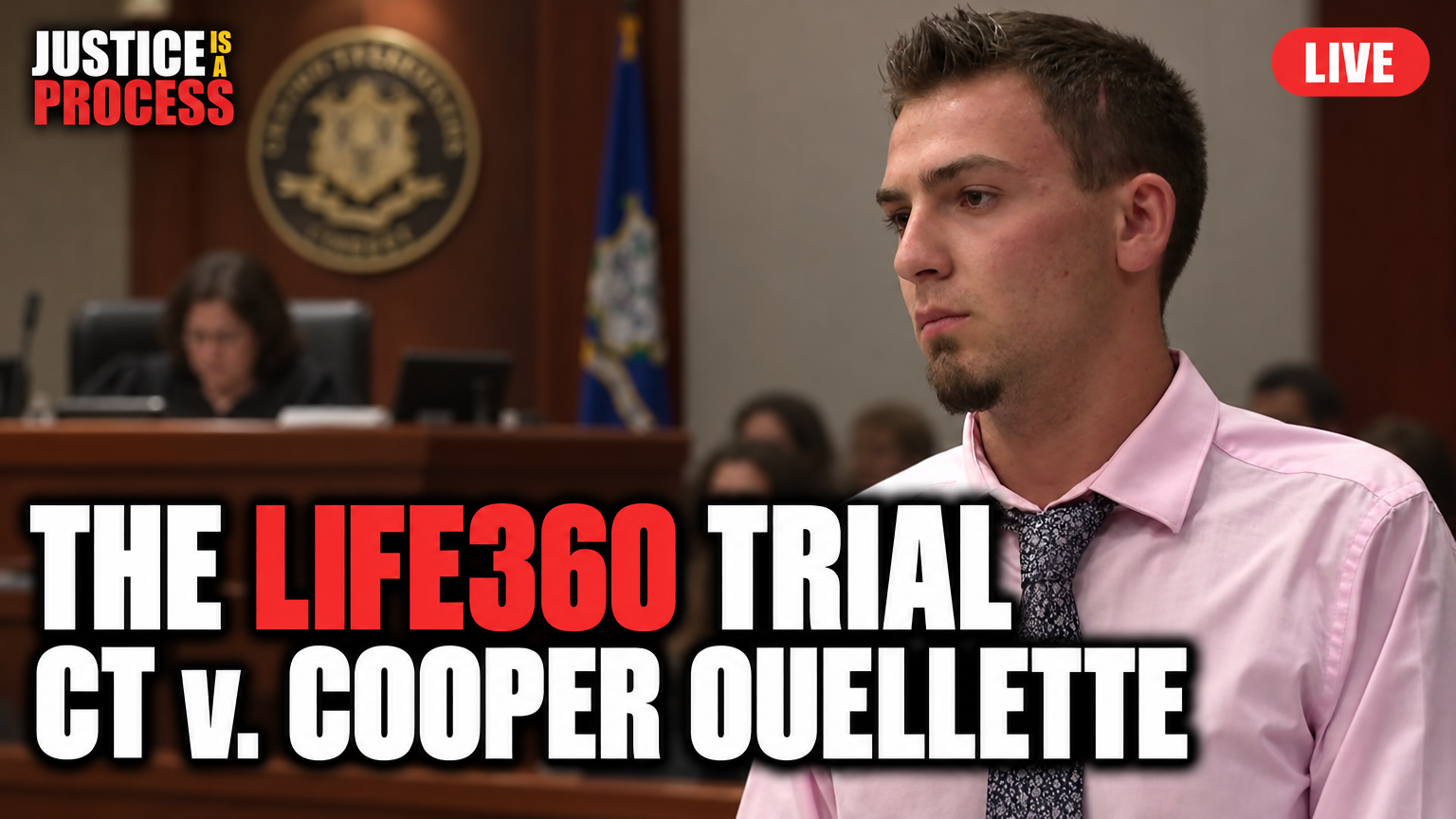
The Life360 Trial. A 17-year-old girl died after a ride home from a party in her boyfriend's pickup truck. The State says it can prove first-degree manslaughter, and the heart of its proof is a reconstruction built from the location app on two phones. The defense says that data cannot be trusted. Now a jury decides whether the State has carried its burden.
October 2026 | Justice Is A Process
Sophie Ringquist kept a journal. Somewhere in it, in her own handwriting, she wrote down what she wanted out of life. She wanted a beautiful and healthy family. She wanted to be happy. And she wrote one line that her family would later put at the top of everything they said about her: "Be remembered as fierce."
She was seventeen. She lived in Burlington, Connecticut, a small town in the hills west of Hartford, and she was a junior at Lewis Mills High School who was on track to graduate a semester early. She was already taking college classes. She wanted a degree in construction management, and every week she went to work beside her father, Scott, in construction. In the summers she taught little kids in town how to swim. She liked the gym, she liked her friends, and her family says she had a real gift for writing. They described her as loving, hardworking, joyous, goofy, passionate, fierce and compassionate. She had a spot where she liked to sit in her truck and watch the sun go down. Her motto, her family wrote, was "leave the past where it belongs."
On the evening of Saturday, May 20th, 2023, Sophie left her house with her boyfriend, Cooper Ouellette, who lived in neighboring Harwinton. They had what the police would later call an "on-again, off-again" dating relationship. They went to a party in Terryville. Shortly before midnight, Cooper Ouellette's pickup truck pulled up at the Ringquist home with Sophie in the front passenger seat. Her family rushed her to Bristol Hospital. At 12:51 in the morning on Sunday, May 21st, she died. The state medical examiner found that she died of blunt-impact injuries to her torso and ruled her death a homicide.
In the language of a medical examiner, "homicide" means a death caused by another person. It is not a verdict and it is not a finding of a crime. Whether a crime happened, and which one, is the job of a jury. That job begins in New Britain on Thursday, October 29th, 2026.
Cooper Ouellette is now 21. More than a year after Sophie died, the Connecticut State Police obtained a warrant for his arrest, and he was charged with first-degree manslaughter and with delivering alcohol to a minor. He has pleaded not guilty to both charges. He is presumed innocent of each of them. Nothing in this report should be read any other way.
Here is what makes this trial different. Nobody but the two people in that truck saw what happened on those back roads, and one of them is gone. To prove its case, the State is relying on a piece of technology millions of families use every day without a second thought: Life360, the app parents and teenagers use to see where each other are. Investigators took the location data from both phones, combined it with surveillance video, messages and witness statements, and built a forensic animation of the drive. The defense fought to keep that data away from the jury. It argued that the same data, at points, showed phones moving backward at more than 250 miles an hour, and that his phone's data went silent for eleven minutes at the most important time of the night. On Friday, October 9th, 2026, Superior Court Judge Chris Pelosi ruled from the bench that the jury will see it.
This is Justice Is A Process. A trial is not a contest over who did it. It is the State's chance to prove, one element at a time and beyond a reasonable doubt, each charge it chose to bring. We are not here to convict Cooper Ouellette and we are not here to acquit him. We are here to watch whether the State can prove first-degree manslaughter, piece by piece, with the evidence it has, and whether the system treats a grieving family and an accused young man the way the Constitution says it must. Let's begin.
Everything in this section comes from the arrest warrant affidavit as it has been reported by Connecticut and national news outlets: NBC Connecticut, WFSB, FOX61, CT Insider, Law&Crime and HuffPost. An arrest warrant is the State's version of events, written by the police to persuade a judge that there is probable cause. It is not evidence, it has never been tested by cross-examination, and the reports of it do not always agree with each other on the small details. Where they differ, we say so. Read every sentence below as "according to the police" or "prosecutors allege," because that is exactly what it is.
According to the warrant, Cooper Ouellette picked Sophie up at her home sometime between six and twenty past six on the evening of May 20th, 2023. A little after seven, between about 7:17 and 7:35, he stopped at a package store in Bristol. Police say about $54 worth of alcohol was bought there. Ouellette was not old enough to buy alcohol himself; he was around eighteen at the time. That purchase is the foundation of the second charge in this case, and it is also the foundation of a separate civil lawsuit against the store.
That evening the two went to a friend's house in Terryville, a village in the town of Plymouth, where a party was under way. Reports of the warrant put their arrival at about 8:30 or 9:30. Police say Ouellette drank there and handed out alcohol to others. At about nine o'clock, Sophie sent a selfie on Snapchat. It showed no injuries of any kind. Hold onto that detail. In a case built on a timeline, the State will use every time-stamped picture as a marker.
According to witnesses quoted in the warrant, the couple argued through much of the night. Police say that at about 11:10, a witness saw Ouellette kick Sophie with his boots in a parking area. Witnesses also told troopers he shoved her against the side of his truck, grabbed her phone out of her hand, and got angry when she called people to come and get her. Sophie, police say, called several people asking for a ride home. One witness said she reported that Ouellette was drunk and following her around the party. According to the warrant, he interfered with her efforts to get home some other way. In the end they left together, in his truck.
Notice what this part of the warrant is, and what it is not. It describes conduct before the drive. It is not the act the State says caused Sophie's death. But if the State can prove it, it does two jobs at once: it tells the jury about the state of the relationship and the state of the driver, and it becomes part of the State's argument about recklessness and indifference to her safety. Expect the defense to test every one of these witnesses on what they saw, how much they had to drink themselves, and how far away they were standing.
At 11:13, police say, Ouellette's phone began recording a trip. What follows is the part of the night the Life360 data, the surveillance video and Sophie's own phone are supposed to reconstruct.
According to the warrant, he drove erratically. On Locust Road, police say, the truck stopped and an alarm sounded, the kind a vehicle makes when a door opens. Sophie was recording a selfie video at about 11:24. About thirteen seconds in, according to the warrant as Law&Crime reported it, the truck stopped, and the video shows the truck accelerating and Sophie being knocked to the ground. The warrant's words, as reported, are that Ouellette "suddenly stomped on the gas pedal." NBC Connecticut reported that the warrant describes a thud and that it appeared the truck hit her. HuffPost reported that the video ends with her gasping and sobbing. Police say he then got her back into the truck.
At 11:25, police say, Sophie texted a friend. Her phone's autocorrect changed what she typed to "I'm saved." She corrected it. The word she meant was "Scared."
The reports of the warrant say the drive continued. Police allege he passed her house without stopping. At about 11:38, Sophie posted two selfies on Snapchat. They showed her crying, with a bloody nose and a red mark on her face. According to the warrant, one was sent to a close friend.
Then, police say, came a second moment, the one that matters most to the charge. According to the warrant as CT Insider reported it, during "an abrupt stop of Cooper's truck," Sophie "separated from the vehicle," and a tire ran over her. HuffPost's account of the warrant says he accelerated while she was outside the truck. Police say he then put her back in the front passenger seat. Citing cell phone data, state police said it appeared Sophie was on foot in the area where she was struck. The first report, the night it happened, described a girl who had fallen out of a pickup truck on Field View Drive in Burlington.
At about 11:50, a surveillance camera at the Ringquist home recorded Ouellette's truck arriving. According to the warrant, the footage shows him lifting Sophie from the front passenger seat and moving her, then running through an open garage door and calling for help. Police say he told her family she had been drinking, had gotten sick, and had fallen from the truck while he was driving. The warrant also says nobody called 911 from the scene of her injuries; her parents drove her to Bristol Hospital themselves.
She died at 12:51 a.m. At about 1:25, the Bristol Police Department called the state police to report that a 17-year-old girl had been brought to the hospital by her family after "supposedly falling out of a pickup truck on Fieldview Drive in Burlington." The truck was a Chevrolet Silverado.
According to the warrant, Ouellette told police he was going about ten miles an hour and that Sophie jumped out of his truck. Police say he described her opening the door and falling out while the truck was almost stopped, and later changed his account to say she opened the door while he was driving. Law&Crime reported that, according to the affidavit, he said she needed to vomit and jumped out of the moving truck, and that police say the surveillance footage does not support that account.
His statements will matter at trial in two directions. The State will point to any change in his story. The defense will point out that a frightened nineteen-year-old describing the worst night of his life to police is not a reconstruction expert, and that the question is not whether his story was perfect. The question is whether the State's proof is.
The state police took fourteen months to bring charges. Investigators pulled Sophie's Snapchat history, collected surveillance video from homes in the area, interviewed the people at the party, and examined Ouellette's phone and vehicle data. They asked the New England State Police Information Network, a regional police intelligence center, to analyze the Life360 data from both phones. That analysis produced the forensic animation the jury is now expected to see. The case was classified as a domestic violence crime. A judge signed the arrest warrant on July 11th, 2024. The next day, Ouellette turned himself in at the State Police Troop L barracks in Litchfield. He was released on a $50,000 cash or surety bond and arraigned in New Britain Superior Court.
When the charges were announced, Sophie's family released a statement thanking the state police "and all other entities that worked tirelessly over the past fourteen months to find out what happened to her." They added a plea to anyone else living through what they believe she lived through: "We implore anyone who has been a victim of or witness to domestic violence to stand up for the victim and report it to the police."
If you or someone you know is experiencing dating abuse, the National Dating Abuse Helpline is available at 1-866-331-9474, or text "loveis" to 22522.
It would be easy to let a trial like this turn Sophie into a set of data points: a phone, a location, a timestamp. She was not that. She was a seventeen-year-old who was finishing high school early because she was in a hurry to get to the next thing. She wanted to build. She worked a real job beside her father and she taught other people's children how to be safe in the water. Her friends knew her sunset spot. Her family says she had a writer's voice. Her own words were the ones her family chose to remember her by: be remembered as fierce.
Her mother, Lynne Ringquist, is the administrator of her estate and has filed a wrongful-death lawsuit, described below. Her father is Scott Ringquist. They were the people Cooper Ouellette ran to in their garage that night, according to the warrant, and they will very likely be among the first witnesses the jury hears.
Cooper Anderson Ouellette is from Harwinton, the town next door to Burlington. He was about eighteen on the night Sophie died, nineteen when he was arrested, and he is twenty-one now. Beyond his age, his town, and his relationship with Sophie, very little about his life is in the public record, and we will not fill that space with speculation. He has been free on bond since July 2024. He has pleaded not guilty. He does not have to testify, he does not have to call a single witness, and he does not have to prove anything. If he chooses to stay silent, the jury will be told it cannot hold that against him.
Superior Court Judge Chris Pelosi presides. He has already made the most important pretrial decision in this case: after a multi-day hearing that included testimony from experts on both sides, he ruled that the Life360 evidence is reliable enough for a jury to hear. That does not mean he found it accurate. It means he decided that its weight is a question for the jury.
The case is tried by Senior Assistant State's Attorney David Clifton of the New Britain Judicial District. In his written argument for the Life360 evidence, Clifton defended the speed calculation as "a simple equation of distance divided by time," and added that it was "first appearing in the work of Galileo Galilei and Sir Isaac Newton in the Seventeenth Century." That line tells you how the State plans to present the math to the jury: as common sense, not as rocket science.
Ouellette is represented by Martin Minnella, a veteran Connecticut criminal defense lawyer, and Jonathan Raad. Their pretrial fight focused almost entirely on the data. Their expert, Jeff Martin of Evidence Solutions, testified at the October hearing that Life360 data cannot reliably establish a vehicle's speed or location.
The Connecticut State Police investigated the case. The analysis of the two phones was done by the New England State Police Information Network, known as NESPIN. A state witness at the hearing described comparing more than 700 Life360 data points with a vehicle's speedometer during a test drive. Expect that analyst, the troopers who processed the scene and the truck, and the state medical examiner to be central witnesses.
The people who were at the party in Terryville will tell the jury what they saw before the drive: the argument, the kick, the phone, the calls for a ride. Their credibility, their sobriety and their distance from what they describe will all be tested. The young man who hosted the party, Tyler Schultz, and his parents are named in the civil suit; whether any of them testifies in the criminal trial is not yet public.
In 2024, Lynne Ringquist, as administrator of Sophie's estate, sued Ouellette, Edgewood Wine and Spirits of Bristol, and Tyler Schultz of Terryville and his parents, Bill and Noreen Schultz. The suit, brought by the law firm RisCassi & Davis, alleges that Ouellette was negligent while intoxicated, that the store sold alcohol to an underage buyer, and that the party had alcohol present for underage guests. Those are allegations in a civil complaint, they have not been proven, and the civil case is a separate proceeding with a lower burden of proof. It is not on trial in New Britain this fall. We mention it because jurors may hear about the store and the party, and because the family's lawsuit is part of how this case has been reported.
Cooper Ouellette faces two charges. Here is what each means in plain English, and what the State must prove to get a conviction on it. Not what the State has proven, because nothing has been proven yet.
What it means: Connecticut's first-degree manslaughter statute can be proven three different ways. A person is guilty if (1) intending to cause serious physical injury, he causes someone's death; or (2) intending to kill, he causes a death while under the influence of extreme emotional disturbance; or (3) "under circumstances evincing an extreme indifference to human life, he recklessly engages in conduct which creates a grave risk of death to another person, and thereby causes the death of another person." The public reporting does not say which subsection is charged. The allegations in the warrant, a truck driven recklessly with a girl at its door, fit the third, the reckless "extreme indifference" form, most closely. If the State relies on the first form instead, it must prove a specific intent to seriously injure her, which is a different and harder thing to prove.
What the State must prove under the reckless form, element by element:
First, that Cooper Ouellette engaged in conduct that created a grave risk of death to Sophie. Second, that he did it recklessly, meaning he was aware of that risk and consciously disregarded it, and that disregarding it was a gross deviation from how a reasonable person would act. Third, that he did it under circumstances evincing extreme indifference to human life, which Connecticut courts treat as more than ordinary recklessness: conduct so dangerous and so careless of life that it approaches the line of murder. Fourth, that his conduct caused her death.
Potential sentence: A class B felony, carrying one to twenty years in prison.
The burden: Entirely on the State, beyond a reasonable doubt, on every element. Cooper Ouellette does not have to prove anything.
What it means: It is a crime for any person to sell, ship, deliver or give alcoholic liquor to a minor, meaning anyone under twenty-one. The law applies to anyone who provides it, not only to stores and bars.
What the State must prove: That Ouellette delivered or gave alcohol, and that the person he gave it to was a minor. Police say he gave alcohol to others at the party, and Sophie was seventeen. The State will have to prove a specific delivery to a specific minor, through witnesses or records.
Potential sentence: A fine of up to $3,500, up to eighteen months in jail, or both.
The burden: Entirely on the State.
One more thing about the charges. A jury in a homicide case is sometimes allowed to consider lesser offenses than the one charged, when the evidence supports them and a party asks for it. Connecticut law has several homicide crimes below first-degree manslaughter, including ones written specifically for deaths caused with a motor vehicle. Whether this jury is given any of them is a decision for Judge Pelosi near the end of the trial. If it happens, it will tell us a great deal about how both sides read the evidence.
Every case that reaches a jury is there for a reason. This one is at trial because the State has charged one of the most serious crimes it can bring short of murder, and to prove it, it has to do something hard: show a jury, element by element and beyond a reasonable doubt, exactly what happened on a dark road with only two people present, one of whom cannot testify. The State's answer is a reconstruction built from phone data. The defense's answer is that the data is not good enough to carry that weight.
Look at what first-degree manslaughter asks the State to prove. Not just that Sophie died, and not just that she died near Cooper Ouellette's truck. The State has to prove what he did, what he was aware of when he did it, and that the way he did it showed extreme indifference to her life. Each of those turns on details: how fast the truck was moving, where it was, when the door opened, when it accelerated, and where Sophie was when it did. Those are exactly the questions the Life360 reconstruction claims to answer.
That is why the most important fight in this case so far has not been about whether something terrible happened. Everyone agrees that it did. It has been about whether the State's tool for proving how it happened can be trusted.
The State's theory, as reflected in the warrant and its pretrial arguments, is that Ouellette, after a night of drinking and arguing, drove recklessly with Sophie in his truck, accelerated while she was at or outside the open door, knocked her to the ground, and later ran her over with a tire during an abrupt stop, then drove her home rather than calling for help. To prove it, the State has disclosed a layered case: witnesses from the party, Sophie's own time-stamped selfies, video and texts, surveillance video from homes along the route and from the Ringquist driveway, Ouellette's phone and vehicle data, his own statements to police, the medical examiner's findings, and the NESPIN analysis of both phones' Life360 data, assembled into a forensic animation.
Prosecutors argued at the hearing that Life360 has about 100 million users and has been in business for eighteen years. A state witness described a test drive that compared more than 700 Life360 data points against a speedometer. And Clifton argued that the defense was attacking a straw man: the reconstruction does not rest on Sophie's phone alone, he said, but on data from both phones, cross-checked against surveillance footage.
The defense has told us exactly where it will fight. In its written motion, Minnella and Raad argued that the reconstruction of the truck's speed, location and movements "relies on technology that is not reliable," and that the calculations behind it were invalidated. They pointed out that Life360 itself "does not recommend its data be used for establishing speed or location." They pointed to data that showed phones appearing to move backward, at one point reportedly at more than 250 miles an hour in reverse. And they pointed to an eleven-minute gap in Ouellette's own Life360 data during what they called a critical period.
Their expert, Jeff Martin of Evidence Solutions, testified at the hearing that Life360 data cannot reliably establish a vehicle's speed or location. Judge Pelosi let the evidence in anyway. That does not end the fight. It moves it. Every weakness the defense raised to keep the data out, it can now raise in front of the jury to argue that the data should not be believed.
The defense has not publicly announced a theory beyond the data. But the warrant already tells us what Ouellette told police: that Sophie jumped or fell from a truck moving slowly. Whether the defense builds on that account, or simply argues that the State cannot prove beyond a reasonable doubt how fast, where and in what way the truck moved, we will learn in opening statements.
Connecticut, like the federal courts, requires a judge to act as a gatekeeper before scientific or technical evidence reaches a jury. Under the standard the Connecticut Supreme Court adopted in State v. Porter (1997), the judge must decide whether the method is reliable and relevant enough for jurors to weigh. Over several days in early October 2026, Judge Pelosi heard from both sides' witnesses. On Friday, October 9th, after final arguments, he ruled from the bench that the prosecution may present the Life360 data to the jury.
That ruling makes this, as far as public reporting shows, one of the first Connecticut criminal trials in which a jury will be asked to weigh a speed-and-location reconstruction built from a consumer family-tracking app. The phone in your pocket is about to be a witness.
The burden of proof is not a slogan. In this case, it is the whole case. A jury could believe that Sophie's death was a tragedy, could feel deep anger about how the night unfolded, and could still find that the State did not prove extreme indifference, or did not prove the speed and position that make the conduct reckless in the way the statute requires. That would not be a jury failing Sophie. It would be a jury doing its job. And a jury that finds each element proven beyond a reasonable doubt will also be doing its job. We will be tracking every element, witness by witness, and telling you which ones the State has carried and which ones it has not, as we see it, while never forgetting that we are not the jury.
Life360 was built to answer a parent's question: where is my kid right now? It was not built to answer a jury's question: how fast was this truck moving at 11:24 p.m., and where exactly was it? The State says the math is as simple as distance divided by time. The defense says the inputs are unreliable, and that the physics only works if the location points are right. That gap, between a consumer app's purpose and a courtroom's demand for precision, is where this trial will be won or lost. Watch for how the State's analyst explains the 250-mile-an-hour readings and the eleven-minute gap, and watch for whether the surveillance video truly corroborates the animation or simply sits alongside it.
The Sixth Amendment guarantees a defendant the right to confront the witnesses against him. When the witness is an animation, that right runs through the people who built it. The defense is entitled to cross-examine the analyst on every assumption, every data point that was used, and every one that was thrown out. An animation is persuasive precisely because it looks like a video of what happened. It is not. It is an argument in moving pictures, and the jury must understand the difference.
Sophie's family has waited three and a half years for this trial. Cooper Ouellette has lived under a manslaughter charge for more than two of them. The system owes the family an honest answer and owes the defendant a fair process. Those obligations are not in conflict. A trial done right delivers both. We will be watching whether the jury is shown only what the rules allow, whether pretrial publicity and the emotional weight of a teenager's death are kept in their place, and whether every juror understands that sympathy for Sophie and the presumption of innocence can live side by side.
If a jury convicts on the strength of Life360 data, prosecutors around the country will notice. If a jury rejects it, defense lawyers will. Either way, how this court, this analyst and this jury handle consumer location data will be cited in the next case. The man whose legacy this channel honors, Steven M. Askin, used to say that justice is a process, not an outcome. This is the process, applied to a technology that most of us carry everywhere and almost none of us understand.
The length of the trial has not been announced. Expect the State to begin with the people closest to Sophie and the night itself, move through the troopers and the medical examiner, and build to the data analysis and the animation. The defense's case, if it puts one on, will almost certainly feature its data expert. The jury will then decide each charge separately.
Live broadcasts. No Breaks editions. Justice Breakdowns every night.
The defendant is presumed innocent until proven guilty beyond a reasonable doubt.
Let's watch the system together.
Starting Thursday, October 29th, we will follow this trial as it happens, from the first witness through the verdict. You will get live coverage of the courtroom as the proceedings unfold, No Breaks editions for anyone who wants the full day without the dead air, the Case Story trial podcast that walks through the testimony piece by piece, Key Moments for the exchanges that matter most, and Justice Breakdowns with deeper analysis after each day. When the Life360 analyst takes the stand, and when the defense expert answers, we will slow it all the way down and walk through what the data says, what it does not say, and which element of the charge it goes to. Members of the channel get the case notebook, where you can question the record yourself.
This is not about guessing what happened on Locust Road. It is about watching whether the State can prove, element by element, the crime it chose to charge, with the evidence it chose to rely on. Sophie Ringquist deserves the truth. Cooper Ouellette deserves a fair trial. A trial done right gives both.
The defendant is presumed innocent until proven guilty beyond a reasonable doubt. That is not a technicality. That is the foundation of everything we do here.
Subscribe to Justice Is A Process on YouTube for live trial coverage, No Breaks editions, and breaking news as it happens.
🔴 Subscribe on YouTube86,000+ subscribers watching the system with us
Discussion